A static result answers a different question
A hypothetical large-span civil survey aircraft is proposed with a new payload configuration. The supplier offers a wing static-strength summary. The review question is what additional evidence addresses the aircraft’s dynamic and aeroelastic behavior in the proposed configuration. This is not a claim that an GAUTEN aircraft has an instability, or a suggestion to discover limits through improvised flight tests.
FAA AC 20-107B treats flutter and other aeroelastic instabilities separately from static structural substantiation. Its discussion includes control reversal, divergence and undue loss of stability and control associated with structural loading and deformation. The document is certificated-aircraft guidance; it does not supply an operating envelope or approval for this hypothetical fixed-wing UAV. [1]
Define the configuration before reading the conclusion
Ask for a substantiation summary that identifies the assessed airframe, payload arrangement, control surfaces and relevant installed components. Request the assumptions and evidence references, not just a sentence saying that the wing is stiff. A conclusion without a clear configuration boundary cannot answer whether the proposed installation is represented.
For this large fixed-wing review, create a configuration comparison between the evidence package and the proposed aircraft. Record differences as questions for the responsible assessment. Do not infer that identical total mass means identical applicability, or that a payload change matters only when it exceeds an invented threshold.
Ask about mass, stiffness and damping
FAA specifically identifies stiffness, mass and damping as critical properties to consider when evaluating effects of repeated loading, environmental exposure and service damage on composite aeroelastic behavior. It gives examples where a damaged control surface may retain residual strength while stiffness loss or added mass affects aeroelastic characteristics. [1]
Use those categories to organize questions, not to calculate a margin from incomplete data. Ask how the relevant properties were represented, which evidence supports the representation and how uncertainty was addressed. The explainer cannot supply a required modal frequency, damping value or clearance speed without actual applicable documentation.
In the hypothetical survey project, a payload configuration review should name the affected assumptions rather than relying on a general reassurance. If the reviewer concludes the earlier evidence remains applicable, request the basis and configuration reference for that conclusion.
Do not overlook repairs and finishes
FAA’s aeroelastic discussion identifies changes in weight or stiffness from repairs, manufacturing flaws and multiple paint layers as factors needing evaluation. It also mentions sandwich disbond and water ingression in discussing potential changes to control-surface behavior. These are contextual examples, not evidence that all such changes produce the same effect on every aircraft. [1]
For the proposed fixed-wing review process, include repair status and relevant configuration history when checking the evidence package. Ask how authorized repairs preserve the assumptions of the assessment and how undocumented differences are referred for disposition. Do not prescribe removal, balancing or repainting steps from this article.
Request a usable substantiation summary
A practical evidence request would ask the responsible organization to identify the methods used, the configurations represented, the assessed conditions and the supporting validation. Keep analysis, test correlation and any operating limitations distinguishable. The reader should be able to tell what the summary demonstrates and what lies outside its stated applicability.
FAA notes that effects on composite structure may be determined by analysis supported by test evidence or by appropriate tests. [1] That is not permission to select a test program independently of the applicable aircraft process. This article deliberately offers no excitation procedure, flight sequence or universal acceptance number.
Ask how subsequent configuration changes are screened. A proposed document-control record could link each change to an engineering applicability decision and the exact evidence revision. This is original workflow reasoning intended to prevent an old conclusion from silently becoming a claim about a different aircraft.
Keep clearance claims out of the explainer
No GAUTEN aeroelastic analysis, installed mass model, structural test data or aircraft-specific limits were supplied. The useful outcome is therefore a better-defined evidence request, not a declaration of flutter clearance. A stiff-looking wing or a favorable static result should not be promoted into a flight assurance that the source and configuration documents do not establish.
Related reading
Sources
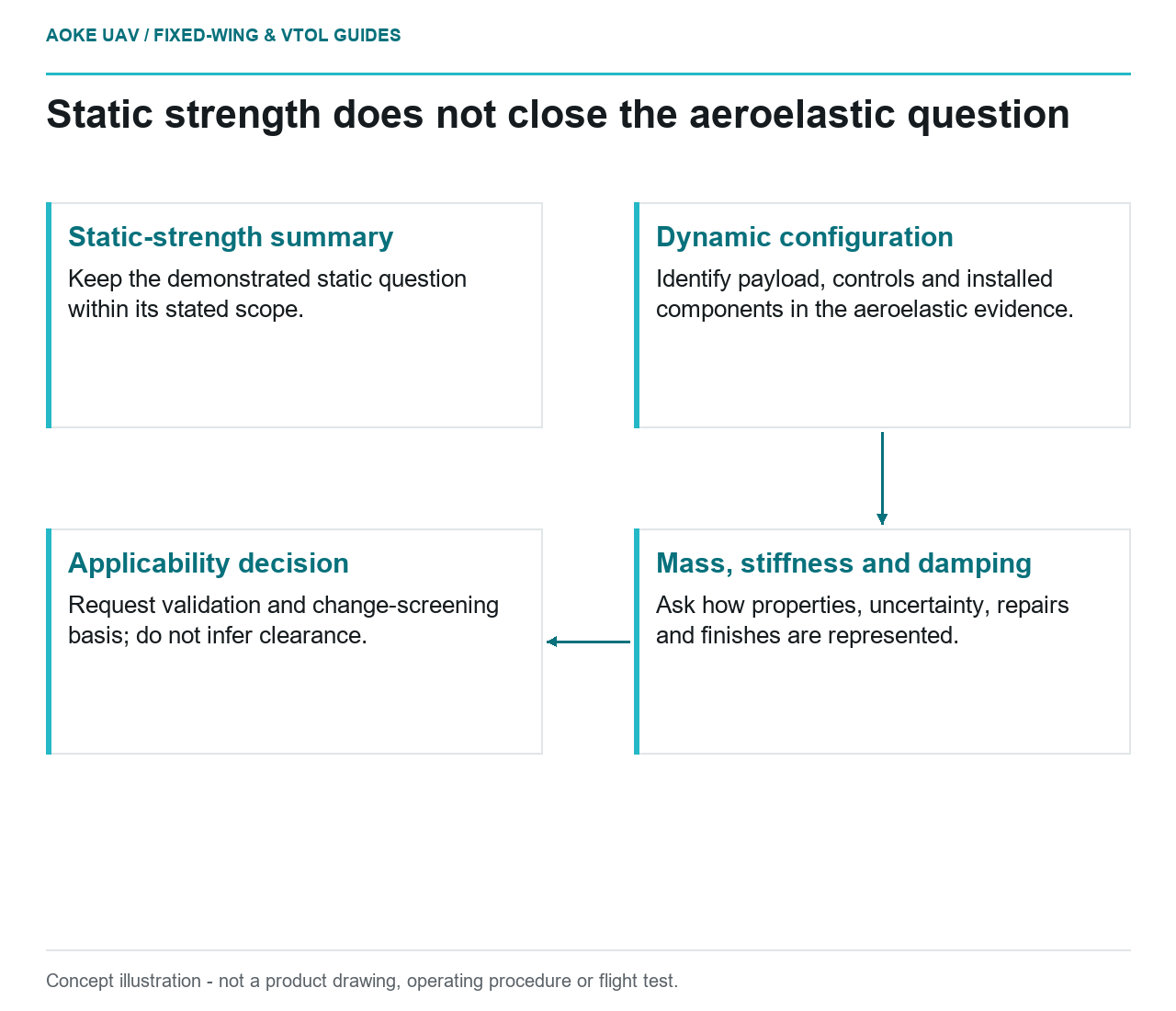
Visual summary
Concept illustration
Read diagram notes
- Static-strength summary: Keep the demonstrated static question within its stated scope.
- Dynamic configuration: Identify payload, controls and installed components in the aeroelastic evidence.
- Mass, stiffness and damping: Ask how properties, uncertainty, repairs and finishes are represented.
- Applicability decision: Request validation and change-screening basis; do not infer clearance.