Concept illustration
Read diagram notes
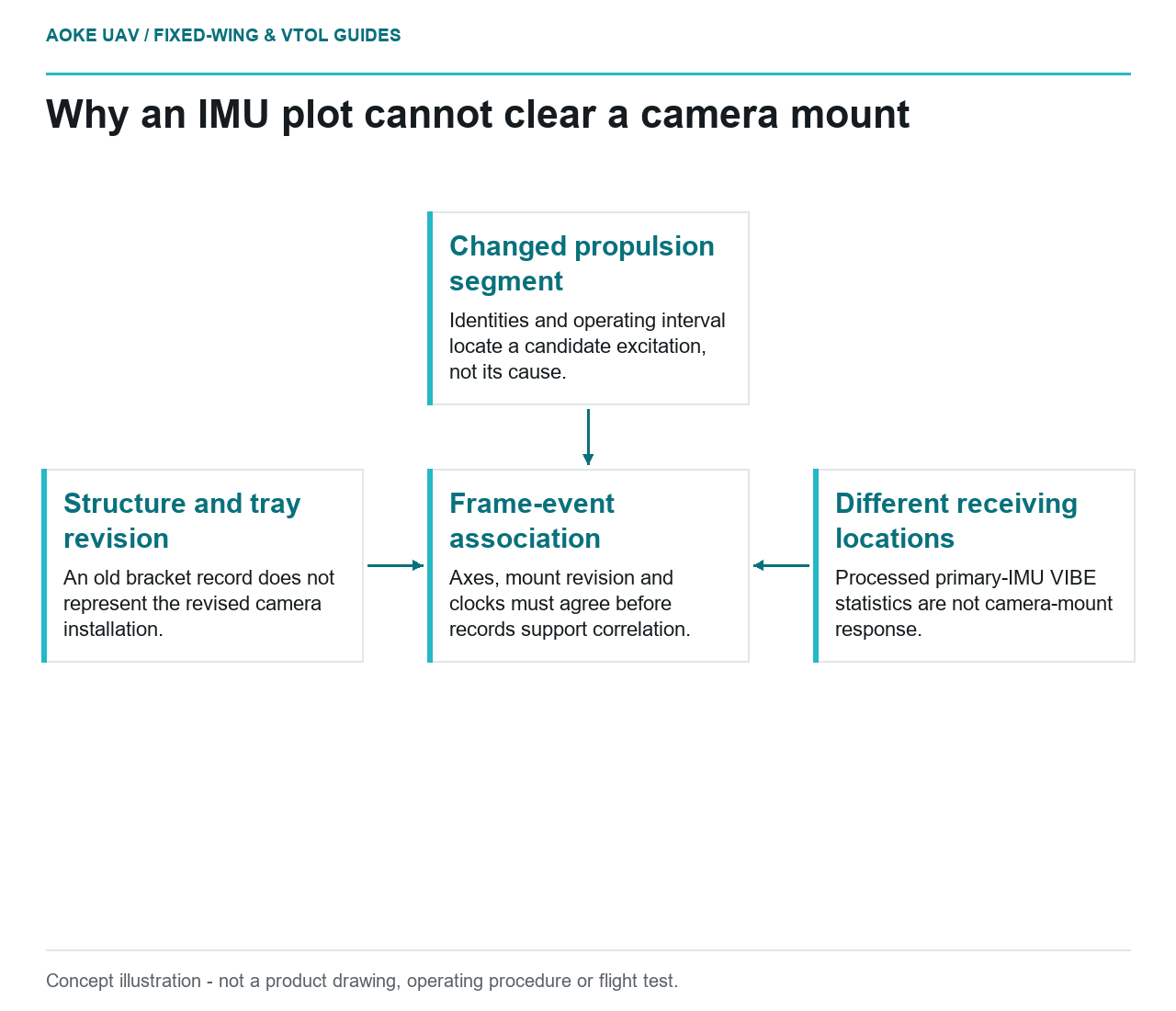
- Changed propulsion segment: Identities and operating interval locate a candidate excitation, not its cause.
- Structure and tray revision: An old bracket record does not represent the revised camera installation.
- Different receiving locations: Processed primary-IMU VIBE statistics are not camera-mount response.
- Frame-event association: Axes, mount revision and clocks must agree before records support correlation.
In one hypothetical investigation, a large fixed-wing survey team reports reduced image detail during a cruise segment after a propulsion replacement. The propulsion group supplies an operating-state log, navigation supplies a favorable VIBE plot, and structures supplies a camera-bracket response record. They appear reassuring until the payload team discovers that the files do not describe the same reference, time interval or mounting configuration. This is an original cross-team handoff example, not an observed GAUTEN event or an image diagnosis.
Excitation sources and operating states
The reported observation is simply reduced detail in identified original frames. In the scenario, the propulsion log records the replacement motor and propeller identities and distinguishes the cruise segment from ground operation. That supports locating the configuration and candidate operating interval. It does not measure the camera’s mechanical response, establish propeller balance or prove that propulsion caused the observation.
Navigation’s plot needs its own definition. ArduPilot describes VibeX, VibeY and VibeZ as accelerometer statistics from its primary IMU, calculated with filtering. Its clipping fields concern accelerometers reaching their measurement limit.[1] These are not a camera-mount spectrum. The page’s numerical guidance is not adopted as a whole-aircraft acceptance criterion here.
In our hypothetical handoff, the favorable plot can support a statement about those processed navigation-sensor records. It cannot close the camera concern. A team could otherwise mistake a reassuring signal at the controller for evidence about a different receiving interface several structural connections away.
Structural transmission and mounts
Structures then identifies its bracket response record as belonging to the previous payload tray. The suspect images belong to a revised tray fitted when the propulsion replacement was installed. This is the configuration mismatch: both documents may be genuine, but they cannot be combined into one demonstrated configuration. The structural team’s legitimate decision is to retain the earlier record for its original arrangement, not declare the revised camera interface substantiated.
The bracket record also uses a local bracket-axis reference, while the navigation export is labeled by controller axes. In this illustrative case the axes have not been related by a controlled orientation definition. Comparing two columns both called vertical would therefore be unjustified. Structures must supply the sensor location, orientation and mounting revision before a comparison can even address a common physical direction. No transformation coefficients or isolator design are supplied by this article.
Sensor and navigation interfaces
The timing mismatch is equally consequential. Suppose the payload spreadsheet labels command-issue time in its own computer clock, while the navigation export labels elapsed recorder time. The plotted peaks and suspect frames have been placed beside each other without a documented clock relationship. The handoff cannot support simultaneity yet, much less causation. The teams must first identify the time origins and uncertainty of their association.
The December 2021 RedEdge-P guide supplies a useful model-specific distinction: it lists trigger input and Center of Frame output as different configurable GPIO functions and separately describes API capture commands.[2] A column named trigger cannot be assumed to contain the documented output event. In this example, the payload engineer must establish which interface actually generated the retained event record; the guide alone supplies no latency correction for these files.
The same guide says external API GPS data can replace DLS GPS data in image metadata for a specified interval.[2] Consequently, the navigation team should not infer the metadata’s source solely from the presence of a DLS. In our scenario, its legitimate contribution is identifying the configured position/attitude source and reference, not claiming image sharpness or mechanical clearance from metadata.
Configuration-specific investigation boundaries
The concrete handoff is an association that each team can defend: propulsion names the changed assembly and operating segment; structures states which interface and mount revision its response evidence represents; navigation defines its processed measurement and reference; payload connects original frame identities to documented acquisition events. An unresolved clock relationship or tray mismatch prevents joining those items into one causal claim.
For this hypothetical fixed-wing project, the immediate outcome is to reject the proposed conclusion that a favorable navigation plot clears the camera installation. It is not to reject the individual records. Once their compatibility is established, they may support a targeted investigation designed by the responsible engineers. Image-signature interpretation remains with the related image-quality article, and component balance remains a different question. No flight procedure, universal isolation remedy or successful corrective result is implied.
Related reading
- Vibration and Image Quality in Fixed-Wing Payloads
- Aeroelasticity Questions for a Large Fixed-Wing UAV