Concept illustration
Read diagram notes
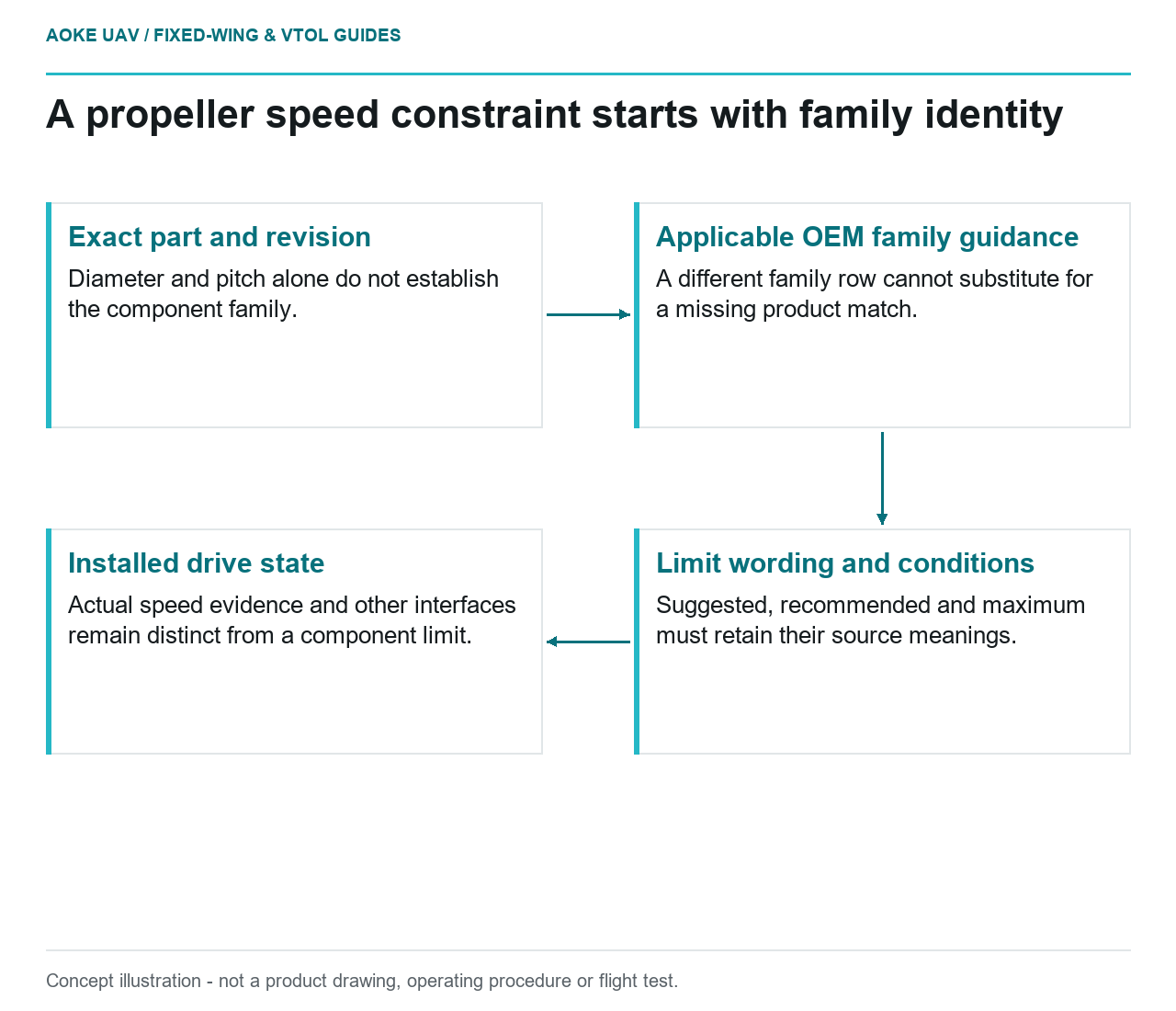
- Exact part and revision: Diameter and pitch alone do not establish the component family.
- Applicable OEM family guidance: A different family row cannot substitute for a missing product match.
- Limit wording and conditions: Suggested, recommended and maximum must retain their source meanings.
- Installed drive state: Actual speed evidence and other interfaces remain distinct from a component limit.
A propeller rotational-speed limit belongs to an identified component and a defined set of manufacturer conditions. It is not a portable allowance for anything with the same diameter. In large industrial fixed-wing integration, a replacement request should therefore begin with product identity and documentation, not with the most permissive number found in a table.
Resolve the exact product family
Imagine a hypothetical civil fixed-wing survey aircraft whose maintenance planner receives a replacement propeller with a familiar diameter-and-pitch label but a different family designation. This is an original review scenario, not an GAUTEN maintenance event. The planner should ask whether the replacement matches the approved project configuration and what documentation establishes its identity. This explainer does not authorize the substitution.
APC’s RPM Limits page separates suggested guidance for several families, including thin electric, folding electric, multi-rotor and slow-flyer products.[11] The point is the separation, not a numeric limit to reuse here. The page concerns APC products; it does not establish allowable speed for another manufacturer’s large propeller or for the entire propulsion installation.
APC’s FAQ defines family letters and modifiers used in its product designations.[4] That makes suffixes and other markings part of the evidence, not decorative text to omit from the replacement record. For the hypothetical aircraft, capture the actual manufacturer, part designation, revision information and applicable documentation. Resolve ambiguity with the responsible manufacturer rather than interpreting similar markings as equivalence.
Read the limit definition and qualifications
Preserve whether the source describes guidance as suggested, recommended, maximum or conditional. Those words should not disappear when a supplier table is summarized. Ask what operating conditions and product variants the document covers. If a calculation is required by the applicable manufacturer document, retain its units, inputs and exact family reference in the engineering record; this article provides no calculated operating limit.
In the proposed review workflow, a missing family match is a stop in the evidence chain, not an invitation to choose the nearest-looking row. Likewise, do not promote an example limit into a design target. The task is to determine the applicable constraint from the actual documentation, then assess it alongside the rest of the installation.
Keep the installed drive in scope
For the survey scenario, request the actual motor, controller, hub and drive configuration represented by the speed evidence. Ask how rotational speed is established and what evidence covers the relevant aircraft states. Do not substitute a no-load motor label for a substantiated propeller operating condition, and do not prescribe a controller setting from this general article.
A propeller component limit does not establish mounting adequacy, clearance, acceptable vibration or aircraft handling. Assign those questions to their respective engineering reviews. This is an original integration checklist, not an assertion that the hypothetical aircraft meets any requirement. A comparison remains incomplete if it checks one propeller constraint while leaving the attachment and aircraft configuration undefined.
Retain evidence after replacement
APC’s technical advisories state that multiple versions of a propeller can remain in circulation as designs change.[13] That product-specific observation supports keeping revision and identification evidence, not assuming every visually similar item is interchangeable. It does not establish the condition of the hypothetical replacement or a universal inspection method.
Propose retaining the removed and proposed part identities, documentation versions, applicable family decision and engineering disposition together. If the supplier changes a designation or construction, record the clarification before updating the aircraft’s configuration record. Future reviewers should be able to see why the selected document applied, rather than merely finding an unexplained speed number in a maintenance note.
The useful outcome is a traceable component-limit assessment within a larger installation review. For large fixed-wing civil work, family-specific guidance can narrow the questions, but it cannot approve the aircraft. Keep the precise product match and the unresolved system questions visible until the actual project evidence resolves them.
Related reading
- Propeller Diameter Is an Airframe Integration Choice
- Serialised Assembly Records for Large UAV Structures