Concept illustration
Read diagram notes
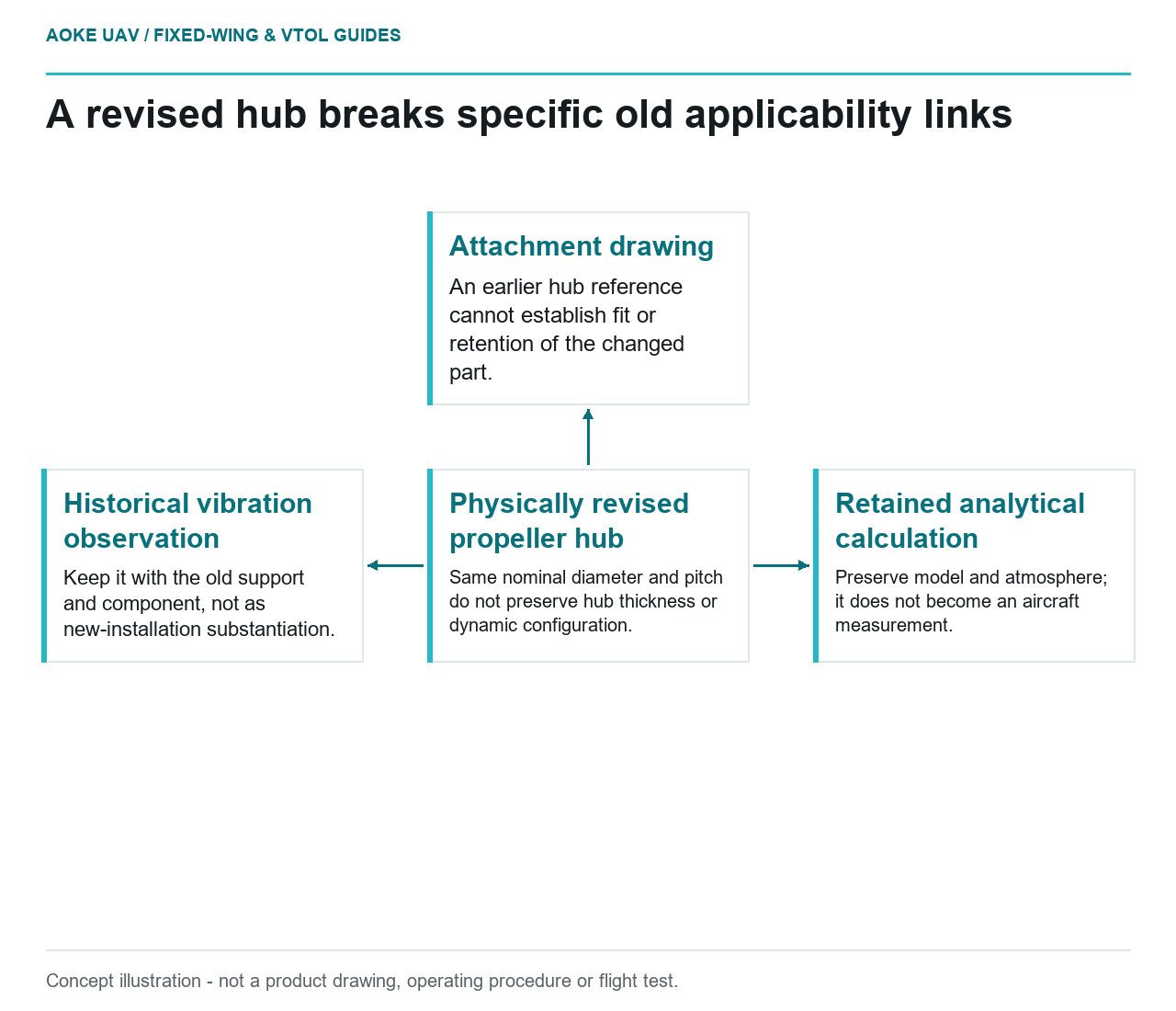
- Physically revised propeller hub: Same nominal diameter and pitch do not preserve hub thickness or dynamic configuration.
- Attachment drawing: An earlier hub reference cannot establish fit or retention of the changed part.
- Historical vibration observation: Keep it with the old support and component, not as new-installation substantiation.
- Retained analytical calculation: Preserve model and atmosphere; it does not become an aircraft measurement.
Imagine a hypothetical large fixed-wing mapping project replacing an older propeller with a later physical revision. Its old report combines an analytical thrust estimate with an installed vibration observation. Procurement sees the same nominal diameter and pitch; the engineer must separate those two claims before deciding what survives. The APC example below documents a real component change, but this aircraft case is illustrative: it is not an GAUTEN installation or test result.
Electrical and mechanical compatibility
APC reports that, starting in 2010, its Thin Electric line received a thicker hub and thicker hub-to-blade transition in response to increasing motor and battery power. APC says the change places the blade’s first natural frequency outside its recommended operating RPM range. That is a particular design statement, not a universal permission to operate any propeller at a chosen speed.[1]
For this hypothetical review, the changed physical interface is the hub and adjacent blade root, not merely the purchase description. Suppose the old installation drawing identifies the earlier hub thickness. A replacement carrying the same nominal size would no longer match that drawing. The immediate decision is to reopen the attachment applicability assessment: the old drawing cannot establish fit or retention of the changed part. This is not a recommendation to alter hardware or borrow a tightening instruction.
The electrical side need not be declared changed without evidence. In this case the motor, controller and supply are assumed unchanged. Their identities can remain in the baseline, but an unchanged motor does not prove that its load is unchanged. The assessment must connect the replacement propeller to the same required shaft operating point before retaining an electrical-demand claim.
Structural and thermal interfaces
Now separate an old conclusion about vibration from the calculation used for aerodynamic demand. APC identifies its performance data as analytical; its power, torque and thrust calculations use sea-level standard-atmosphere conditions.[1] A retained calculation must keep that provenance. It cannot turn into a measured aircraft result simply because a physically revised part has been purchased.
In the example, the old vibration observation belongs to the earlier hub and installed support. APC’s component-frequency explanation gives a concrete reason not to transfer that observation silently: a physically relevant part of the dynamic configuration changed. It does not predict the new aircraft response. The defensible disposition is to retain the historical observation as historical evidence while withholding its use as substantiation for the replacement installation.
Thermal applicability is a separate dependency. Maxon explains that motor current produces winding losses and that continuous operation depends on heat dissipation; temporary operation is treated separately.[2] If the project’s old thermal argument assumed a particular load and cooling arrangement, its applicability depends on those assumptions, not on the replacement’s marketing label. The generic motor reference supplies no temperature limit for this aircraft.
Control and payload effects
Suppose the earlier project report also says that mapping images were satisfactory during the recorded operating segment. That statement can remain a description of those files. It cannot establish that the revised mechanical configuration leaves the camera or navigation installation unaffected. Nor does the APC blade-frequency statement establish that any image problem has been cured.
The changed-interface case therefore splits the report three ways: a calculation remains an identified calculation; a past observation remains tied to its old hardware; a proposed claim about the new installation remains unsubstantiated. This is more useful than requesting every document again. It identifies exactly which inference breaks when the physical configuration changes.
Updated records and substantiation scope
For this hypothetical fixed-wing project, the revision note would name the old hub reference, the replacement revision, the affected attachment drawing and the old vibration conclusion that cannot be carried forward. Any analytical file kept for comparison would retain its model identity and atmospheric basis; if its correspondence to the replacement is unknown, that uncertainty stays explicit.
No result here establishes replacement fit, allowable speed, cooling adequacy, endurance or flight clearance. The useful engineering outcome is a selective change-impact decision: preserve valid historical evidence without pretending that either an analytical curve or a component design revision substantiates the changed aircraft. Procurement equivalence and aircraft evidence applicability are different decisions.
Related reading
- When a New Payload Requires a Structural Reassessment
- Vibration and Image Quality in Fixed-Wing Payloads