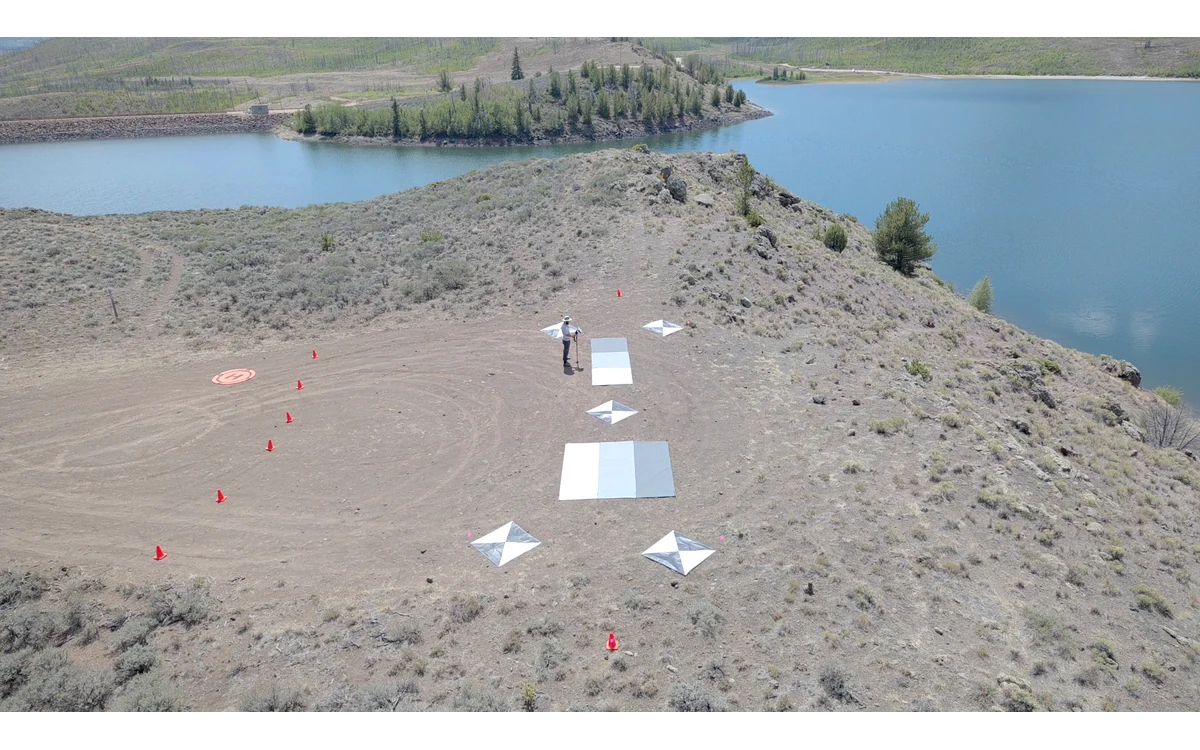
A calibration-panel photograph is useful only if it can support the correction actually applied to the survey. In a hypothetical large fixed-wing multispectral land-management project, the crew captures a panel near the launch area before covering a broad civil survey block. The processing team needs to know which panel was observed, under what conditions and how that observation connects to the airborne images. A photograph alone does not close that chain.
Panel calibration and condition
USGS explains that image-based radiometric calibration depends on spectrally characterized targets. It discusses reflectance across relevant wavelengths, directional behavior and changes with exposure or degradation. It also distinguishes raw digital numbers from physical quantities such as radiance and reflectance. An object that merely looks uniformly gray is not thereby a characterized reference. [1]
For this hypothetical fixed-wing workflow, preserve the panel identity and its applicable reflectance record beside the image dataset. Have the team confirm that the record corresponds to the actual panel and sensor bands. Inspect the panel’s condition using the supplier’s handling guidance, and record concerns about contamination or damage rather than inventing a universal cleaning procedure. A replacement panel should bring its own documentation, not inherit a familiar filename.
Illumination during panel capture
The USGS report identifies constant illumination and idealized surface behavior as assumptions that limit empirical-line calibration. It recommends panel observations at the beginning and end of flights in its described workflow. Those recommendations provide planning context; they do not prove that two observations fully represent every changing condition across a long mission. [1]
In the example review, record the capture time and conditions and examine whether an operator, aircraft component or surrounding object shaded the panel. For the specific RedEdge-MX and DLS 2 combination, the integration guide warns against shading light sensors while using the capture button for a preflight panel image. That is a model-specific instruction, not a universal mounting or trigger specification. [2]
Plan the evidence collection so a panel capture can be linked to the relevant flight, not just to the day’s folder. If conditions change between panel observation and fixed-wing acquisition, preserve the distinction for processing review. Do not describe the observation as contemporaneous with every distant strip.
Exposure and image quality
USGS discusses the need for usable interior panel pixels with limited influence from neighboring objects, as well as camera settings and radiometric corrections. Thus panel assessment concerns image content and metadata, not simply whether the reference target appears somewhere in the frame. [1]
For the proposed workflow, inspect each band and ask whether the selected panel region avoids boundaries, shadows and saturated values. Confirm that the processing method can interpret the recorded exposure and gain information. The team should use the exact sensor and software documentation to decide whether a capture is suitable; this article supplies no generic pixel threshold or exposure setting for an unspecified payload.
Link observations to the flight dataset
The hypothetical handover would include original panel files, their timestamps, the reflectance record, selected sample regions, camera configuration and a processing report identifying how the reference was used. Keep unsuccessful captures in an exception record so a reviewer can understand why a later observation was selected. If a panel image belongs to a different camera or mission, do not let its similar appearance conceal that mismatch.
Before accepting the large fixed-wing product for quantitative civil monitoring, compare the calibration evidence with the intended analysis. Identify whether reported values are raw digital numbers, radiance, estimated reflectance or a display adjustment. If panel provenance or illumination coverage is insufficient, narrow the comparison claim or obtain suitable observations. The objective is a traceable radiometric method with stated limits, not ceremonial proof that the crew photographed a panel before takeoff.
Related reading
Sources
- [1] Guidelines for Calibration of Uncrewed Aircraft Systems Imagery
- [2] MicaSense RedEdge-MX and DLS 2 Integration Guide
Visual summary
Concept illustration
Read diagram notes
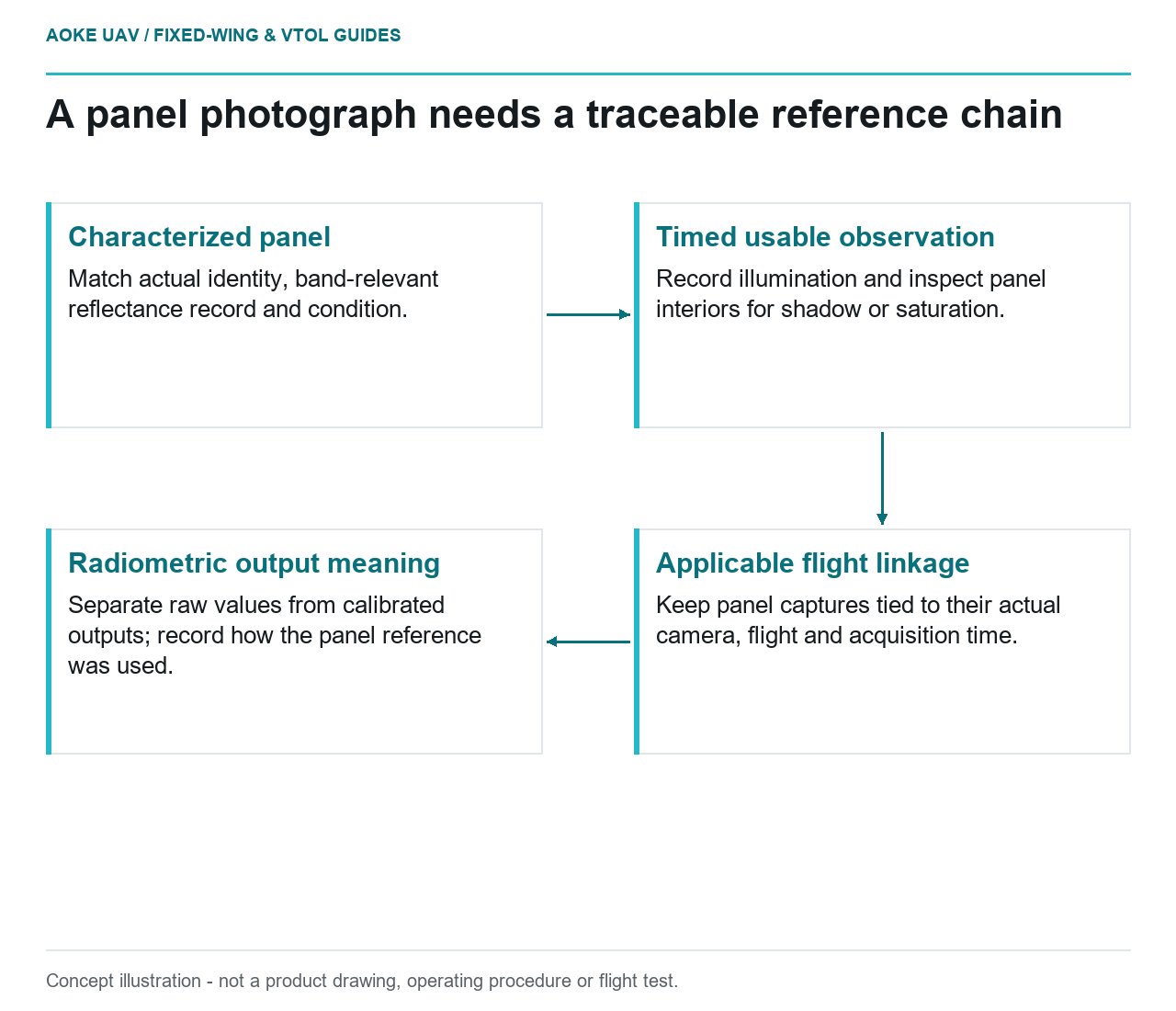
- Characterized panel: Match actual identity, band-relevant reflectance record and condition.
- Timed usable observation: Record illumination and inspect panel interiors for shadow or saturation.
- Applicable flight linkage: Keep panel captures tied to their actual camera, flight and acquisition time.
- Radiometric output meaning: Separate raw values from calibrated outputs; record how the panel reference was used.