Concept illustration
Read diagram notes
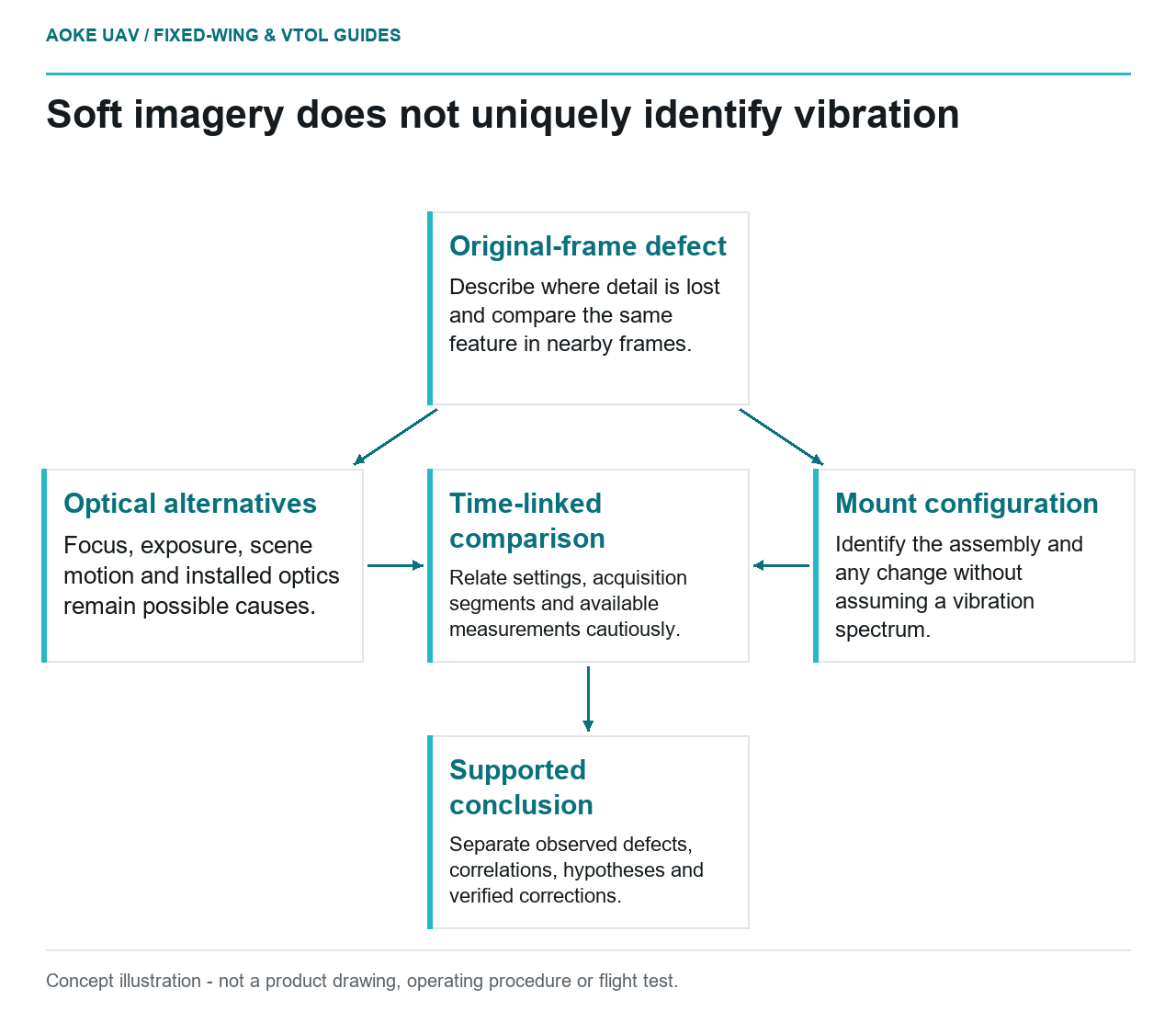
- Original-frame defect: Describe where detail is lost and compare the same feature in nearby frames.
- Optical alternatives: Focus, exposure, scene motion and installed optics remain possible causes.
- Mount configuration: Identify the assembly and any change without assuming a vibration spectrum.
- Time-linked comparison: Relate settings, acquisition segments and available measurements cautiously.
- Supported conclusion: Separate observed defects, correlations, hypotheses and verified corrections.
Blur is an observation, not a complete diagnosis. Suppose a hypothetical large fixed-wing survey produces inconsistent image detail after a propulsion or payload-mount change. The investigation needs to distinguish what the original frames show from what the team suspects. A finished orthomosaic is useful for locating concerns, but the diagnosis should remain tied to acquisition evidence and the actual installation.
Possible signatures in original frames
USGS imagery guidance treats camera settings, geometric calibration, tie-point quality and data verification as connected parts of a quantitative workflow. It notes that exposure-setting choices can interact with image appearance. This supports retaining the original image and its settings rather than diagnosing a capture problem from a resampled product alone. [6]
For the hypothetical fixed-wing dataset, the reviewer would compare suspect frames with nearby accepted candidates at the original image scale. The record would describe whether loss of detail appears across the frame or in a restricted region, whether it repeats and whether the same ground feature appears differently in another exposure. These are observations to record, not unique signatures proving vibration.
A soft image might prompt questions about focus, exposure, scene motion and installed optics as well as vibration. The proposed investigation would keep those alternatives open until evidence distinguishes them. A label such as motion blur in a processing report should be read as a starting point for review, not an aircraft fault finding by itself.
Payload mount and excitation sources
The RedEdge-MX guide discusses vibration in its installation recommendations, alongside its model-specific shutter and mounting context. That guidance does not establish a vibration spectrum, allowable acceleration or isolation design for another camera in a large aircraft. A general recommendation cannot be converted into a tested mount prescription. [20]
The example team would identify the actual camera mounting arrangement, installed accessories and configuration change. It would request sensor-specific environmental limits and the responsible engineer’s assessment of the installation. If measured vibration data are needed, their sensor placement, time reference and operating configuration would have to be defined before they could be meaningfully compared with image events.
No isolator stiffness, propulsion adjustment or structural modification is recommended here. A softer mount should not be assumed to improve a measurement system without evaluating the complete configuration. This article concerns image-led evidence collection, not the design approval of a replacement mounting assembly.
Exposure and timing interactions
The USGS field-data guidance recommends retaining equipment settings and precise image-acquisition time, altitude and location. It also describes the importance of acquisition patterns and stable tie points for geometric calibration. Those records help organize comparisons across a long fixed-wing collection rather than attributing every quality change to one mechanical cause. [6]
For the hypothetical investigation, the analyst would group frames by recorded settings and acquisition segment. Comparisons before and after a configuration change would state other differences that might confound the result. If the clocks cannot be related confidently, a claimed correlation with an aircraft event would remain provisional.
A missing frame would be treated separately from a recorded but unsuitable frame. The former calls for an acquisition-completeness review; the latter requires scrutiny of image content and its measurement utility. Combining both under a generic image-quality score would make the troubleshooting record less useful.
Controlled investigation and evidence limits
The proposed next step would be a controlled evaluation designed by the responsible aircraft and payload team. It would define the configuration, comparison method, retained files and acceptance question before collecting new evidence. No test is represented as performed here, and no operational procedure replaces the applicable aircraft documentation.
The final report would distinguish observed image defects, supported correlations, unresolved hypotheses and verified corrective results. USGS cautions that small GSD is not an accuracy guarantee; apparently fine sampling cannot rescue an inadequately checked geometric product. [6] The useful outcome is a traceable explanation of whether the imagery meets the project’s needs, not an unsupported declaration that vibration has been eliminated.
Related reading
- Propulsion Vibration Across Structure and Survey Payloads
- When a New Payload Requires a Structural Reassessment