Concept illustration
Read diagram notes
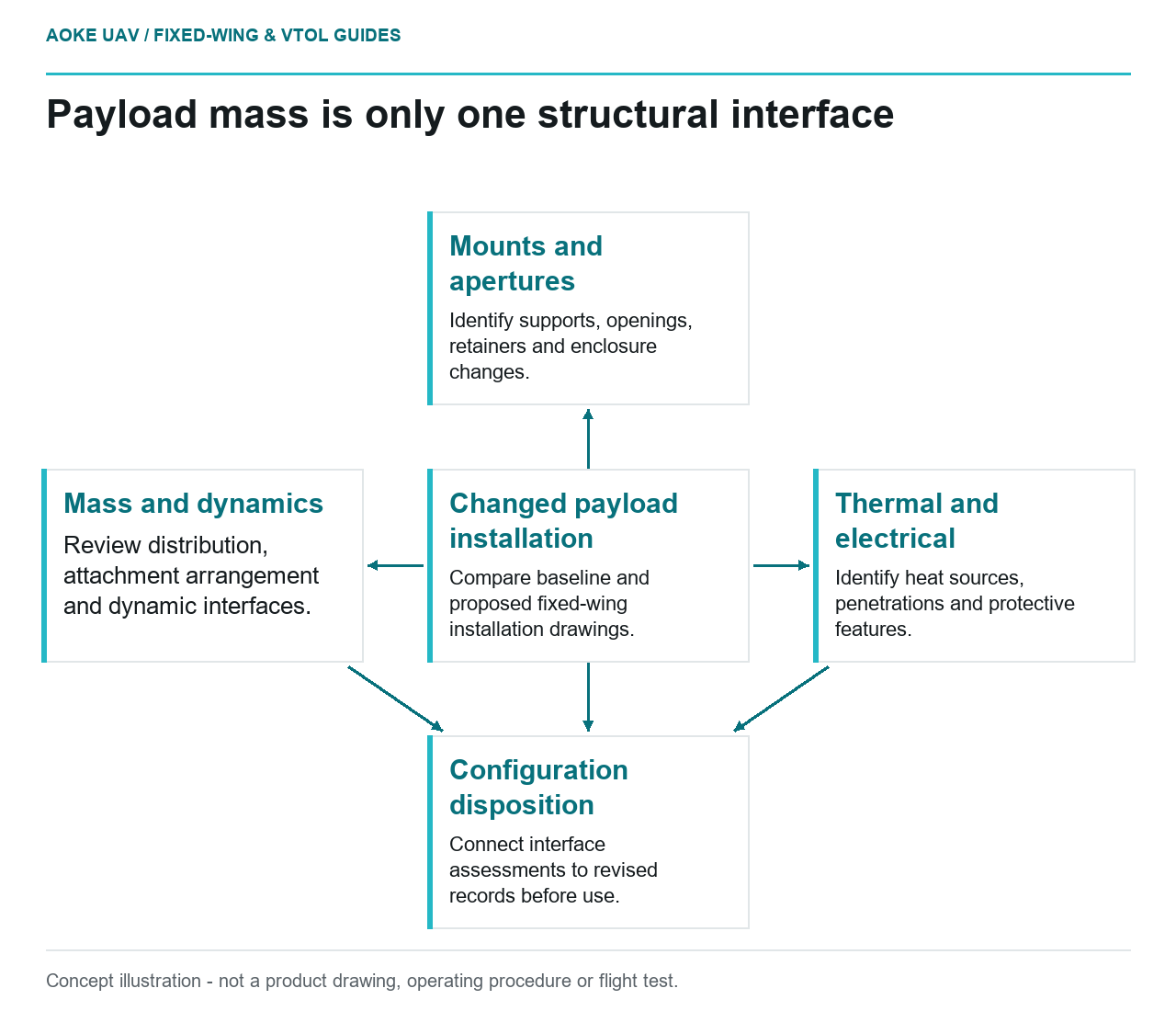
- Changed payload installation: Compare baseline and proposed fixed-wing installation drawings.
- Mounts and apertures: Identify supports, openings, retainers and enclosure changes.
- Mass and dynamics: Review distribution, attachment arrangement and dynamic interfaces.
- Thermal and electrical: Identify heat sources, penetrations and protective features.
- Configuration disposition: Connect interface assessments to revised records before use.
A hypothetical large fixed-wing civil mapping aircraft is offered a new sensor package with a mass close to the original payload. The integration proposal says that an updated center-of-gravity check should be enough. A structural review needs a broader comparison of what the installation changes and which existing evidence remains applicable. This article identifies those questions without calculating loads, approving a mount or specifying a test flight. No GAUTEN product, customer installation or successful payload conversion is represented by the scenario.
Mount loads and aperture changes
Compare the baseline and proposed installation drawings. Identify mounting locations, supporting structure, openings, retainers and any changes to the payload enclosure. Ask whether the new package uses documented installation provisions or requires a new structural disposition. Similar payload mass does not, by itself, establish that the mounting arrangement is the same configuration.
FAA composite guidance treats joints, holes and cut-outs as configuration-specific structural details addressed through appropriate substantiation. [1] Its scope is US certificated aircraft, not approval for this fixed-wing UAV. Use it to ask which evidence covers the revised installation. The responsible designer must determine relevant load cases, including any applicable emergency and ground-handling cases. This article does not provide numerical loads or allow a field team to infer them from the payload’s appearance.
Dynamic mass and vibration interfaces
Request the designer’s comparison of the changed mass distribution, attachment arrangement and dynamic interfaces. Ask which existing analyses or tests remain applicable and what differences require further assessment. Keep the distinction between balancing the aircraft and substantiating its structure explicit. No vibration threshold or acceptable mount flexibility can be established from the general source used here.
FAA aeroelastic guidance discusses stiffness, mass and damping and notes that manufacturing changes, damage and repairs can affect the assessed structure. [1] For the hypothetical industrial fixed-wing installation, this is a reason to refer the complete change to the appropriate reviewers rather than preserve every baseline conclusion. A static fit check or a reassuring balance result does not independently demonstrate the dynamic behaviour of a different payload support arrangement.
Thermal and electrical installation effects
Identify changes to heat sources, electrical equipment, cable penetrations and adjacent protective features in the proposed installation. Ask which of these alter assumptions in the airframe’s structural or environmental evidence. The review should show the installed arrangement and the relevant operating and failure conditions defined by the actual equipment documentation. It should not invent electrical settings or thermal limits.
FAA environmental guidance specifically calls for identifying peak structural temperatures near systems generating heat, including worst-case normal and failure conditions within its scope. It also addresses composite/metal interfaces and protective provisions. [1] Those principles do not determine a permissible equipment temperature for this fixed-wing aircraft. They help identify the documentation needed when a new sensor changes an interface that a simple mass comparison would leave unexamined.
Updated configuration evidence and records
Assemble a change package showing the baseline, changed interfaces, applicability assessments and unresolved questions. Link the final installation to drawing revisions, mass/loading records, inspection access and any revised maintenance instructions. Ask the responsible design authority to provide the disposition before use; no flight trial or operational release is authorized by this explainer.
FAA guidance expects records for substantiated design and process changes and maintenance documentation appropriate to the particular composite structure. [1] For this hypothetical large fixed-wing program, the review is complete only when the installed configuration and its evidence agree, not when a list of questions has been circulated. Where an assessment remains missing, state that gap rather than retain the original performance or structural claim without qualification. Center-of-gravity information remains necessary where applicable, but it is not a substitute for the complete interface comparison described here.
Related reading
- Removable Payload Trays Without Hidden Structural Assumptions
- Propulsion Vibration Across Structure and Survey Payloads