Concept illustration
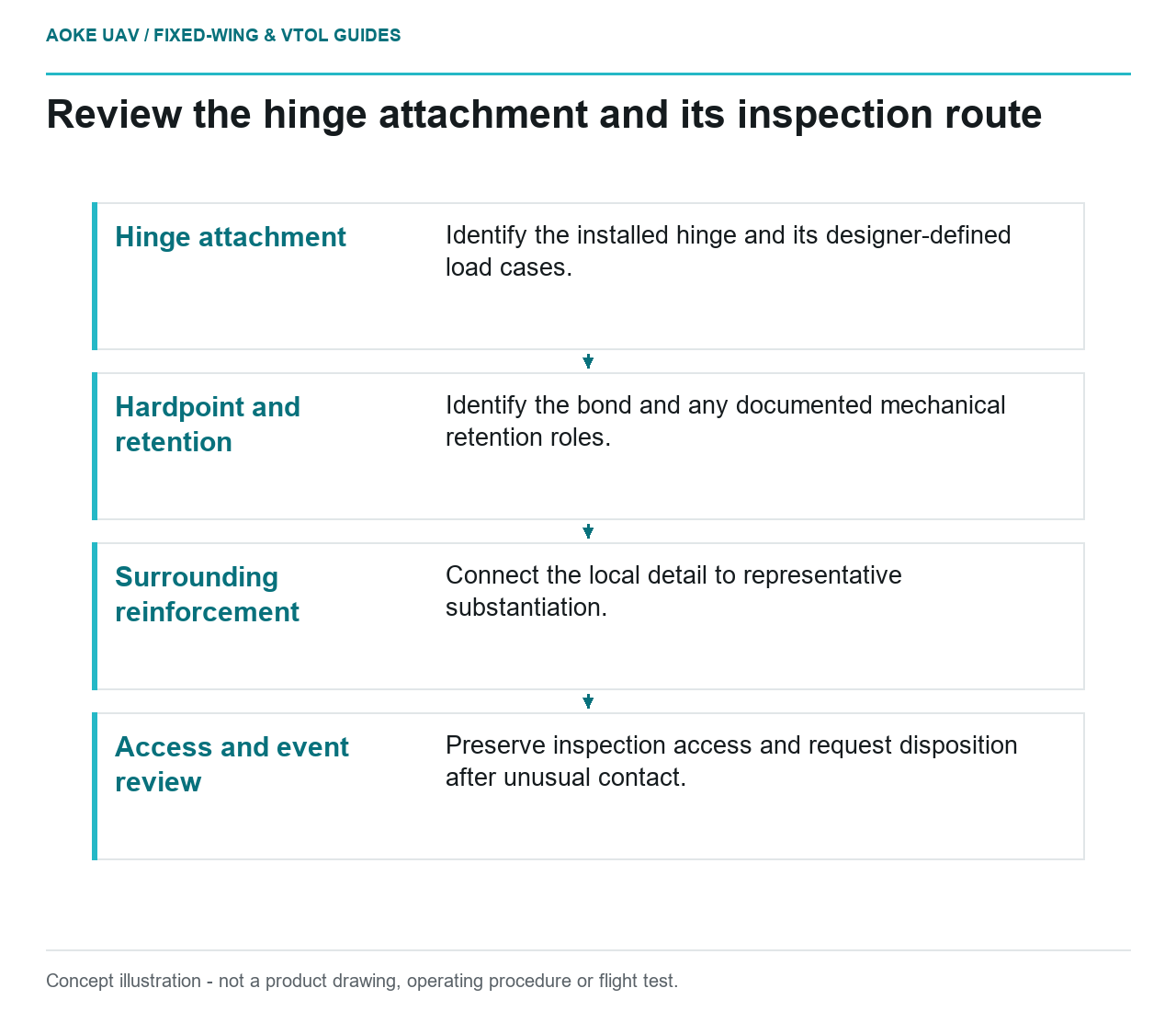
Read diagram notes
- Hinge attachment: Identify the installed hinge and its designer-defined load cases.
- Hardpoint and retention: Identify the bond and any documented mechanical retention roles.
- Surrounding reinforcement: Connect the local detail to representative substantiation.
- Access and event review: Preserve inspection access and request disposition after unusual contact.
Consider a hypothetical large fixed-wing survey aircraft with a bonded control-hinge hardpoint in a thin composite wing skin. A drawing shows the hinge location, but the integration team wants to know what establishes the suitability of the attachment. This is a local structural evidence problem: how the hinge reaction reaches the surrounding structure and how that region is manufactured and inspected. It is not a calculation of whole-wing torsion, an actuator recommendation or a procedure for adding a hinge to an existing wing.
Hinge reactions and local reinforcement
Request a section drawing identifying the hinge, hardpoint, bond interface and surrounding reinforcement. Ask the designer to identify the load cases used for the detail and how those cases relate to the installed control system. These are requests for design evidence, not suggested loads. A picture showing a substantial-looking insert does not identify its relationship to the rest of the wing.
FAA composite guidance treats structural details and discontinuities as configuration-specific issues and explains a building-block progression from material specimens to more complex details and components. [1] In this US certificated-aircraft context, evidence must represent the relevant detail. For the hypothetical fixed-wing UAV, use the same question: which substantiation actually includes this hinge attachment rather than merely the nominal skin material?
Bonded versus mechanically retained features
Identify every intended retention mechanism without assuming that redundant-looking hardware supplies independent protection. Ask whether a fastener carries a defined load, locates a bonded item during manufacture or serves another documented function. If the proposal changes from bonded retention to mechanical retention, request a revised structural disposition rather than treating it as an interchangeable assembly option.
The FAA discusses qualified bonding processes, controlled surface preparation and limitations of relying on final inspection to establish bond quality. [1] Therefore, a clean external fillet cannot replace the process record for this fixed-wing hardpoint. Ask which manufacturing controls and verification steps apply to the actual interface, including how any deviation was dispositioned. Do not adopt adhesive thicknesses, preparation methods or reinforcement dimensions from a generic example.
Alignment and service access
In the hypothetical integration review, compare the hinge drawing with the installed actuator linkage and the defined alignment references. Ask the responsible designer how misalignment and assembly variation were addressed. Avoid introducing an alignment tolerance here: the aircraft’s controlled design data must establish it. A hinge that moves freely during an informal check does not by itself substantiate the attachment.
Also ask how the local region is reached for the documented inspection and how the assembly is identified after replacement. FAA maintenance guidance emphasizes inspection and repair access appropriate to structural details. [1] That is a reason to resolve access at the design-review stage, not to enlarge a service opening later. Keep access proposals tied to the current fixed-wing configuration and its controlled inspection requirements.
Inspection after a control-surface event
After a hypothetical control-surface contact or other unusual event, preserve what was observed: affected surface, attachment location, configuration and circumstances. Ask which aircraft-specific inspection and disposition are required. Do not infer remaining attachment strength from a control movement check, a lack of visible cracking or the fact that the event occurred on the ground.
FAA guidance distinguishes visual indications from characterization of hidden damage and expects substantiated inspection methods. [1] For this large industrial fixed-wing aircraft, the review output should identify the hardpoint evidence, its manufacturing linkage and the event-response route. It should also state what was not assessed. Whole-wing aeroelastic behaviour and actuator capability remain separate subjects, even though their design inputs may interact with the hinge. Local acceptance must not be presented as proof of either.