Concept illustration
Read diagram notes
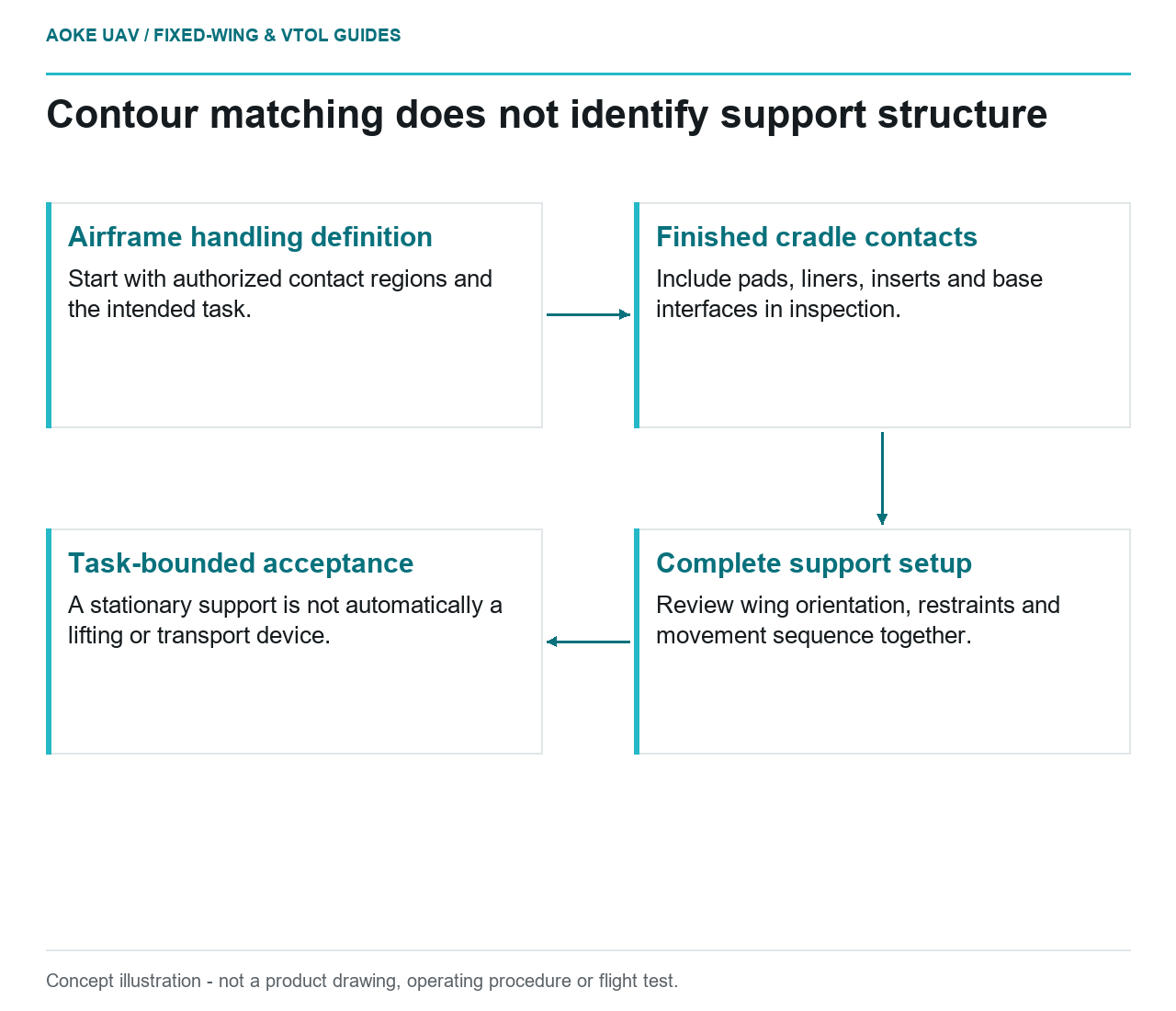
- Airframe handling definition: Start with authorized contact regions and the intended task.
- Finished cradle contacts: Include pads, liners, inserts and base interfaces in inspection.
- Complete support setup: Review wing orientation, restraints and movement sequence together.
- Task-bounded acceptance: A stationary support is not automatically a lifting or transport device.
A detached multi-meter wing is an awkward object to handle, and a contour-matched printed cradle may appear reassuring. In this hypothetical civil fixed-wing workshop, the cradle is proposed for ground support at locations already identified by the airframe documentation. The review concerns whether that particular fixture implements the intended arrangement. It does not establish new wing handling loads or authorize lifting from convenient-looking surfaces.
Approved support locations
Obtain the relevant airframe handling instructions before finalizing the cradle. Identify the wing configuration, allowed contact regions, permitted handling task, and any restrictions that accompany the documented arrangement. If those instructions do not resolve the proposed use, ask the airframe authority. A scan of the exterior shape can define a matching contour, but it cannot establish which internal structure may carry a support reaction.
For the tool itself, retain a drawing that distinguishes locating surfaces, supporting surfaces, restraints, and the base interface. Formlabs describes manufacturing aids as devices that support manufacturing operations and recommends checking seating against locating surfaces and supports. That guidance helps frame fixture verification; it does not contain handling limits for a large wing or validate a cradle made to an arbitrary surface model. [4]
Contact geometry and local pressure
The proposed inspection should check the finished contacts rather than only the unprinted CAD. Include any pads, liners, inserts, or joining hardware in the inspected configuration. Ask how the cradle will avoid unintended contact with adjacent skins and fittings while implementing the documented support arrangement. These are original review questions, not an assurance that a particular material pairing or contact footprint is acceptable.
Formlabs recommends dimensional comparison with CAD and functional fixture checks after printing and processing. It also cautions against unsupported arms or overly thin features without validation. [4] In this fixed-wing example, that supports verifying the actual tool geometry and function. It is not a basis for selecting a pressure limit or estimating skin strength from the fact that the wing appears to seat smoothly.
Restraint during handling
Review the entire cradle installation: printed elements, base, attachments, work area, wing orientation, and the intended handling sequence. Clarify whether the arrangement is a stationary support or has a separately authorized transport function. Do not silently expand a bench fixture into a lifting device or road-transport restraint. Each change in intended use needs its own review against applicable airframe and equipment requirements.
Write the proposed sequence so that a reviewer can see when the wing is transferred, when restraints are applied, and who controls the movement. Examine access for hands and tools without inventing an aircraft-specific maneuver. Where the documentation leaves an ambiguity, stop the release of that use rather than assume that a visually stable arrangement is adequate for every handling condition.
Wear and dimensional verification
Establish a finished baseline with the cradle assembled as it will be used. Specify which contacts and datums matter and who can disposition damage or dimensional change. Formlabs notes wear concerns and suggests metal or hybrid solutions for high-wear areas; it also warns about sustained loading of SLA parts. Those observations justify material-specific review, not a universal replacement interval. [4]
For a large fixed-wing maintenance team, the final record should say which tool, which wing arrangement, and which task were accepted. Record anomalies before returning the cradle to storage, and keep uncertain fixtures out of the normal-use rack. An intact cradle cannot clear a damaged wing, just as documented wing handling locations cannot prove that an uninspected printed cradle still implements them correctly.
Related reading
- Supporting Multi-Meter Composite Wings During Handling
- Printed Soft Jaws for Composite Airframe Assembly