Concept illustration
Read diagram notes
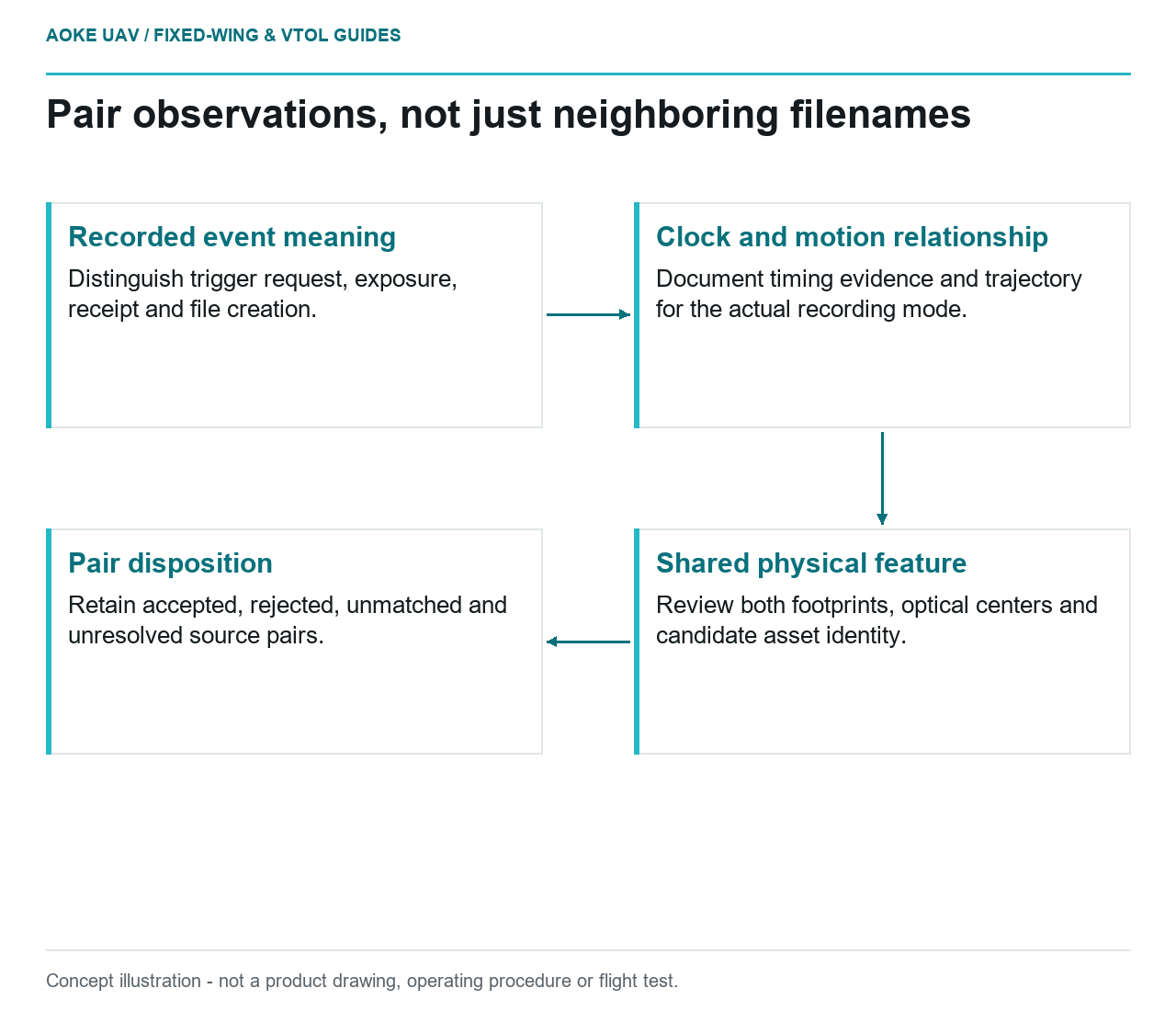
- Recorded event meaning: Distinguish trigger request, exposure, receipt and file creation.
- Clock and motion relationship: Document timing evidence and trajectory for the actual recording mode.
- Shared physical feature: Review both footprints, optical centers and candidate asset identity.
- Pair disposition: Retain accepted, rejected, unmatched and unresolved source pairs.
Two convincing images do not automatically describe the same physical observation. In a hypothetical civil integration, a large fixed-wing UAV carries separate thermal and RGB cameras over an industrial corridor. The report pairs one thermal frame with one visible frame and assigns a component identifier. Before accepting that association, the reviewer needs to understand when and where each camera observed. This is not an GAUTEN payload installation or demonstrated synchronization result.
Separate camera timing and fields of view
ArduPilot’s camera documentation distinguishes a logged trigger command from camera feedback used to record when a picture is taken. Its example uses TRIG and CAM log messages for those different events. [8] The distinction illustrates why a command timestamp should not silently become proof of the installed camera’s exposure time.
For the proposed thermal/RGB installation, request a timing diagram identifying each clock, recorded event and timestamp convention. Does a value denote a trigger request, exposure event, receipt by a recorder or file creation? Which time reference is used, and how was its relationship to the other records established? Treat an unanswered question as a documented integration gap.
Ask separately about the cameras’ footprints. Even when timestamps are associated correctly, the receiving team should verify that the intended asset is visible in both original images. Do not assume identical lenses, pointing directions or image boundaries because two cameras share a payload enclosure.
Aircraft motion between exposures
In the hypothetical fixed-wing pass, consider the possibility that one image was acquired after the other while the aircraft continued along the corridor. The review question is whether the pairing process accounts for the actual event times and trajectory, not whether both files were saved within the same mission folder.
Require the integrator to state how any capture delay was established and under which recording mode it applies. If a correction is estimated, preserve the evidence and its uncertainty. Do not carry a convenient bench assumption into flight reporting without checking whether the installed acquisition chain supports it.
Include unmatched and ambiguous frames in a proposed association log. A missing image should produce a visible exception rather than shifting every subsequent pairing by one filename. This is especially important to the review when the large fixed-wing acquisition contains recording interruptions or mode changes.
Georeferencing and association logic
USGS’s imagery calibration guidance emphasizes geometric data quality, control and calibration metadata rather than treating image sampling as an accuracy guarantee. [2] It supports evaluating the spatial evidence behind an association, but does not certify the hypothetical thermal/RGB pairing system.
Document which camera position and orientation each calculation uses, how the camera-to-camera relationship is established, and how an image region becomes an asset identifier. Ask for the relevant calibration evidence rather than assuming the aircraft navigation record represents both optical centers perfectly.
A proposed review should examine the same physical feature in each original frame, the associated location records and the asset-register mapping. If the feature is hidden or the location falls between neighboring components, label the pairing unresolved. A precise coordinate in the database is not a reason to conceal uncertainty about identity.
Review paired evidence before tagging
Before handing findings to the owner, require a representative set of accepted, rejected and unresolved pairs. The reviewer should be able to trace each pair to source files, recorded times, association software and the configuration used. Include the event evidence supporting the association, not only the final side-by-side illustration.
Make a distinction between a contextual visible image and a verified matched observation. A broad RGB view may help a person locate a thermal finding while not supporting the same component-level correspondence. State that role explicitly in the report, and avoid overlaying a confident defect marker when its association has not been established.
Keep the fixed-wing deliverable within its demonstrated observability. No synchronization accuracy, detection guarantee or inspection equivalence is asserted here. The useful acceptance question is whether the documented acquisition and association chain can support the particular asset tag the report proposes to attach.