Concept illustration
Read diagram notes
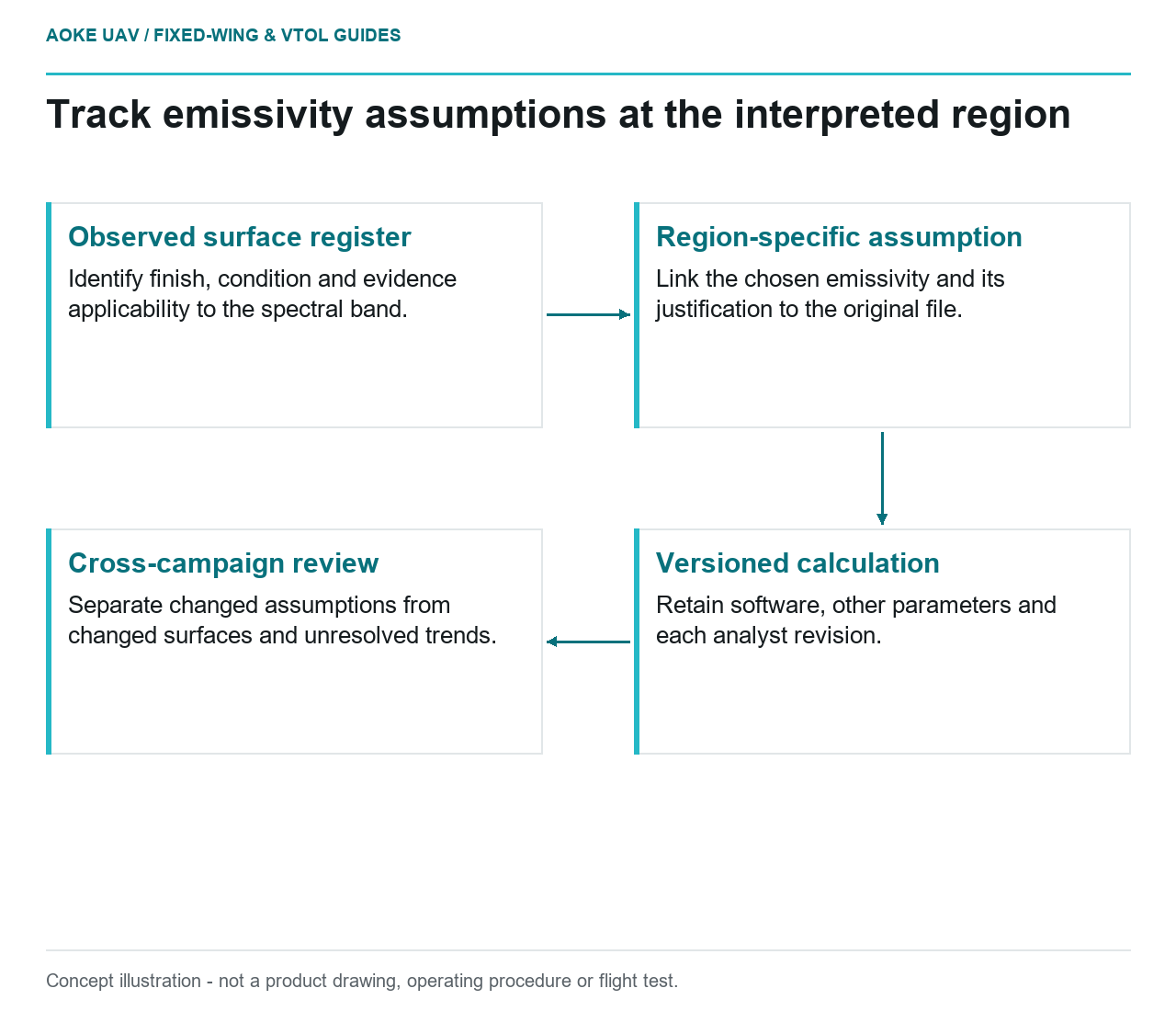
- Observed surface register: Identify finish, condition and evidence applicability to the spectral band.
- Region-specific assumption: Link the chosen emissivity and its justification to the original file.
- Versioned calculation: Retain software, other parameters and each analyst revision.
- Cross-campaign review: Separate changed assumptions from changed surfaces and unresolved trends.
Imagine a large fixed-wing UAV recording thermal imagery across an industrial estate. Its footprint includes painted enclosures, weathered metal covers and surfaces whose finish is unknown. This is a hypothetical civil integration problem, not an GAUTEN inspection result. The useful engineering question is not which palette looks clearest. It is whether each reported temperature has an identifiable, defensible emissivity assumption.
Emissivity enters the measurement model
FLIR describes emissivity by comparison with a blackbody at the same temperature and identifies it as an important input when converting received infrared radiation to temperature. The camera’s signal also contains contributions other than the object’s emission. [1]
For the proposed workflow, treat emissivity as part of the measurement record rather than a hidden software preference. If an analyst changes that setting after capture, retain both the original setting and the revised interpretation. A reviewer should be able to distinguish a newly acquired observation from a recalculation using different assumptions.
Do not present a temperature with more certainty than its inputs justify. If the surface cannot be identified reliably from the fixed-wing imagery or asset records, describe the observation as conditional on an assumed emissivity. The uncertainty belongs next to the finding, not only in a general disclaimer at the end of the report.
Surface finish and wavelength context
FLIR’s guidance distinguishes polished, oxidized and painted surfaces in its emissivity discussion. That makes a material name alone an inadequate explanation of the selected setting. [1] An integration review should therefore ask what surface the camera actually observes: the underlying material, a coating, contamination, or an uncertain combination.
Build a hypothetical surface register before creating a sitewide temperature table. For each asset group, request the source of the emissivity estimate, the relevant finish and condition, and whether the evidence applies to the camera’s spectral band. This is a proposed documentation practice, not permission to copy a single handbook value across an industrial site.
A broad fixed-wing image may not settle whether two visually similar covers have the same coating or surface condition. If that information is essential, the asset team needs a separate way to establish it. Do not fill the gap by assuming all steel, all paint or all roof surfaces behave identically.
Reflections and environmental parameters
Keep reflected radiation separate from emission in the interpretation. FLIR explains that the surrounding radiation reflected by the object also reaches the camera and that reflected apparent temperature is a compensation parameter. [1] An unexplained bright region should prompt questions about both the surface and its surroundings before it is assigned a maintenance meaning.
In the hypothetical dataset, review neighboring frames and the surface orientation. Ask whether a candidate finding remains tied to a physical location when the view changes, while recognizing that this comparison does not itself measure emissivity. Retain the relevant frames rather than selecting only the most dramatic one for the report.
Changing emissivity until a result looks plausible would make the analysis circular. Instead, document why the chosen value is supported, which other parameters were held constant, and what observation could contradict the interpretation. Where evidence remains missing, preserve the question rather than manufacturing a confident temperature.
Document assumptions with radiometric data
Specify a handover table linking each interpreted region to the original file, asset identifier, emissivity value, justification and analyst revision. Include the software and processing configuration used for the reported result. If the image contains mixed surfaces, require the analyst to state which region the setting is intended to represent.
For a large fixed-wing monitoring program, this traceability matters when campaigns are compared. A proposed comparison should identify whether its emissivity assumptions stayed the same and whether the observed surface itself changed. Otherwise, label the comparison unresolved rather than interpreting every temperature difference as changed asset condition.
FLIR’s measurement chapter is not an industrial asset diagnostic standard. It supports understanding the input, not declaring a fault or deciding a repair limit. The final deliverable should make that boundary practical: original thermal evidence, explicit surface assumptions, unresolved cases and a clearly assigned request for appropriate asset-specific follow-up.
Related reading
- Reflected Apparent Temperature in Thermal Inspection
- Reflectance Panels in Fixed-Wing Multispectral Workflows