Concept illustration
Read diagram notes
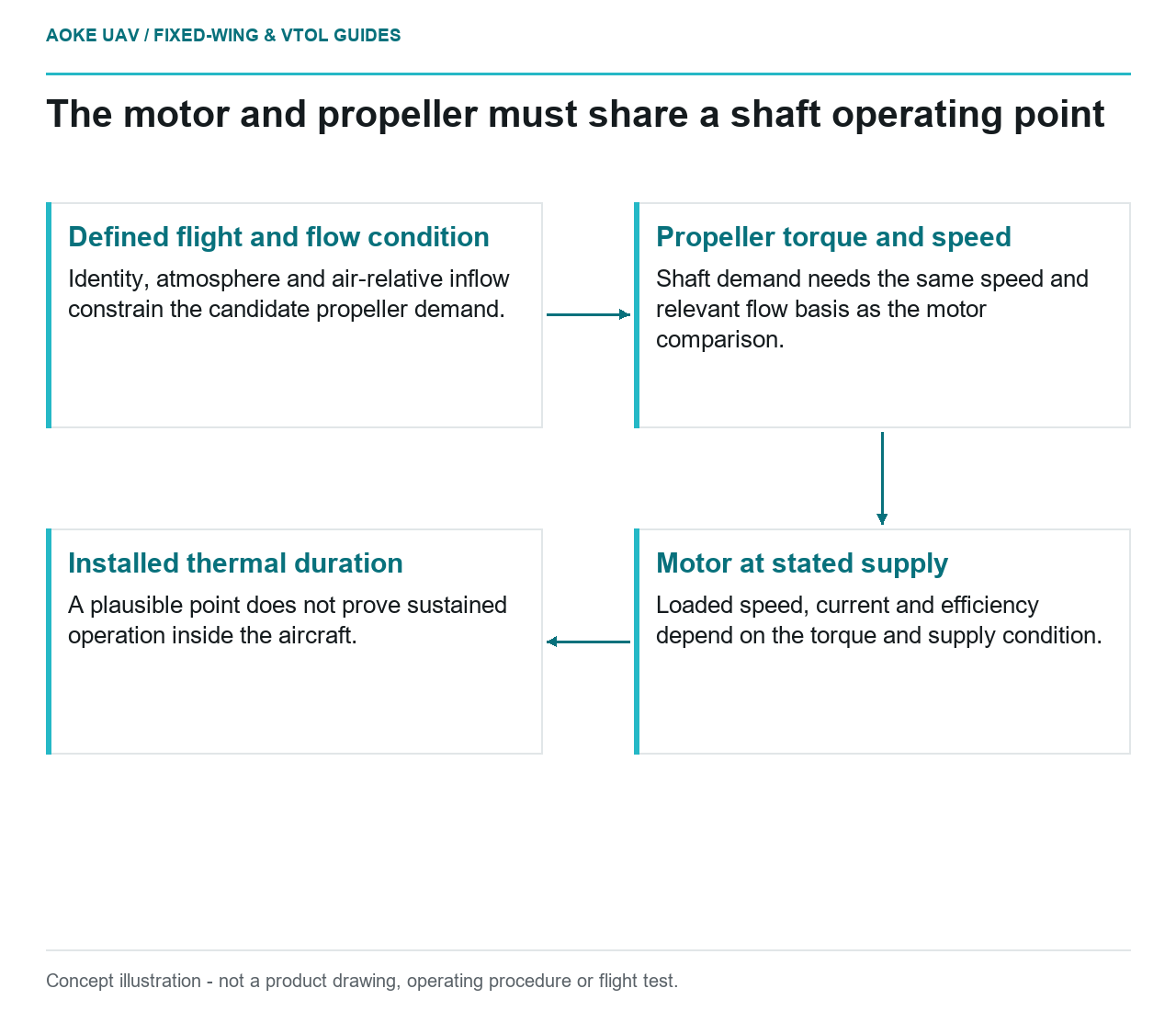
- Defined flight and flow condition: Identity, atmosphere and air-relative inflow constrain the candidate propeller demand.
- Propeller torque and speed: Shaft demand needs the same speed and relevant flow basis as the motor comparison.
- Motor at stated supply: Loaded speed, current and efficiency depend on the torque and supply condition.
- Installed thermal duration: A plausible point does not prove sustained operation inside the aircraft.
Start with the shaft demand, not the headline watts
Imagine a hypothetical large fixed-wing mapping aircraft with a candidate motor and propeller proposed for cruise. The team has a motor power label and an isolated propeller data file, but no matched installed record. Its task is to identify what evidence would locate their shared operating point. This is an original engineering-review scenario, not a calculation for a real aircraft.
The maxon reference presents speed, current, output power and efficiency as functions of torque at a specified voltage. Its speed-torque diagram distinguishes no-load speed from loaded operation and explicitly notes that tolerances and temperature influences are absent from that first-estimation diagram. The diagram’s conditions are part of its meaning. [1]
Write down the proposed shaft demand as torque and speed under named flight conditions. If those quantities are not established, mark the demand unresolved. A motor power label alone does not identify which combination the propeller would require or which supply condition would produce it.
Keep the motor curve and propeller evidence compatible
Within the maxon model, changing applied voltage shifts the speed-torque relationship, while increasing torque at constant voltage reduces speed. The reference also links torque with motor current. These relationships explain why a proposed motor point needs supply and load information together, rather than separate maximum values taken from unrelated lines of a datasheet. [1]
APC states that its performance data are analytical and that power, torque and thrust calculations use sea-level standard-atmosphere conditions. Such data may help frame a propeller-load discussion within their scope, but they do not provide installed performance for a large civil fixed-wing aircraft. Retain the exact propeller identity and calculation conditions when using them. [2]
For the illustrative review, ask whether the motor and propeller evidence share the same shaft speed and relevant flow condition. If one represents a stationary arrangement and the other a forward-flight demand, do not call them matched simply because their power figures look similar. The evidence request should expose that mismatch before further integration claims are made.
Read current, efficiency and losses at that point
Maxon defines efficiency as mechanical power delivered relative to electrical power consumed and explains that maximum efficiency and maximum output power occur at different torques. Its reference separates winding losses from the mechanical conversion discussion. The useful question is therefore what the relevant operating point implies, not whether a motor has an attractive single efficiency number. [1]
Ask for current and loss information at the candidate point, along with the controller and measurement conventions used to obtain it. The generic reference does not document an arbitrary aircraft controller’s battery-bus telemetry. Keep any controller-side input quantity distinct from a motor-model winding quantity until the applicable documentation defines them.
For a fixed-wing VTOL adaptation, repeat the evidence mapping for each motor’s actual role. This proposal does not assume that the cruise propulsion point describes lift or transition operation. The point of separating the cases is to prevent a cruise match from silently standing in for the complete aircraft power assessment.
Record a conditional match and its remaining limits
A proposed operating-point worksheet should name the motor winding and revision, supply condition, controller, propeller, flow assumption and measurement basis. Beside the torque-speed pair, record the corresponding current and efficiency evidence, or explicitly mark what remains unavailable. This worksheet is an editorial method for organizing evidence, not a manufacturer qualification procedure.
The maxon material treats continuous operating range and temporary overload as separate questions with thermal conditions. Consequently, locating a plausible point on a generic diagram is not equivalent to demonstrating that an enclosed aircraft installation can remain there. The actual motor and installation require their own applicable thermal evidence. [1]
The outcome for the hypothetical large fixed-wing project should be a traceable candidate match with stated uncertainty. It should not be an invented shaft speed, a safe throttle setting or a promised aircraft performance result. Finding the point makes the next evidence request precise; it does not replace validation of the installed propulsion system.