Concept illustration
Read diagram notes
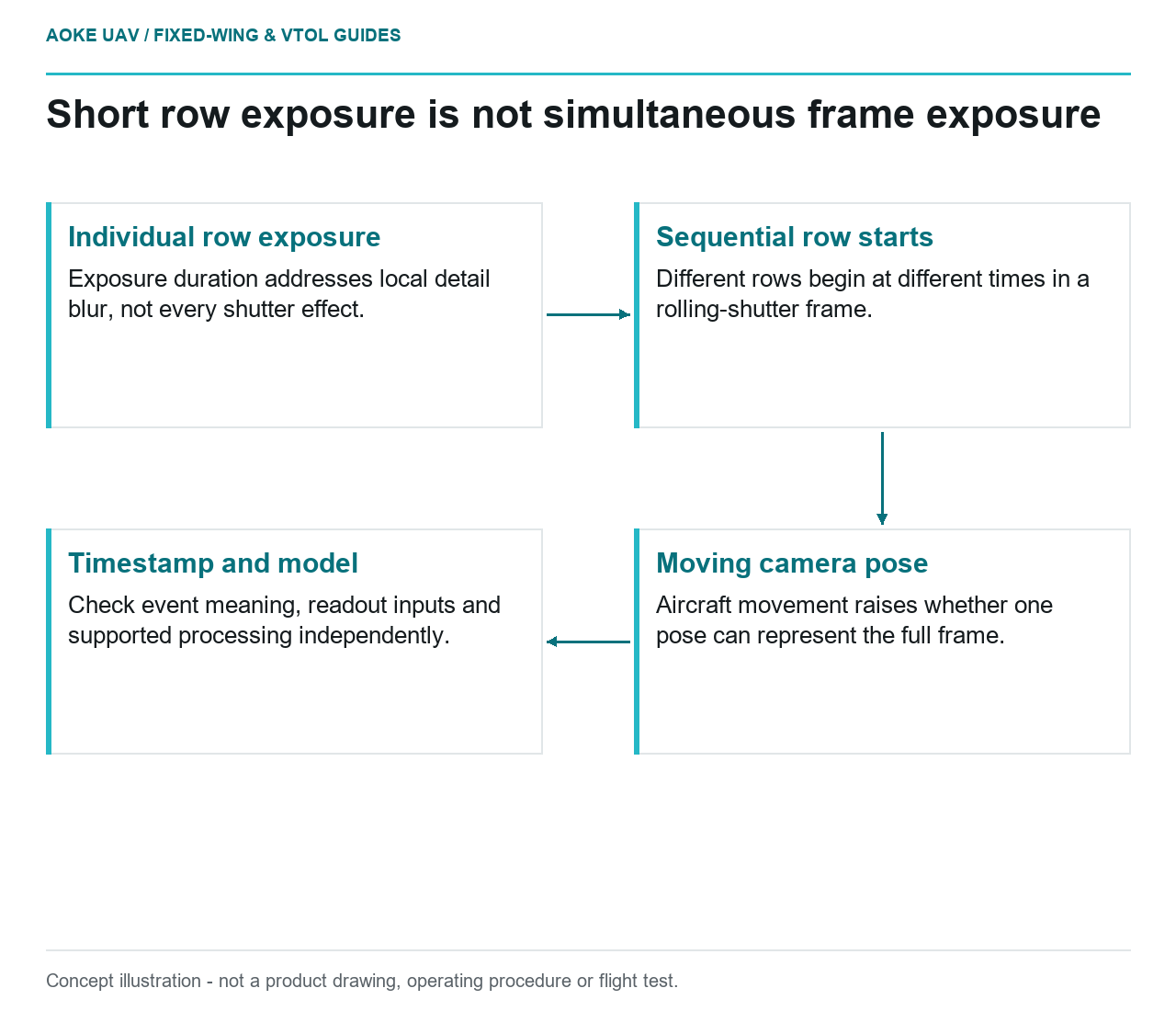
- Individual row exposure: Exposure duration addresses local detail blur, not every shutter effect.
- Sequential row starts: Different rows begin at different times in a rolling-shutter frame.
- Moving camera pose: Aircraft movement raises whether one pose can represent the full frame.
- Timestamp and model: Check event meaning, readout inputs and supported processing independently.
A short exposure setting does not answer every shutter question. For a hypothetical large fixed-wing civil land survey, an integrator proposes a rolling-shutter camera because its imagery looks sharp during a ground demonstration. Before accepting that payload, the review should separate individual-row exposure duration from the time structure of the complete frame. This example concerns suitability evidence, not a test result or a recommendation for a particular aircraft.
Sequential readout and platform motion
Basler’s manufacturer documentation explains that rolling-shutter rows start exposure at different times, with a model-dependent temporal offset between rows. It also describes distortion of moving subjects caused by that offset. By contrast, its global-shutter explanation has pixels begin and end exposure together. These descriptions establish the shutter distinction; they do not establish the behavior of an undocumented mapping camera. [5]
Applied to the hypothetical fixed-wing mission, the review question becomes whether a single frame can be treated as one camera pose in the chosen reconstruction workflow. The aircraft’s movement is part of that question even if the terrain is stationary. Ask the camera supplier for the actual sensor mode, readout direction, relevant timing and any dependence on image configuration. Do not infer those values from nominal frame rate or a similarly named camera.
Exposure duration is a different quantity
Basler further notes that a rolling-shutter Exposure Active output can remain asserted from the first row’s exposure start until the last row’s exposure end. Its duration can therefore exceed the exposure duration selected for an individual row. That makes the signal useful context, but not automatically a single exposure-midpoint event. [5]
For this integration review, list three separate questions: whether local image detail is blurred, whether different rows represent different moments, and what the image timestamp describes. A fast shutter setting might be proposed to address the first question; it should not be presented as proof that the other two disappear. Keep any aircraft-motion observations tied to the conditions and sensor mode in which they were collected.
Check the calibration and processing model
Obtain the exact processing software documentation before relying on a rolling-shutter correction option. The proposed evidence package should identify the supported camera model, required timing inputs, motion assumptions and software revision. A checkbox named correction is not an independent validation result. If readout timing is unavailable or the mode is unsupported, record that gap instead of filling the field with a value borrowed from another sensor.
USGS calibration guidance explains why ground control and tie-point quality matter to geometric results independently of imagery GSD. Thus a small nominal pixel footprint cannot guarantee that the hypothetical rolling-shutter installation produces accurate survey coordinates. The project’s check observations must address the delivered product, not just its planned resolution. [1]
For the large fixed-wing example, propose a controlled evaluation that preserves raw photographs, navigation information, configuration and processing reports. Have the responsible team define appropriate observations and acceptance criteria before comparing processing variants. This article supplies review questions, not a flight profile, an aircraft operating limit or a universal shutter-speed threshold.
Inspect residual distortion in the product
In the hypothetical evaluation, compare image features and independent check observations across the survey rather than selecting one attractive mosaic crop. Review discrepancies by image position and acquisition segment. If a pattern appears, investigate timing, calibration and processing assumptions together instead of declaring rolling shutter the cause solely because the camera has that design.
Preserve unsuccessful processing variants and explain why the selected workflow was retained. A fixed-wing survey handover should state the camera mode, calibration identity, timing information available and limitations that remain. If evidence does not establish suitability for the requested civil measurement, narrow the intended use or select a documented alternative. The defensible outcome is a demonstrated processing scope, not a general claim that all rolling-shutter cameras either work or fail on moving aircraft.
Related reading
- Exposure Time and Motion Blur in Fixed-Wing Mapping
- Propulsion Vibration Across Structure and Survey Payloads