Concept illustration
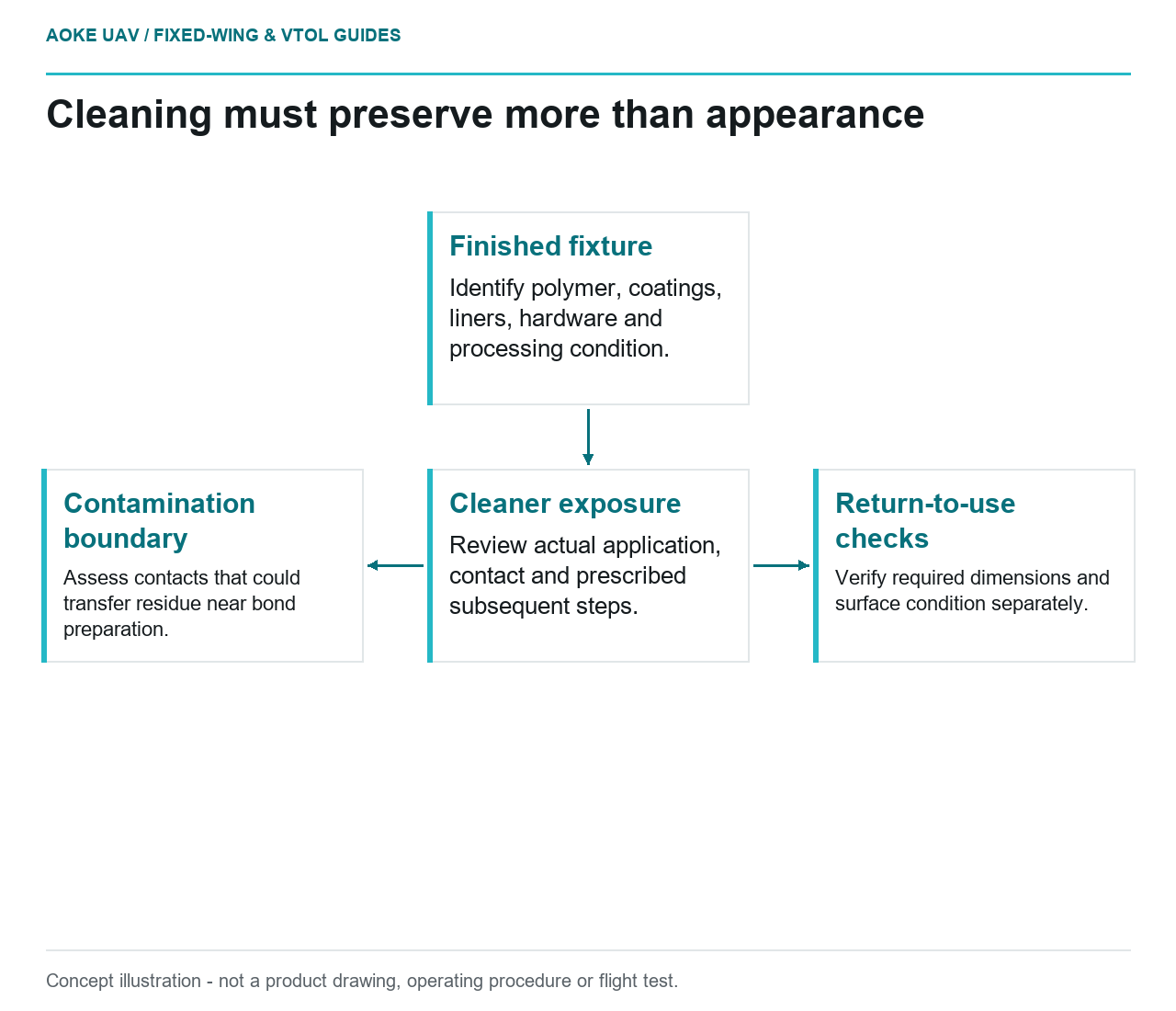
Read diagram notes
- Finished fixture: Identify polymer, coatings, liners, hardware and processing condition.
- Cleaner exposure: Review actual application, contact and prescribed subsequent steps.
- Contamination boundary: Assess contacts that could transfer residue near bond preparation.
- Return-to-use checks: Verify required dimensions and surface condition separately.
A wing-assembly fixture has adhesive residue on a precision contact surface. Reaching for the usual workshop solvent may seem simpler than opening its material record. In this hypothetical large civil fixed-wing assembly process, however, the fixture helps locate components near a contamination-sensitive operation. The cleaning decision needs to preserve both its controlled geometry and its defined surface condition, not merely leave the tool looking clean.
Actual printed resin or thermoplastic
Identify the printed material and manufacturing process before selecting a cleaner. Include the material revision, post-processing condition, coatings, sealers, liners, and inserted hardware in the review. A compatibility statement for the bulk polymer may not address the complete finished fixture. Ask the material and process owners which instructions apply to that exact construction and intended assembly environment.
Formlabs directs users to individual material guidance for properties and wash/cure instructions rather than providing one processing recipe for all manufacturing aids. [4] That distinction matters here: washing a newly printed resin part under its processing instructions is not automatically the same task as cleaning an in-service fixture that carries coatings, contamination, and dimensional acceptance requirements.
Cleaner contact and exposure
Record the proposed cleaner, method of application, expected contact, and any subsequent drying or reinspection steps specified by applicable instructions. Distinguish routine wiping from immersion or an accidental spill. Do not supply a generic solvent concentration, contact time, or drying temperature where the actual material guidance has not been established. A familiar chemical name is not a complete cleaning process.
Stratasys reports solvent-exposure characterization on unsealed ULTEM 1010 coupons with stated exposure, drying, and flexural-evaluation conditions. [3] The evidence is specific to that material and test sequence. It cannot establish that another polymer, an SLA resin, a sealer, or a dimensional datum is unaffected by a different cleaning operation. Even compatible bulk behavior would not automatically settle every finished-fixture requirement.
Surface residues and bond contamination
For this fixed-wing scenario, ask the assembly process owner what surface condition is required before the fixture returns near bond preparation. Identify which contacts could transfer residues and how the cleaning operation will be controlled. These are proposed contamination-review questions, not claims that a named cleaner leaves a particular residue or that a fixture has caused an adhesive failure.
Keep cleaning acceptance separate from visual appearance. A useful record can identify the area cleaned, the approved instruction used, any unexpected surface change, and who assessed the outcome. If the applicable instructions do not cover the observed contamination, seek a disposition rather than repeat an unreviewed cleaning step until the appearance improves. Protect the workpiece from uncertainty in the tool’s status.
Reinspection after cleaning
Determine which dimensions and surfaces require checking before reuse. Formlabs recommends inspection of printed aids against CAD and functional evaluation of locating and support contacts. [4] In this context, those checks can help verify a fixture’s return-to-use condition. They cannot establish chemical compatibility retrospectively or replace a process owner’s acceptance of the required cleanliness state.
The final large fixed-wing tooling record should retain the cleaning history where it affects disposition, including any accidental exposure or change from the established method. If the fixture needs replacement, verify the replacement through its full processing and inspection sequence. Do not assume that a new print has the same accepted geometry or cleanliness merely because it uses the old file. This approach treats cleaning as a controlled maintenance decision, not an informal cosmetic repair.
Related reading
- Printed Masks and Guides for Controlled Adhesive Placement
- Bond Preparation Records for Composite Airframes