Concept illustration
Read diagram notes
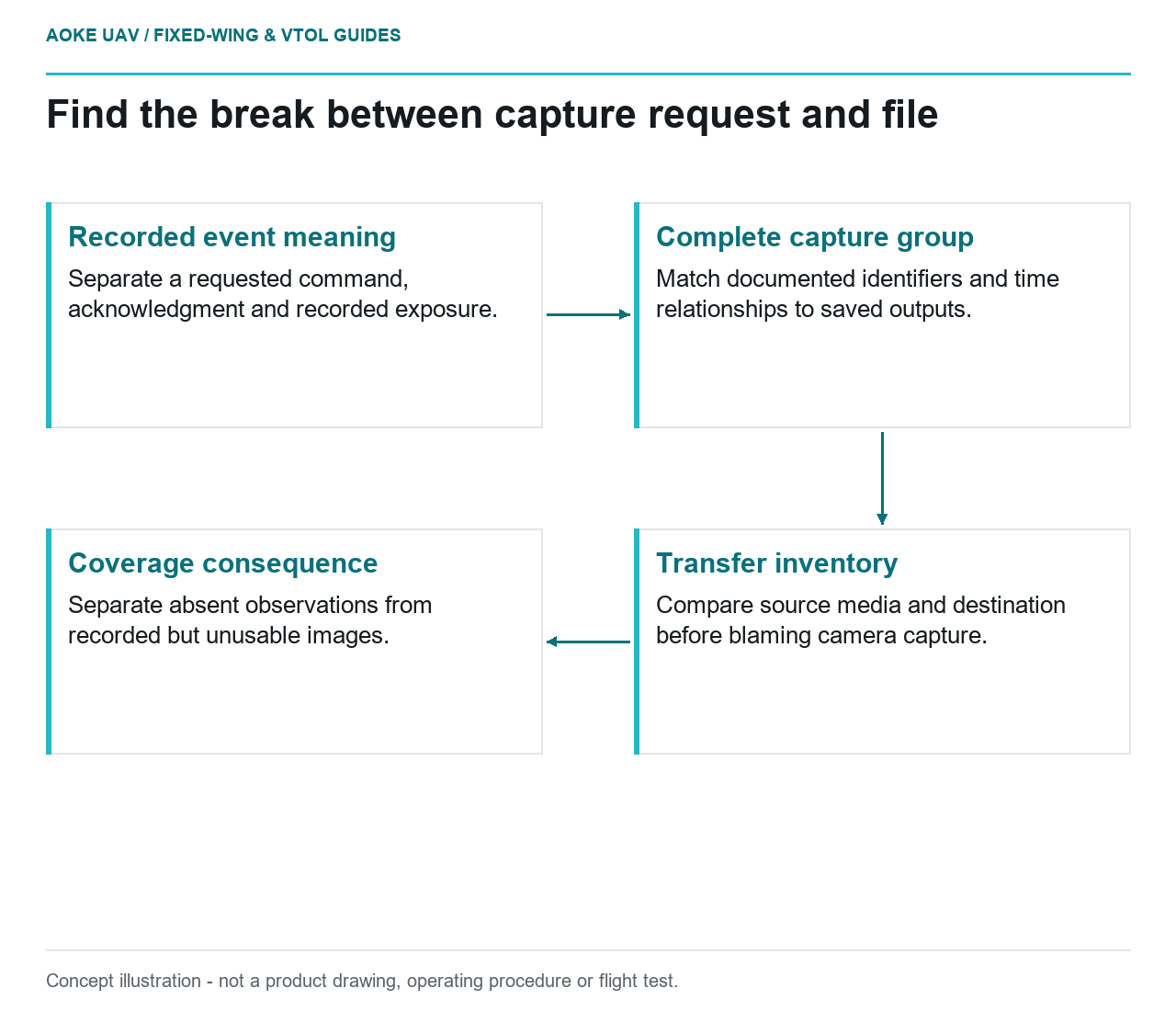
- Recorded event meaning: Separate a requested command, acknowledgment and recorded exposure.
- Complete capture group: Match documented identifiers and time relationships to saved outputs.
- Transfer inventory: Compare source media and destination before blaming camera capture.
- Coverage consequence: Separate absent observations from recorded but unusable images.
A hole in a photogrammetric product does not immediately identify the stage that failed. In a hypothetical large fixed-wing mission, one long strip appears incomplete after processing. Before adjusting reconstruction settings, the team needs to determine whether the required observations were recorded at all. That investigation follows commands, capture groups and original files rather than starting with the final mosaic.
Expected events and recorded images
The RedEdge-MX guide distinguishes overlap, timer and external triggering configurations and describes multiple band outputs. The expected event sequence therefore depends on the actual capture mode and sensor setup. A flight-controller trigger count cannot be assumed to represent every camera configuration or to prove a complete set of stored images. [20]
For the hypothetical fixed-wing strip, the analyst would identify the source of each event record and what it means: requested command, camera acknowledgment or recorded exposure. If the system supplies only one of those, the report would state the limitation. The actual device documentation would be needed before interpreting a status field as proof of acquisition.
The proposed reconciliation would match available events to complete capture groups using documented identifiers and time relationships. Missing groups, incomplete groups and unmatched events would be listed separately. The objective is a traceable acquisition inventory, not a count engineered to match an expected total.
Timestamp gaps and duplicate names
USGS recommends retaining precise image-acquisition time, altitude and location, along with equipment settings and flight descriptions. Such records provide context for investigating a sequence, but their existence does not certify that all clocks or event meanings agree. [6]
The example reviewer would first establish timestamp conventions and known clock relationships. A sequence gap would then be compared with the chosen capture mode, planned collection segments and any recorded interruptions. A deliberate pause outside the survey block would not automatically be a failure; a missing group over a required feature would merit further review.
Filename sequence alone would be treated cautiously. Separate sorties or media may use overlapping names, and post-copy consolidation may introduce its own omissions. The analyst would preserve original directory context and compare source-media and destination inventories before concluding that the camera failed to capture a file.
Storage and power interruptions
The RedEdge-MX guide warns that storage write performance can cause inconsistent capture intervals when timer demand is too high. It also discusses maintaining the specified supply at the camera and the potential for unreliable operation outside its input range. These are model-specific mechanisms to investigate, not proof of what happened in this hypothetical collection. [20]
The team would compare the acquisition gaps with whatever storage, supply and restart evidence is actually available. A correlation would be recorded with its limitations. If there is no relevant telemetry, the cause may remain unresolved even when the missing-file interval is clear. Inventing a voltage dip or buffer overflow would make the report less trustworthy.
A controlled follow-up evaluation could be specified for the actual payload configuration. Its purpose would be to distinguish competing causes under an approved test method. This article does not prescribe aircraft operations or represent any such test as completed.
Document missing coverage for reacquisition
The fixed-wing diagnostic handover would show which planned observations exist, which are absent and which are present but unusable. It would connect those findings to the acquisition geometry and affected ground areas. That keeps an acquisition fault distinct from a later matching or reconstruction failure.
USGS treats acquisition geometry, calibration and quality verification as connected parts of imagery production. A fine GSD does not directly establish map accuracy or eliminate a missing-observation problem. [6] Processing may recover information from other valid images, but it cannot make an unrecorded exposure appear in the evidence archive.
The final diagnostic statement would stop at what the records establish. Whether the resulting coverage gap requires another collection is a separate project-acceptance decision. The useful output here is an accountable event-to-file record that allows that decision without concealing missing acquisition behind a finished rendering.
Related reading
- Along-Track Overlap and Camera Trigger Capacity
- Camera Trigger Interfaces in a Powered Aircraft System