Concept illustration
Read diagram notes
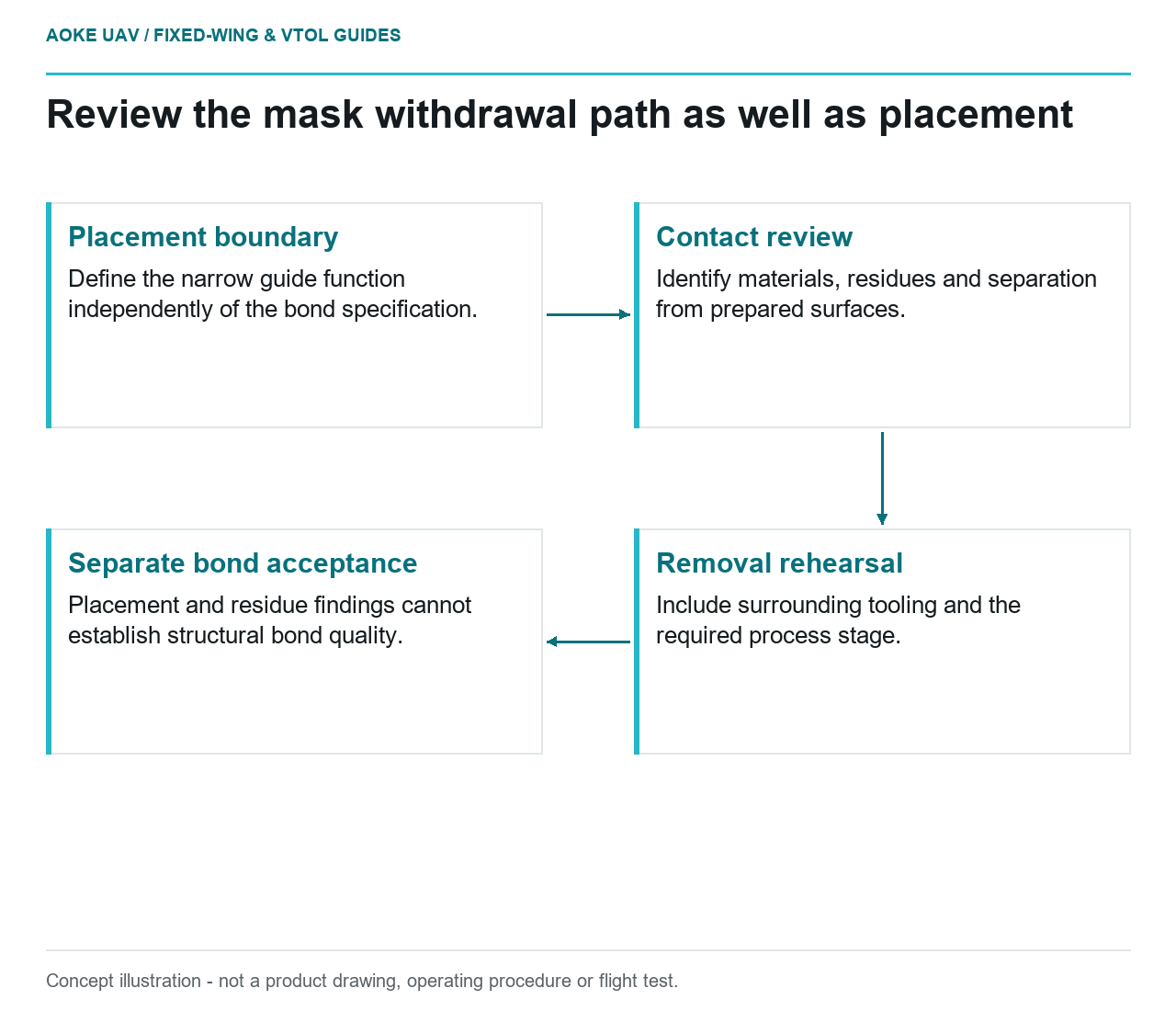
- Placement boundary: Define the narrow guide function independently of the bond specification.
- Contact review: Identify materials, residues and separation from prepared surfaces.
- Removal rehearsal: Include surrounding tooling and the required process stage.
- Separate bond acceptance: Placement and residue findings cannot establish structural bond quality.
A neat adhesive outline is not evidence of a sound structural bond. In this hypothetical civil fixed-wing manufacturing review, a printed mask is proposed near a prepared bonding surface on a large survey-aircraft assembly. Its intended job is to guide placement and protect a defined neighboring region. The engineering question is whether that convenience can be demonstrated without introducing unreviewed contact, residue or an inaccessible removal step.
Define the mask’s narrow function
Formlabs describes printed aids for assembly and alignment, while FAA composite guidance addresses adhesive application as one element of controlled structural bonding. Neither source qualifies this proposed mask for contact with a particular adhesive or laminate. [2] [3]
Write a function statement before modeling the mask: which boundary does it indicate, which surface does it touch and when is it removed? Keep that statement distinct from the bond specification. The mask cannot define an unapproved joint width, compensate for missing application instructions or establish adhesive quantity merely because its cavity can be filled.
For our large fixed-wing assembly, compare a contacting mask with a noncontact placement reference. A stand-off guide may avoid one contact question while creating another access or alignment question. Evaluate the actual alternatives against the intended task rather than assuming the more elaborate printed object is the better manufacturing aid.
Control material contact and cleanliness
FAA guidance highlights controlled surface preparation and subsequent handling before assembly and cure, including contamination exposure. This is relevant process context, not UAV certification. [3] Our proposed assessment would identify every material that could touch the prepared surface, including coatings, cleaning residues and any liner used with the print.
Require compatibility evidence for the actual proposed combination and exposure. A printer resin being fully processed does not, in this review, settle whether it is acceptable at this bond interface. Conversely, a mask that never touches the bond region needs a credible method to maintain that separation during use. Document the difference instead of leaving contact assumptions implicit.
Define storage and handling for the mask after acceptance. If an operator must lubricate a moving feature or clean a difficult recess, review whether that action changes the contamination controls. Do not invent a solvent recommendation from generic printing guidance. The governing bond process and the mask material instructions must be reconciled by the responsible team.
Demonstrate removal before cure
In the hypothetical trial, rehearse the complete sequence with a representative nonflight assembly before introducing structural adhesive. Include adjacent tooling, access restrictions and the direction of removal. The important question is not whether the mask can be lifted off an empty flat coupon, but whether the proposed assembly permits the intended action at the required process stage.
Plan what happens if the mask cannot be removed normally. Define a stop and disposition route instead of allowing improvised scraping or cutting beside a controlled surface. If a design feature risks leaving fragments behind, redesign it or obtain a defensible inspection and recovery method before continuing.
Review the removal path as well as the final position. A guide can clear the seam while parked yet cross a prepared surface during withdrawal. Make that path visible in the work instruction and trial record. Where visibility is restricted, identify how the operator will know the mask has cleared without making unintended contact.
Record placement separately from bond acceptance
Our suggested mask record would cover identity, location, contact condition, removal and residue findings. The separate bond record must retain the actual adhesive application and other required process checks. A photograph of a clean-looking boundary is not offered as a replacement for those records or for application-specific acceptance inspection.
For the fixed-wing assembly, define a clear decision: accept this mask for its documented limited purpose, revise it, or reject it because an important contact or removal question remains unresolved. This explainer supplies a review framework, not chemical compatibility results, structural allowables or proof that any resulting wing bond is fit for service.