Concept illustration
Read diagram notes
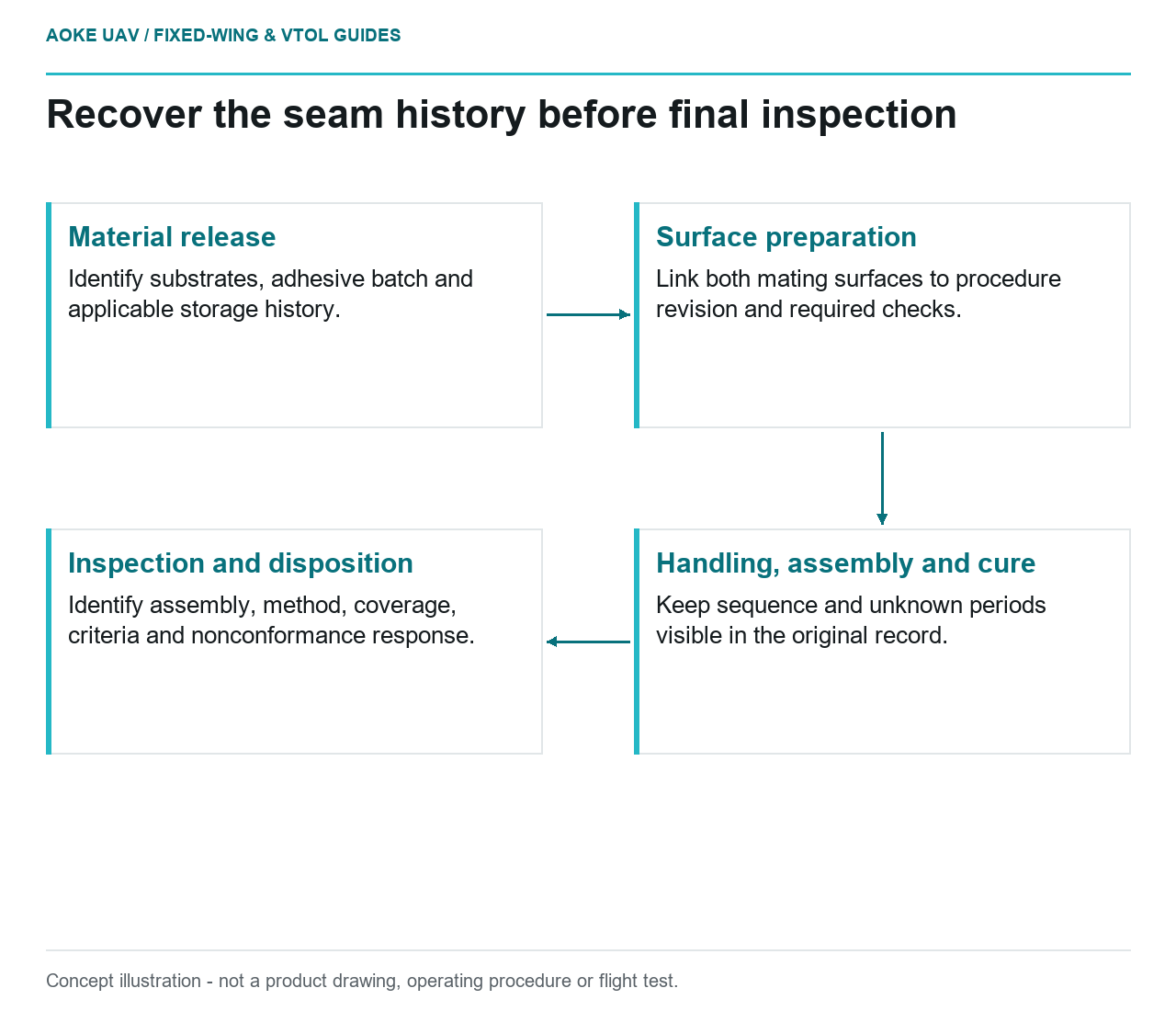
- Material release: Identify substrates, adhesive batch and applicable storage history.
- Surface preparation: Link both mating surfaces to procedure revision and required checks.
- Handling, assembly and cure: Keep sequence and unknown periods visible in the original record.
- Inspection and disposition: Identify assembly, method, coverage, criteria and nonconformance response.
An adhesive brand identifies a purchased material, not the history of a structural joint. Imagine a hypothetical long seam joining two assemblies in a large fixed-wing civil survey airframe. A buyer is offered an adhesive data sheet and photographs of the finished seam. This original review scenario asks what additional records would make the bond evidence traceable. It does not describe GAUTEN production or supply a surface-preparation recipe.
Surface condition before bonding
FAA composite guidance treats substrate preparation and the handling that follows it as controlled parts of a qualified bonding process. It discusses preparation of previously cured composite and metal interfaces and emphasizes exposure to contamination and the environment before assembly. A final photograph cannot reconstruct those intermediate conditions. The document concerns certificated composite aircraft, providing context rather than proof of this UAV seam. [1]
For the hypothetical fixed-wing assembly, request the applicable substrate definition, preparation procedure revision, process sequence, and inspection points. Ask whether the records identify both mating surfaces and the actual assembly to which they belong. Where a surface was reworked or prepared again, request the deviation and disposition record. Avoid prescribing a solvent, abrasive, waiting period, or universal visual standard without the governing process specification.
Material batches and storage history
Ask for the adhesive identity and batch together with the substrate material identities and the history required by the applicable specifications. FAA guidance includes material storage and handling among bonding process controls. [1] This makes the adhesive certificate one link in the chain, not the entire chain. For the scenario, request how storage excursions or uncertain material identity would be recorded and resolved.
NASA’s JSC sandwich assembly specification offers a concrete documentation example: it links material requirements to drawings or models, addresses shelf life and cumulative out-time, and calls for traceable storage records for materials with temperature limits. Its requirements apply within its stated JSC process context when invoked; they are not a generic UAV bonding recipe. [2] The transferable review question is whether the offered records actually demonstrate the controls required for this fixed-wing seam.
Process sequence and environment
Build the proposed seam history in order: material release, surface preparation, subsequent handling, assembly, cure, and required inspections. Ask which steps required independent checks and how the record shows those checks occurred before the work advanced. Keep unknown periods explicit. A polished summary created afterward should not erase gaps in the original production record.
FAA guidance connects bond quality to controls on application, dimensional fit, pressure, bondline thickness, thermal management, and trained personnel. [1] NASA’s JSC specification separately illustrates written process instructions, contamination controls, and verification records. [2] Neither source establishes values for the hypothetical seam. Ask the supplier to identify the applicable process limits and demonstrate conformance rather than adopting limits from either contextual document by analogy.
Inspection evidence linked to the actual assembly
Inspection evidence needs an assembly identity, a method, coverage, and acceptance criteria that actually apply to the bond being discussed. FAA guidance warns that end-item inspection does not eliminate the need for rigorous bonding process control, particularly for weak bonds. [1] Accordingly, a clean final scan should not be presented as a complete substitute for missing preparation or cure records.
For the large fixed-wing buyer’s review, request the seam drawing revision, serialised assembly identity, traveler or equivalent record, inspection report, and dispositions of nonconformances. NASA’s JSC example distinguishes process verification from separately specified nondestructive evaluation and requires traceable mandatory-inspection records for its Level 1 process. [2] Use that distinction to ask what each offered document proves. Do not treat a process certificate as structural substantiation or assume a scan covers a bond region that the report does not identify.
Decision boundary
The credible evidence package connects the actual substrates and adhesive to controlled preparation, processing, inspection, and disposition. It does not rest on brand reputation alone. Without applicable seam design and process data, no bond strength or service-life conclusion follows. The practical fixed-wing purchasing outcome is a list of verified records and unresolved gaps, not an invented production endorsement.