Concept illustration
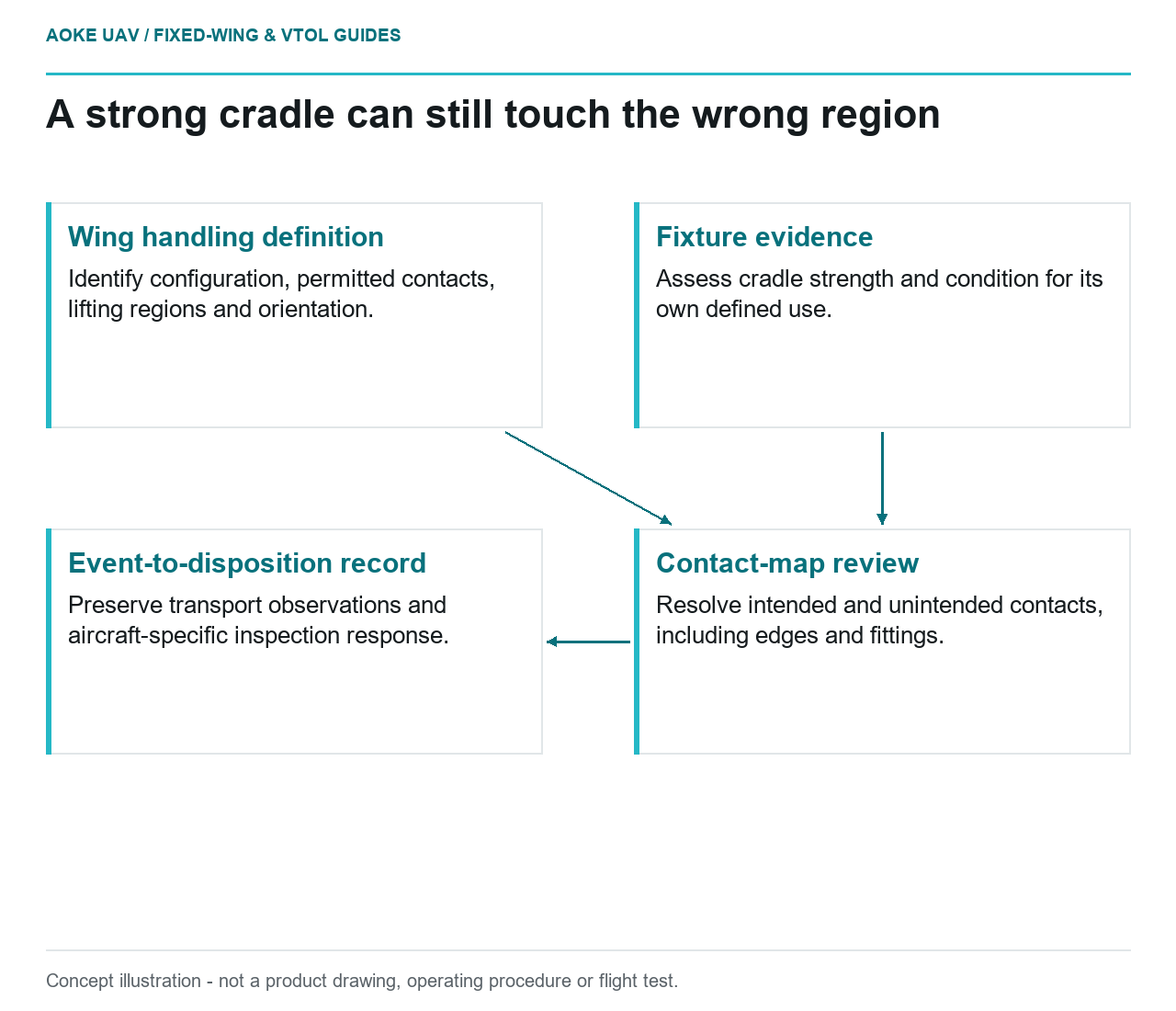
Read diagram notes
- Wing handling definition: Identify configuration, permitted contacts, lifting regions and orientation.
- Fixture evidence: Assess cradle strength and condition for its own defined use.
- Contact-map review: Resolve intended and unintended contacts, including edges and fittings.
- Event-to-disposition record: Preserve transport observations and aircraft-specific inspection response.
A detached multi-meter wing is not simply a long object that needs two padded stands. In a hypothetical large fixed-wing mapping program, the team wants to move a wing from its transport case to an assembly bench without creating an undocumented handling condition. The question is where the airframe may be supported, not whether a particular stand looks robust. This discussion separates aircraft handling evidence from fixture manufacture and avoids inventing support spacing, lifting loads or acceptable contact pressures.
Spanwise support location and local pressure
Begin with the wing identity, installed fittings and actual handling configuration. Ask whether the supplier’s instructions distinguish an empty panel from one carrying actuators, wiring or detachable tips. Request a marked drawing of permitted support and lifting regions, together with restrictions on orientation and assembly state. These details should be supplied for the wing, not inferred from its overall span.
FAA composite guidance places cured-part handling procedures within manufacturing control and expects maintenance documentation to include handling and disassembly. Its scope is US certificated aircraft, not this industrial UAV, but it provides a useful reason to request explicit instructions rather than derive them from photographs. [1] A broad pad is not independent substantiation of an otherwise unapproved support location.
Skin sensitivity around edges
In the hypothetical workshop, compare two proposed arrangements: a cradle contacting designated reinforced regions and a bench whose padding touches an unverified skin area. The review should ask the designer to trace the reactions associated with each arrangement. Do not decide acceptability by softness alone. Record where contact begins and ends, including unintended contact after the panel settles.
Edges, control surfaces and exposed fittings deserve their own entries on the contact map. Ask whether any restraint can bear on them while lifting or turning the wing. FAA structural guidance treats joints, holes and local design details as configuration-specific features requiring substantiation; it does not establish a generic safe region on a composite skin. [1] The fixed-wing team’s task is to resolve those locations before accepting a support layout.
Documented lifting and handling points
A handling package should identify the instruction revision, permitted equipment interfaces and how the crew recognizes the intended support region. Ask what happens when labels are hidden by a protective sleeve or when left and right panels differ. Where instructions require multiple people or special equipment, those requirements must come from the applicable aircraft documentation, not this article.
For this illustrative review, include a drawing comparison before choosing the fixture. A well-documented printed cradle might still contact the wrong part of the airframe. Conversely, an acceptable airframe interface does not verify the cradle’s strength or condition. Keep those two evidence decisions separate so that fixture approval cannot silently become an aircraft handling limit.
Receiving inspection after transport
At receipt, preserve the shipment configuration and note displaced padding, loose restraints, unusual contact, drops or other reported events. Ask the airframe supplier for the applicable inspection response. A photograph can document an event or visible mark, but it should not be used to certify that hidden structure remains unaffected.
The FAA distinguishes initial visual detection from the further inspection needed to characterize composite damage. Its maintenance discussion also calls for documented methods and training appropriate to the structural detail. [1] For a large fixed-wing operator, the useful output is an event-to-disposition record tied to the wing serial number. It is not a new field inspection technique or a promise that an unmarked wing is undamaged. Leave any unresolved handling event visible in the assembly handoff rather than erasing it when the wing reaches the bench.