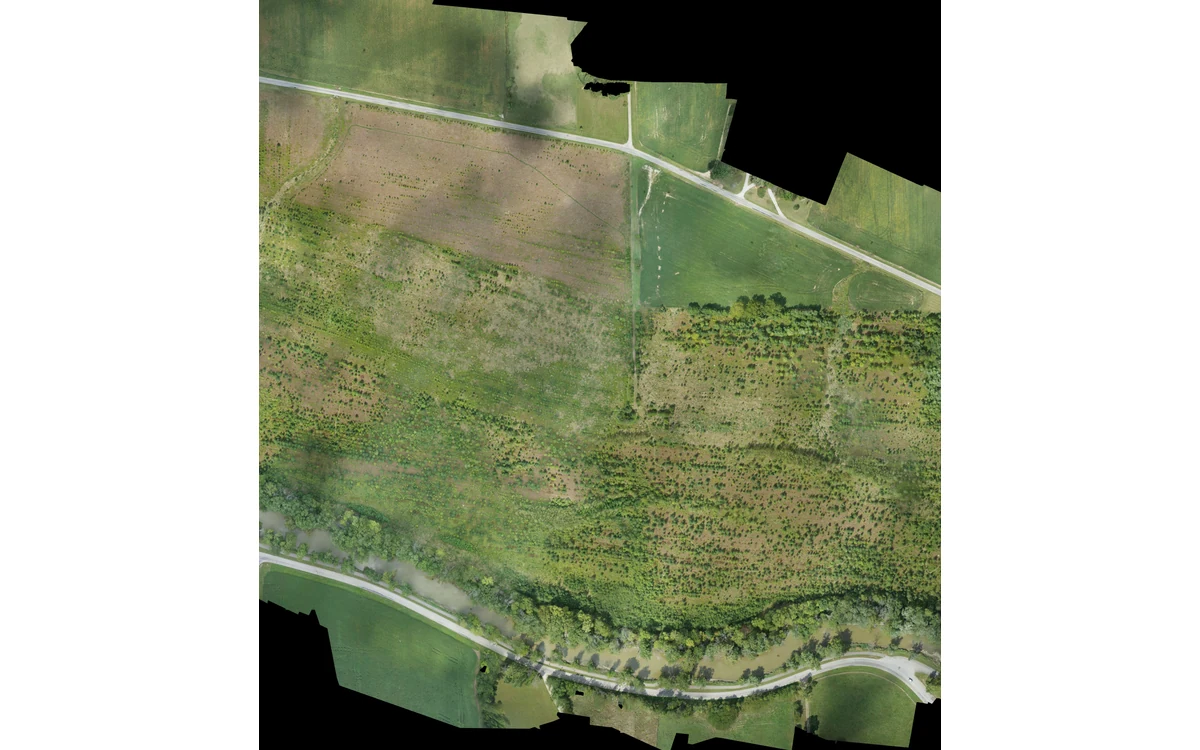
A visible seam is a review clue, not a diagnosis; an invisible seam is not an accuracy certificate. In a hypothetical large fixed-wing survey, a civil client notices a tonal boundary across a paved area and a displaced edge near a structure. The reviewer needs to distinguish appearance, geometry and actual scene differences before deciding what correction is justified.
Radiometric variation across strips
USGS imagery guidance distinguishes digital numbers from calibrated radiometric quantities and discusses camera corrections, illumination and viewing geometry. It recommends retaining acquisition context and the calibration method. These principles support inspecting what produced a tonal change rather than assuming that every difference is a geometric defect. [6]
For the hypothetical fixed-wing mosaic, the analyst would identify the contributing images on either side of the seam. Their original appearance, settings, acquisition times and calibration records would be compared. The record would separate corrections intended to support quantitative reflectance from operations intended only to improve visual consistency.
A color-balanced output could be useful for presentation while remaining unsuitable for an unstated quantitative comparison. The reviewer would therefore ask what the client intends to measure and which version of the raster supports that use. The report would not let an attractive display stand in for the underlying radiometric evidence.
Geometric misalignment and moving objects
USGS describes geometric calibration through camera parameters, orientation, tie points and control evidence. It emphasizes stable tie points rather than features that may move. That framework supports treating a displaced edge as a question about both correspondence and geometry, not automatically as a software seamline problem. [6]
In the example, a fixed pavement marking would be reviewed differently from an object whose position may differ between images. The reviewer would inspect the original observations to determine whether the apparent mismatch concerns the same stable physical feature. If the evidence is ambiguous, the cause would remain unresolved.
The review would also distinguish the coordinate quality of the product from a local visual artifact. A smooth patch elsewhere would not clear the suspect area. Equally, a visible brightness join would not alone prove that a geometric measurement is wrong. Those claims require their own evidence.
Seamline editing versus raw evidence
The proposed editing workflow would keep the original mosaic, source images and an edit record. Each corrective operation would identify its location and purpose. Selecting another source image might improve appearance, but the analyst would still need to show whether the measurement concern was addressed or only hidden from the display.
For a large fixed-wing project, the record would connect edited areas to acquisition strips and processing versions. If the product is regenerated, the team would be able to identify which decisions were reapplied and which require new review. An undocumented manual repair would weaken that traceability even if the image looks cleaner.
USGS recommends documenting processing schemes and calibration information in metadata. Applying that principle here means preserving the distinction between the evidence archive and a presentation derivative. It does not establish a universal seam-editing algorithm or acceptable displacement threshold. [6]
Report corrected and unresolved areas
The hypothetical handover would classify findings by what is known: appearance-only change, supported geometric correction, actual scene difference or unresolved anomaly. Each classification would have source-image links and a stated review basis. The acceptance decision would then follow the intended deliverable and agreed project method.
USGS cautions that smaller GSD does not directly establish geometric accuracy. Neither dense pixels nor visual smoothness can replace independent quality evidence where the civil measurement requires it. [6] If a seam affects a critical feature and available observations cannot resolve the concern, the report would say so.
The goal is not to remove every visible join at any cost. It is to make the delivered image fit for its declared purpose while keeping the supporting observations and remaining limitations accessible to the next reviewer.
Related reading
Sources
Visual summary
Concept illustration
Read diagram notes
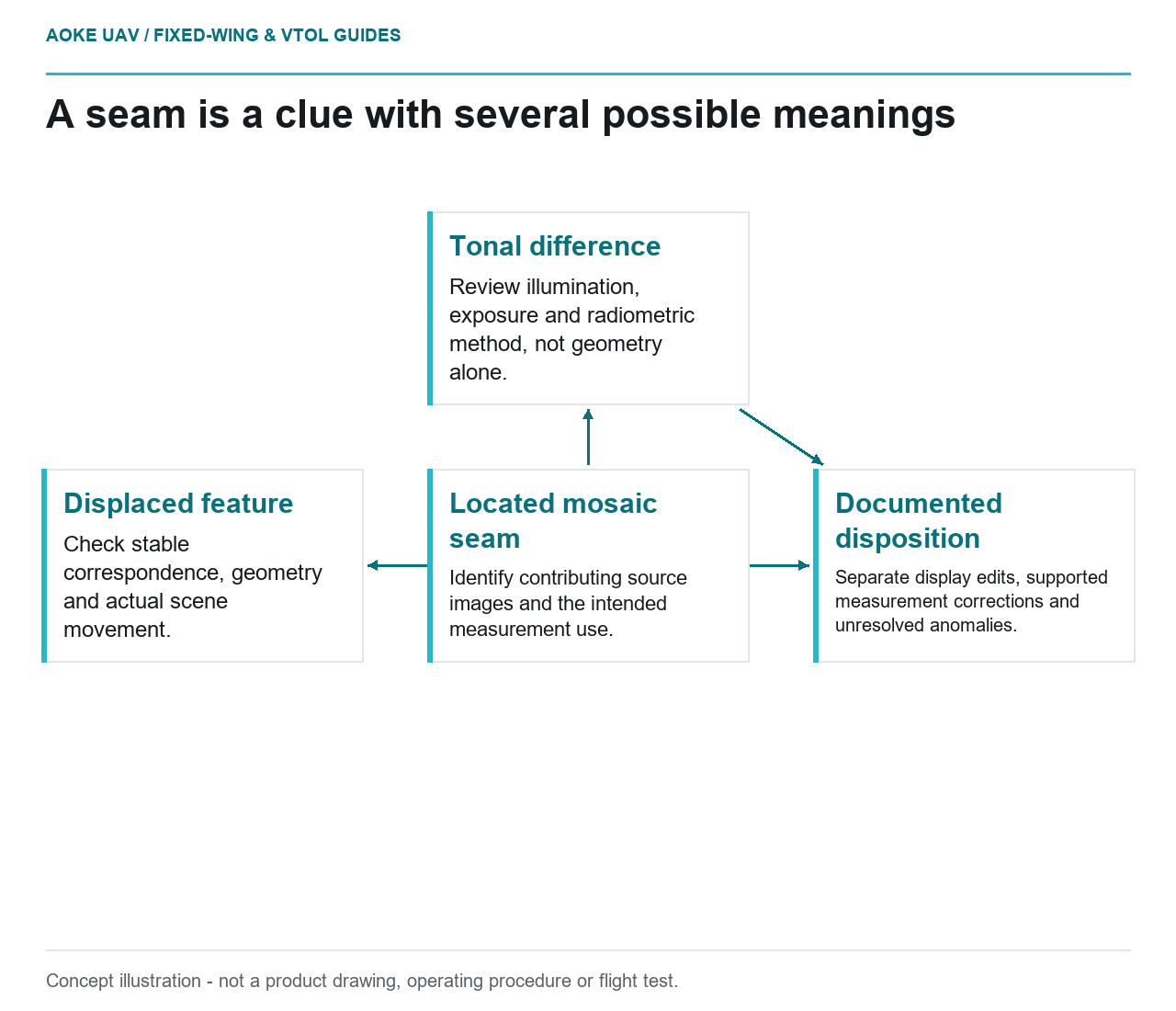
- Located mosaic seam: Identify contributing source images and the intended measurement use.
- Tonal difference: Review illumination, exposure and radiometric method, not geometry alone.
- Displaced feature: Check stable correspondence, geometry and actual scene movement.
- Documented disposition: Separate display edits, supported measurement corrections and unresolved anomalies.