Concept illustration
Read diagram notes
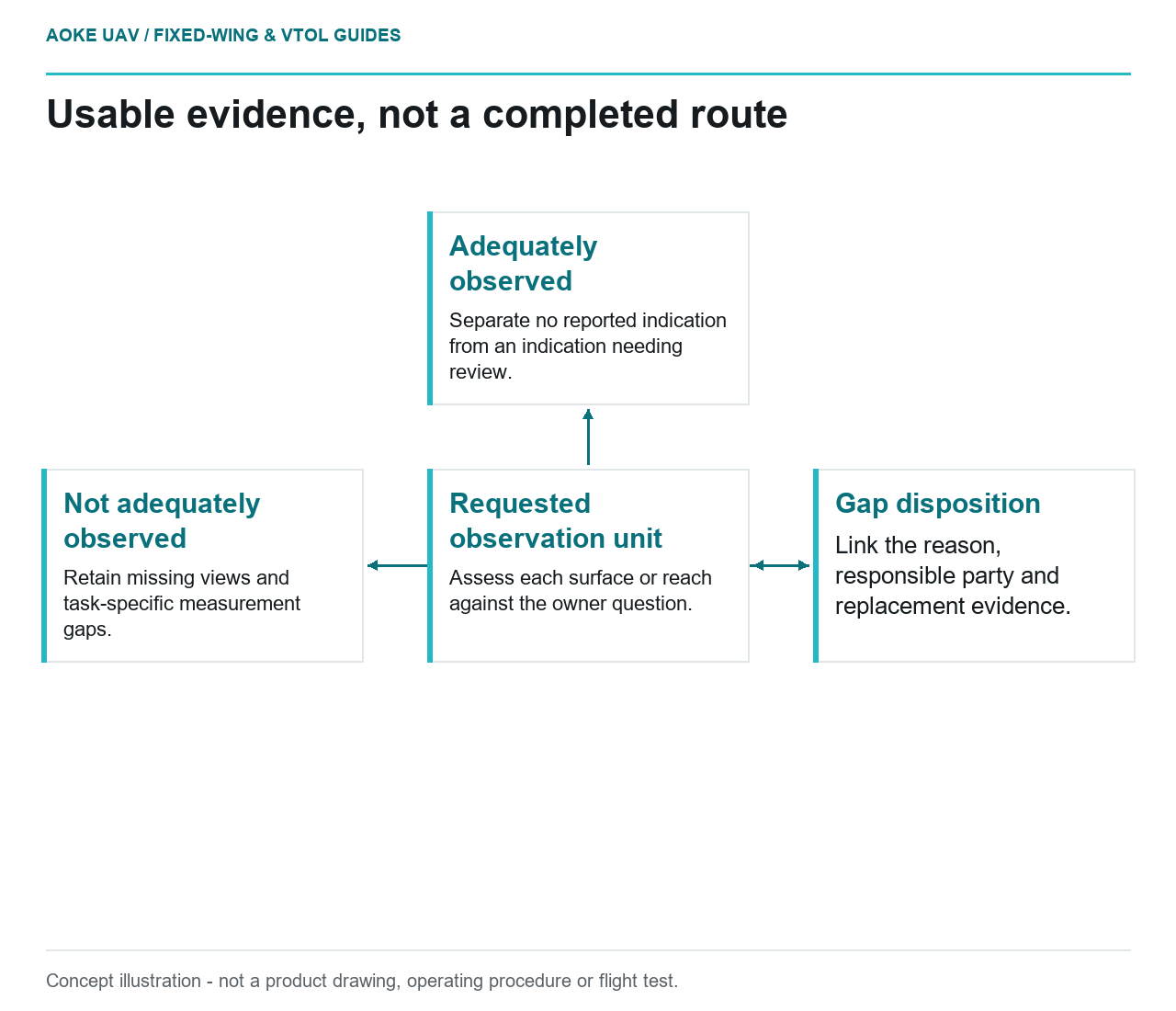
- Requested observation unit: Assess each surface or reach against the owner question.
- Adequately observed: Separate no reported indication from an indication needing review.
- Not adequately observed: Retain missing views and task-specific measurement gaps.
- Gap disposition: Link the reason, responsible party and replacement evidence.
Planned coverage is not the delivered observation
Consider a hypothetical large industrial fixed-wing mission along a civil transport corridor. The route log shows the aircraft traversed the whole assignment, but a shaded cutting and a partly hidden service structure do not yield usable views for the requested observations. The client needs to distinguish completed flight activity from usable inspection evidence. This is an illustrative reporting problem, not an GAUTEN mission result or a finding about any real corridor.
Define coverage against the requested observation unit: an asset, a surface, a reach or another owner-agreed item. A route line or camera footprint can document planned collection context, but the proposed report should separately identify whether the target evidence is actually usable. Keep these layers distinct rather than coloring every asset beneath the flight path as inspected.
Give each gap a reason tied to evidence
In the scenario, classify the cutting as lacking an adequate view of the requested surface, and identify the hidden structure face separately. Other categories might cover missing files or a failed measurement product, but assign a category only when the actual delivery supports it. Preserve unknown causes as unknown instead of retrospectively inventing a camera fault or environmental explanation.
USGS imagery guidance links data quality to acquisition configuration, calibration and verification, and discusses metadata as a way to judge whether a dataset is suitable for a particular application. It does not provide an asset-specific usable-view threshold; the owner must define the evidence required for each task. [1]
For each proposed gap record, attach the relevant original frames or file-inventory evidence, the affected observation unit and the reason the material does not answer the question. If a mosaic contains a visually filled region, establish whether it represents actual usable measurements or a processing assumption. A continuous display should not erase a documented absence of observation.
Keep unobserved separate from no finding
Use separate states for adequately observed with no reported indication, observed with an indication requiring review, and not adequately observed. These are proposed workflow states rather than a diagnostic classification standard. The report must explain their meanings so a receiving system does not convert an empty finding field into a positive statement about asset condition.
In this fixed-wing example, the service structure can have an observed exterior roof and an unobserved side face. Do not force the whole asset into one all-or-nothing status if that would conceal the missing surface. Let the owner see which question each image answers and which parts still require evidence. The lack of an observation should never be worded as proof that no defect exists.
USGS also distinguishes image sampling from geometric accuracy. Apply that distinction when a region has usable appearance imagery but insufficient evidence for a requested dimension or coordinate. The gap concerns the measurement task, not necessarily the existence of the image. Keep both facts in the record rather than deleting useful context or overstating its quality. [1]
Assign a disposition that addresses the actual limitation
For the hypothetical cutting, request owner review of whether another acquisition geometry could supply the missing view within the actual platform’s documented constraints. For the concealed structure face, ask whether a different method is appropriate. Do not automatically prescribe another fixed-wing pass if the required evidence is incompatible with the selected collection approach. No route change or alternative platform is authorized by this reporting exercise.
Give each gap a disposition, responsible party where known and completion evidence requirement. Keep pending items pending until the new evidence has been reviewed. Link a later replacement observation to the earlier gap rather than removing the history of incomplete coverage. This makes repeated monitoring reports auditable without implying that the first delivery was complete.
The handover should include a gap map and an explicit list of unresolved observation units. A clear statement of incomplete evidence is a useful operational planning input for the civil owner. It is more defensible than a blanket coverage percentage that hides the asset surface the client most needed to assess.