Concept illustration
Read diagram notes
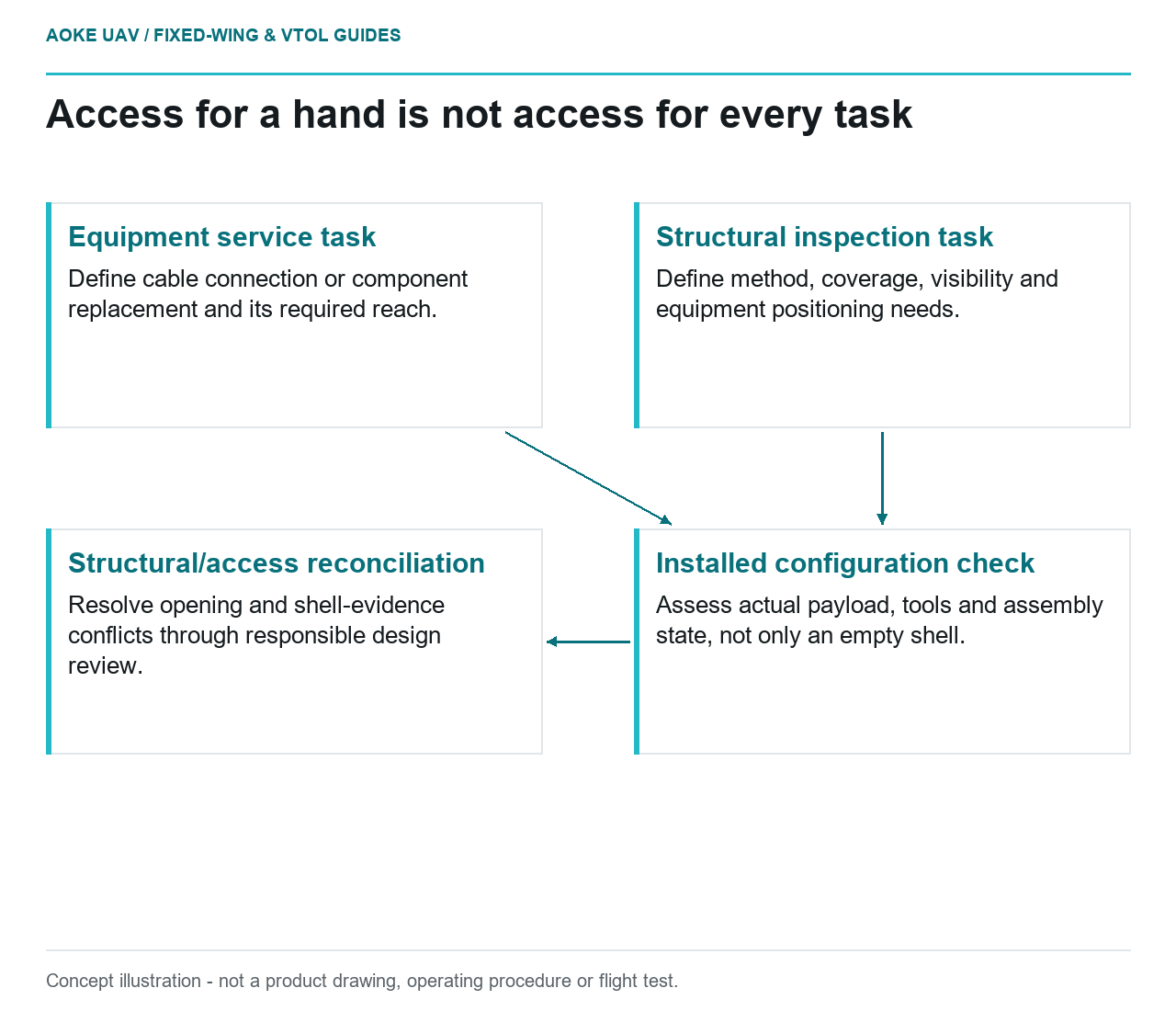
- Equipment service task: Define cable connection or component replacement and its required reach.
- Structural inspection task: Define method, coverage, visibility and equipment positioning needs.
- Installed configuration check: Assess actual payload, tools and assembly state, not only an empty shell.
- Structural/access reconciliation: Resolve opening and shell-evidence conflicts through responsible design review.
A hypothetical large fixed-wing inspection aircraft places a connector and bonded attachment behind a composite fuselage skin. The proposed service panel lets a hand reach the connector, but no one has explained how the nearby structural interface will be inspected. The design-review question is maintainability across defined tasks, not simply whether a cover can be removed. This article develops an access review and does not authorize a larger opening, a new hatch location or a field inspection method for an unidentified airframe.
Access needed by inspection methods
List the documented tasks associated with the enclosed equipment and structure. For each task, ask what must be visible or reachable and which instruction defines the method. Distinguish connecting a cable, replacing a component and inspecting the supporting structure; a panel adequate for one task may leave another unresolved in the proposed design.
FAA composite guidance explicitly calls for inspection and repair access in a field maintenance environment and recognizes the documentation and training needed for difficult damage types. [1] Its scope is US certificated aircraft, not an access-panel approval for this fixed-wing UAV. Use the principle to request task-to-access evidence. An opening shown on the exterior drawing does not explain whether the method’s required coverage can actually be achieved with the installed payload present.
Openings versus shell continuity
Ask the airframe authority to identify how the proposed opening relates to the shell’s structural definition. Request the drawing revision and the substantiation applicable to the actual opening and attachment region. Do not assume that adding access is automatically a harmless maintainability improvement. The review must reconcile access needs with the assessed structure rather than choose one and ignore the other.
FAA guidance treats cut-outs and joints as discontinuities addressed through representative structural evidence. [1] For the large industrial fixed-wing scenario, a useful review outcome is a controlled drawing that both structural and maintenance reviewers recognize. If a task needs more access than the proposed panel offers, return the conflict for design disposition. Do not enlarge the panel or remove nearby structure based on this article or an informal demonstration.
Human access and tool clearance
For the hypothetical review, ask for a demonstration or documented assessment using the specified tools, installed equipment and relevant assembly state. Record what configuration was represented. A successful reach into an empty fuselage does not settle the question for a populated payload bay, and a removed bench assembly does not necessarily represent access on the complete aircraft.
Keep human access and inspection capability separate. Reaching a fastener does not establish visibility of the adjacent bond, and seeing a surface does not establish that a prescribed inspection method can cover it. FAA maintenance guidance distinguishes damage detection from the additional procedures that may be needed for characterization. [1] Ask which access requirements those methods impose on the actual fixed-wing installation. Do not improvise a different inspection technique to fit an inconvenient opening.
Maintainable joints over service life
Review repeated removal and reinstallation as part of the panel’s documented maintenance concept. Ask how hardware identity, attachment condition and replacement history are recorded. Identify which surrounding structural features remain accessible after reassembly and which findings require a supplier disposition. This is a planning request, not a fastener reuse policy or a specified inspection interval.
FAA guidance includes aircraft-specific disassembly and handling information and calls for maintenance records associated with repairs to the particular part. [1] For this hypothetical large fixed-wing operator, the final access matrix should connect tasks, configuration, instructions and unresolved constraints. Keep that matrix current when equipment moves or panel details change. A maintainable layout is supported by demonstrated applicability to the required tasks, not by the number of panels on the fuselage or a promise that technicians will find a way.