Concept illustration
Read diagram notes
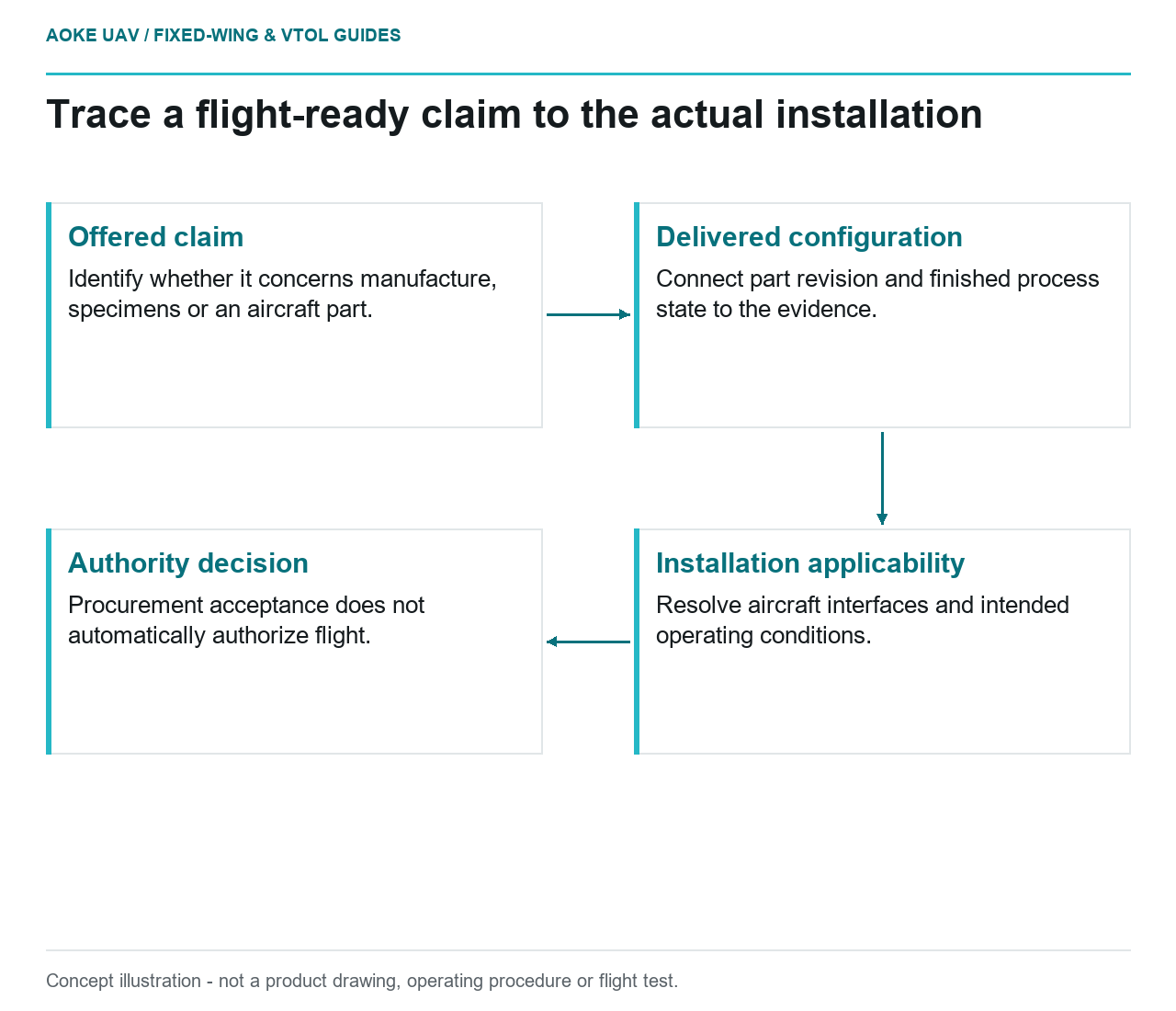
- Offered claim: Identify whether it concerns manufacture, specimens or an aircraft part.
- Delivered configuration: Connect part revision and finished process state to the evidence.
- Installation applicability: Resolve aircraft interfaces and intended operating conditions.
- Authority decision: Procurement acceptance does not automatically authorize flight.
A supplier describes an additively manufactured part as flight-ready and cites a spaceflight standard. For a buyer integrating a large civil fixed-wing aircraft, that is the beginning of a question, not its answer. This hypothetical procurement screen asks what the claim covers, which configuration the evidence represents, and who can determine its applicability. It does not qualify a printed component or provide a shortcut around aircraft engineering review.
Exact part function and failure consequence
Request the precise part identity, revision, material, proposed installation, and intended function. Ask what the claim means: demonstrated manufacture, specimen properties, component verification, or release for an identified aircraft configuration. Those are different statements. A supplier should be able to define its terms without relying on a photograph of another application or a broad assertion that the material is aerospace grade.
NASA-STD-6030 explicitly concerns AM processes for space program flight hardware and related spaceflight applications. Its part-specific information includes purpose in the system, operational environments, manufacturing process, and qualification planning. [5] That context supports asking for a defined part and use, but it supplies no classification or approval for an unidentified UAV component purchased under a marketing description.
Controlled process and material definition
Ask which feedstock, machine/process definition, build identity, and post-processing state produced the article covered by the evidence. Request traceability sufficient for the responsible reviewer to connect the delivered component with that definition. A material family name and a generic strength chart cannot establish that the supplied part was made using the conditions represented by the supporting data.
NASA separates feedstock specifications, build controls, and post-AM processing in its material-process framework and places the resulting process under configuration management. [5] Use that organization to structure procurement questions, not to imply that possessing some of those records proves compliance with the whole standard. If the supplier claims compliance, request its specific basis, scope, exceptions, and responsible assessment rather than paraphrasing the claim as verified.
Part and assembly verification
Distinguish evidence about material specimens from evidence about the supplied geometry and its aircraft interfaces. Ask the design authority what analyses, representative features, environmental evaluations, and installation-level checks are necessary for the component’s actual function. This article provides no test recipe, structural allowable, vibration limit, or acceptance threshold. A buyer’s checklist cannot replace a configuration-specific substantiation plan.
For this fixed-wing procurement screen, organize each document by the claim it supports and the configuration it actually covers. Identify whether attachments, inserted hardware, manufacturing changes, or installation conditions differ from the reviewed article. NASA’s framework treats part-production establishment and modification as controlled decisions. [5] That is an example of disciplined evidence management, not proof that the offered aircraft assembly has completed an equivalent review.
Approval claims and applicability limits
Ask who issued any approval, what document records it, which part and process revisions it covers, and which aircraft application it authorizes. Treat unsupported endurance, strength, or service-life statements as unresolved claims rather than repeat them in a purchasing justification. A real standard title can be accurately quoted while the seller’s implied application remains unsupported. Keep those two issues distinct.
The useful outcome for a large fixed-wing buyer is a documented evidence gap list or an appropriately bounded package ready for the responsible engineering authority. Procurement acceptance, manufacturing records, and aircraft release are separate decisions. If the supplied evidence remains insufficient, hold the relevant claim open. No reference to NASA, no successful print, and no attractive specimen result automatically makes a part suitable for flight in the proposed UAV.
Related reading
- Printed Tooling Is Not a Qualified Flight Part
- A Propulsion Supplier Evidence Checklist for Industrial UAVs