Concept illustration
Read diagram notes
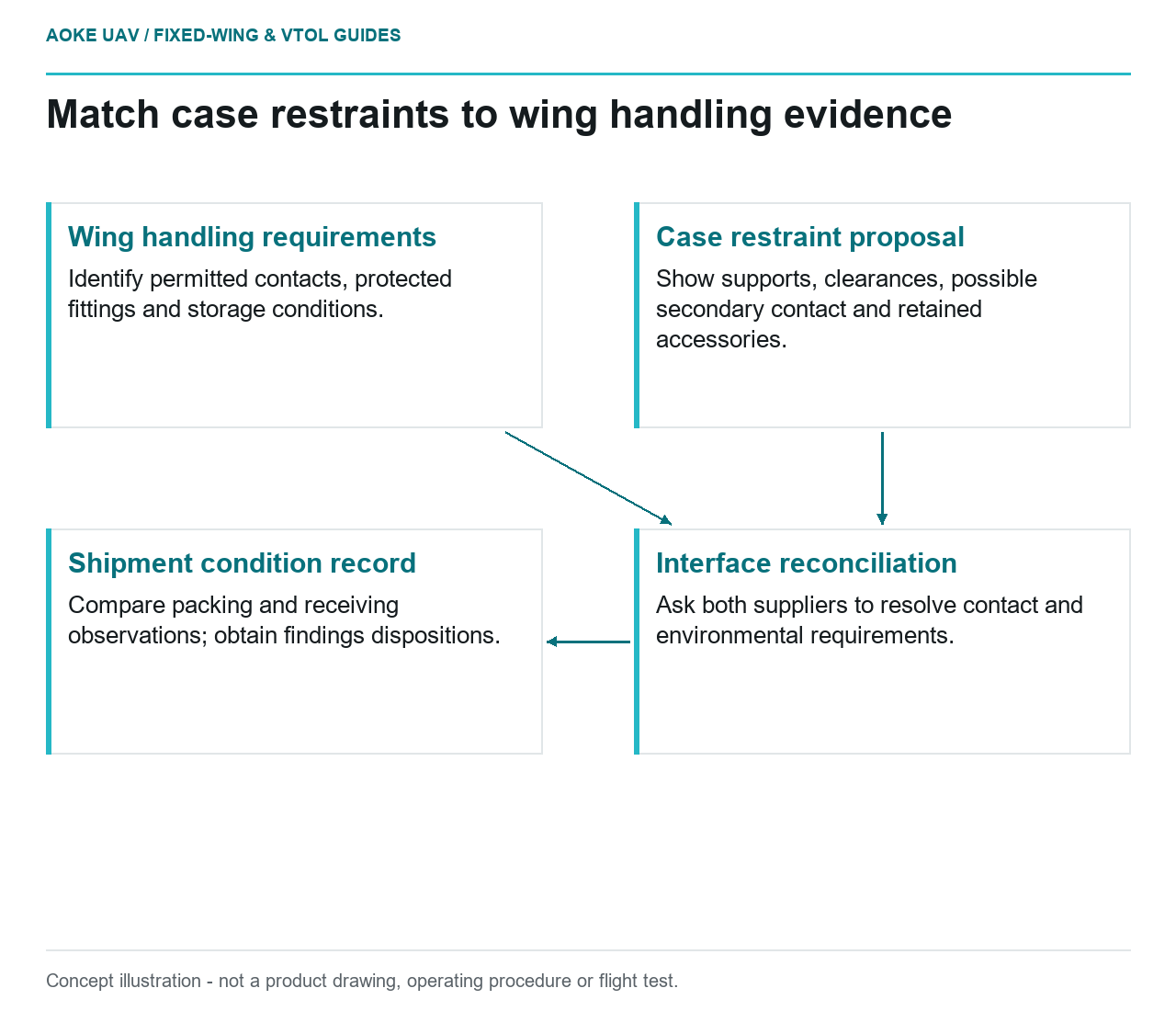
- Wing handling requirements: Identify permitted contacts, protected fittings and storage conditions.
- Case restraint proposal: Show supports, clearances, possible secondary contact and retained accessories.
- Interface reconciliation: Ask both suppliers to resolve contact and environmental requirements.
- Shipment condition record: Compare packing and receiving observations; obtain findings dispositions.
For a hypothetical civil corridor-survey team, the large fixed-wing aircraft travels between sites with its wing panels detached. The transport case is proposed as protection for a valuable composite assembly. A procurement review should ask what the case restrains, where it contacts the wing and how the shipment will be inspected. An attractive exterior and clean foam inserts do not establish the aircraft’s transport tolerance. The goal here is a case-to-airframe interface record, not a packaging certification or a case design recipe.
Restraints and load paths in transit
Start with separate drawings of the wing and the closed case. Mark intended supports, restraints, lid clearances and possible secondary contact if an insert shifts. Ask the airframe authority whether each contact region agrees with its handling instructions. Ask the case supplier how its proposed restraint arrangement is verified for the declared shipment conditions. Do not let either supplier assume the other has answered both questions.
FAA composite guidance includes handling procedures among controlled activities and expects maintenance information to address disassembly and handling. This is background from US certificated-aircraft practice, not a transport standard for the hypothetical fixed-wing UAV. [1] It supports requesting applicable airframe instructions; it does not supply case acceleration ratings or acceptable restraint forces.
Protection for fittings and trailing edges
Build an inventory for alignment pins, connector brackets, wing-root faces, tip features and control-surface edges. In the proposed review, each item receives either a documented clearance or an identified protection interface. Note whether the protective feature remains in place when the case is opened vertically, carried around a corner or repacked by another crew. These are questions for verification, not assumed performance results.
Separate loose tools and hardware from the wing contact volume in the packing proposal. Ask how the packing record demonstrates that every item is retained. A case can appear correctly filled while the identity of a small accessory compartment remains ambiguous. Avoid declaring the fitting protected solely because foam surrounds the panel: the relationship between the restraint and that fitting still needs to be shown.
Humidity and contamination controls
Specify which environmental conditions the procurement review expects the case to address, and ask for evidence against those conditions. Distinguish a sealed case claim from a documented wing storage requirement. Record whether damp equipment might be packed with the structure and whether inspection access is lost after closure. Do not prescribe desiccant quantities, storage temperatures or ventilation modifications without applicable instructions.
The FAA identifies humidity, temperature and chemical exposure as considerations for composite structure and stresses material-system-specific environmental evidence. [1] For this industrial fixed-wing shipment, that means a case datasheet cannot substitute for the wing supplier’s storage and contamination limits. Ask how both sets of requirements are reconciled, including any conflict between keeping contamination out and managing moisture already inside.
Inspection before and after shipment
Use a packing record tied to the wing serial number, case configuration and instruction revision. Capture pre-shipment condition, restraint positions and the identity of protective caps. At arrival, compare the same items before discarding packaging evidence. Record unexpected movement, missing protection or wet areas as observations requiring the specified disposition, rather than immediately attributing them to structural damage.
FAA guidance notes that visual indications provide limited information about hidden composite damage and that further characterization requires appropriate procedures. [1] Accordingly, a successful receiving checklist is not proof that every internal interface survived. For the hypothetical large fixed-wing team, close the shipment review only when reported events and inspection findings have a documented response. Case acceptance and aircraft acceptance remain separate decisions, even when the packaging is reusable and the paint looks unchanged.
Related reading
- Supporting Multi-Meter Composite Wings During Handling
- Printed Transport Protectors for Exposed Wing Fittings