Concept illustration
Read diagram notes
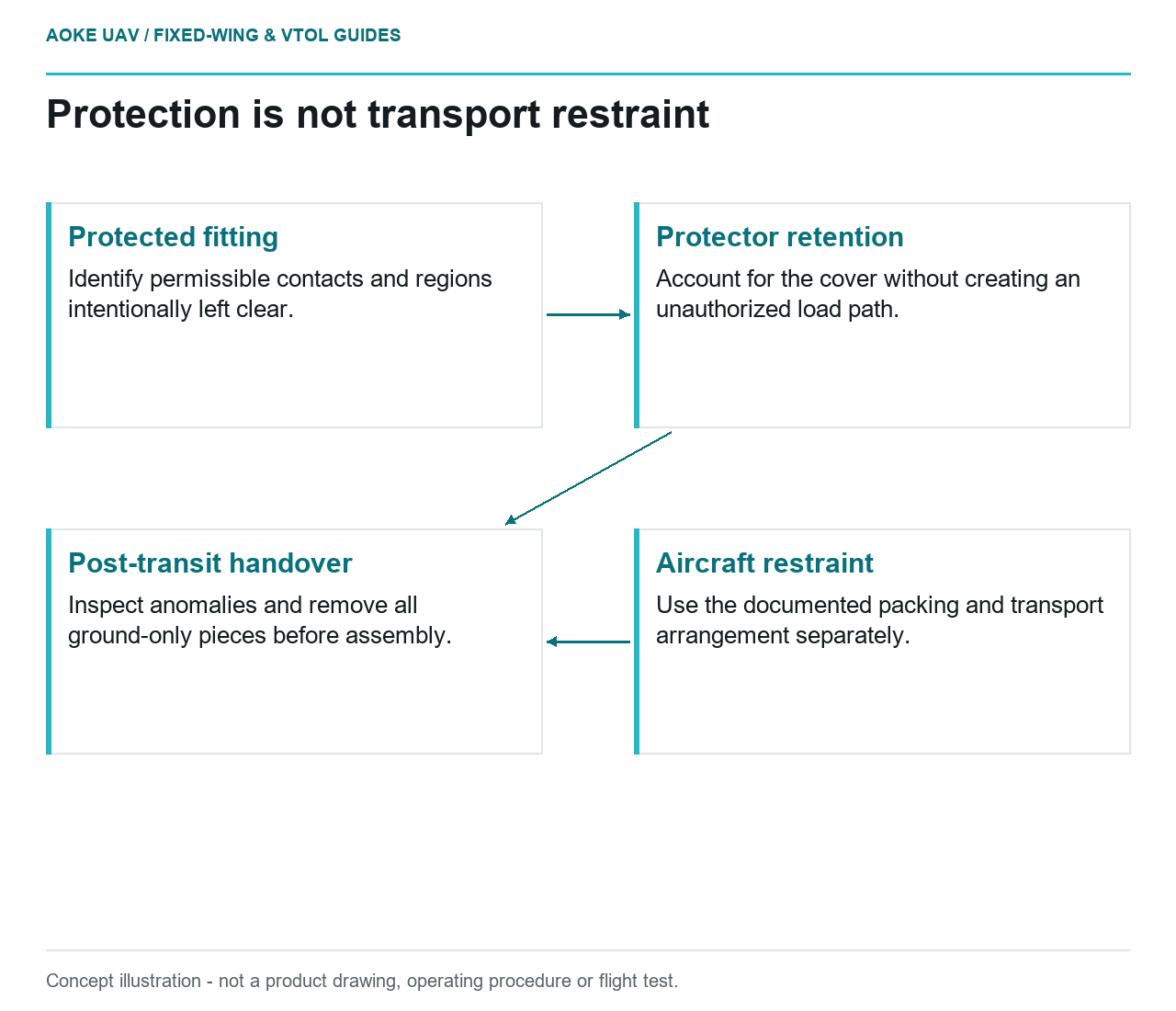
- Protected fitting: Identify permissible contacts and regions intentionally left clear.
- Protector retention: Account for the cover without creating an unauthorized load path.
- Aircraft restraint: Use the documented packing and transport arrangement separately.
- Post-transit handover: Inspect anomalies and remove all ground-only pieces before assembly.
A removable cover for a precision wing-root fitting seems like a modest printing task. The difficult question is what the cover is allowed to touch and carry. Consider a hypothetical large civil fixed-wing aircraft moved between survey sites by road. The printed protector is intended to shield exposed fittings during that journey, not to become a lifting point, tie-down anchor, or substitute for the documented transport arrangement.
Protective envelope and restraint
Define the protected surfaces and the hazards the design is intended to address before drawing a close-fitting shell. Obtain the aircraft handling and transport instructions for the actual wing configuration. If the cover requires clamping onto a fitting, ask the responsible authority to review that interface. A protective purpose does not itself establish an allowable load path or permission to preload the attachment.
Separate the protector’s retention from the aircraft’s transport restraint. In the proposed review, record how the protector remains accounted for and what prevents its installation from interfering with the documented packing arrangement. Do not infer road-shock qualification from a successful bench fit. The available source concerns manufacturing aids, not a tested shipping system or an aircraft-specific transport protection standard.
Contact with precision surfaces
Use a controlled model and identify which features locate the cover and which regions intentionally remain clear. Inspect the completed article with any liners, inserts, or fastening components installed. Formlabs recommends checking printed aids against CAD and evaluating their functional seating on locating surfaces and supports. That supports a disciplined fit review, while leaving fitting tolerances and permissible contacts to the aircraft documentation. [4]
For this fixed-wing example, a useful question is whether removing the protector requires dragging a printed surface across a precision interface. Another is whether a retention feature could mask incorrect seating. These are proposed design-review prompts, not observed defects. Ask for an approved interface solution where necessary rather than prescribe a clearance, liner hardness, or clamping force without the relevant airframe evidence.
Moisture and trapped contamination
The review should ask what enters the protector, what can remain hidden, and how its condition will be checked before use. Consider the actual workshop and transport context, including cleaning instructions and material compatibility. This article does not establish that the selected print resists any chemical, humidity exposure, or transit environment. Those claims would require data for the actual finished protector and the applicable use.
Give the team a way to inspect both protector and fitting without treating the cover as a sealed preservation system. Record whether the design includes closures, pads, or surfaces that need separate cleaning controls. Formlabs directs users to material-specific properties and processing guidance, so generic fixture advice cannot resolve all material compatibility questions for this transport accessory. [4]
Inspection before removal and assembly
A proposed handover record can identify the protected fitting, protector revision, installation condition, and any anomaly noticed after transit. Photograph relevant condition where the operating process permits it. If the protector is broken, displaced, or unexpectedly tight, separate the accessory disposition from any required aircraft inspection. Printing a replacement cover cannot establish that the underlying wing interface remained unaffected.
Before reassembly, account for the ground-only protector and any removable retention pieces under the aircraft’s applicable procedures. Close the protective-fit review only for the configuration actually inspected. For a large fixed-wing fleet, the useful outcome is a traceable accessory with a limited purpose and clear escalation route, not an unsupported promise that a printed cap makes every transport event harmless or preserves precision surfaces indefinitely.
Related reading
- Transport Cases as Part of a Composite Wing Protection Plan
- Printed Cradles for Large Composite Wings