Concept illustration
Read diagram notes
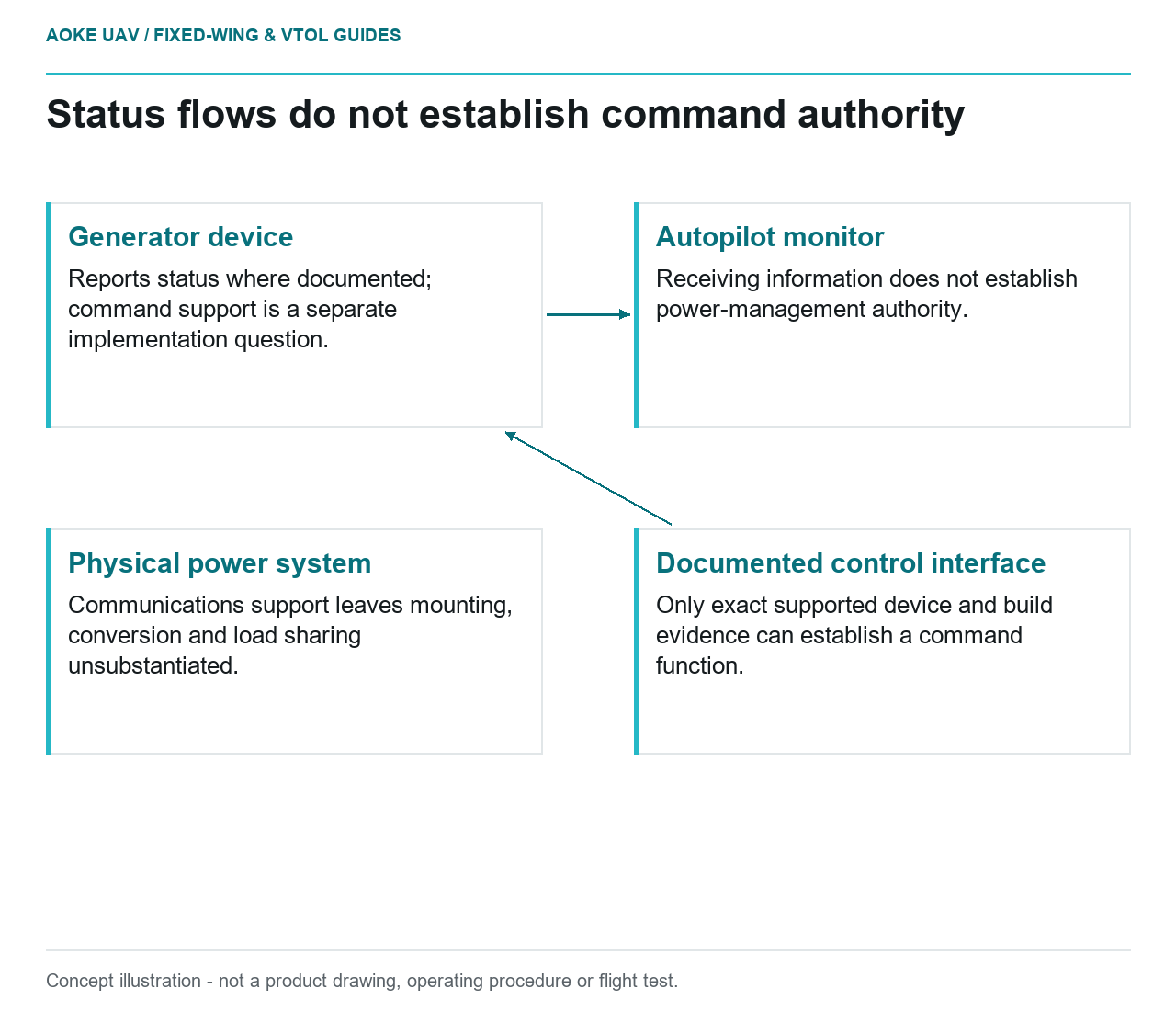
- Generator device: Reports status where documented; command support is a separate implementation question.
- Autopilot monitor: Receiving information does not establish power-management authority.
- Documented control interface: Only exact supported device and build evidence can establish a command function.
- Physical power system: Communications support leaves mounting, conversion and load sharing unsubstantiated.
A hypothetical hybrid civil fixed-wing UAV includes a generator whose name appears in an autopilot documentation list. The integration proposal treats that listing as proof that the aircraft can manage the generator. That conclusion skips several different questions: what can be observed, what can be commanded, which build includes the feature and which mechanical and electrical arrangements are supported. This article keeps those questions separate without offering generator operating instructions or an endurance estimate.
Supported control and status functions
ArduPilot’s Generators page distinguishes devices that can be controlled through ArduPilot from devices supported for telemetry only. It also notes that feature availability can depend on the firmware build and hardware resources.[1] A listing therefore needs to be read as an interface statement with conditions, not a promise that every generator exposes the same commands or that every installed autopilot includes the feature.
For the fixed-wing proposal, request a function matrix with separate columns for observed status, command capability and the primary document defining each. Identify the generator hardware revision and autopilot build to which the matrix applies. Where the overview provides no detail, mark it for the applicable device documentation. Do not fill an empty control column merely because useful telemetry fields are available.
Generator mechanical and electrical interfaces
The software overview does not establish the aircraft mount, wiring, conversion equipment or installation environment. Request the generator OEM’s installation package and the aircraft integrator’s configuration definition. Ask which source owns the requirements for each interface, rather than treating one subsystem supplier as the authority for everything connected to it. This creates a traceable division of responsibility without suggesting a universal installation arrangement.
In the hypothetical large fixed-wing airframe, record the generator location and its interfaces with structure, other equipment and the power distribution system as configuration items requiring assessment. Their adequacy cannot be inferred from a communications link. The overview source supplies no structural limits, cooling arrangement or electrical ratings for this aircraft. Those gaps should remain explicit in the integration proposal instead of being hidden behind the word supported.
Battery and load interactions
Ask how the generator subsystem interacts with stored energy and changing aircraft demand. Identify which controller owns any power-management decision and what evidence describes its behavior. A status message can reveal a reported state while leaving that decision authority elsewhere. Keep that architectural distinction visible, especially where the autopilot is only a consumer of information rather than the controller of the electrical system.
For this fixed-wing scenario, separate the evidence request from load-sharing design. The team needs actual generator and battery documentation and the substantiation for their combination. This article supplies no charge target, start command sequence or buffering rule. A software feature also cannot establish fuel consumption or mission duration; an endurance claim would need its own configuration-specific evidence and clearly stated conditions.
OEM installation data still required
An effective review record pairs each claimed function with an exact source and a defined limitation. For example, a telemetry-only integration can be described honestly as monitoring if that is what the applicable documentation establishes. It should not be renamed autonomous generator control. Where device-specific control support is documented, that still leaves the physical installation and aircraft-level consequences to their own evidence owners.
The resulting large fixed-wing handoff should include the function matrix, hardware and firmware identities, interface-document revisions and unresolved OEM questions. Retain the distinction between a capability documented by the autopilot project and a capability demonstrated in the proposed aircraft. The former is a useful starting point. It is not installation approval, a reliability assurance or proof that the generator and buffer battery can satisfy the intended mission loads.
Related reading
- Hybrid Generator Load Sharing and Buffer-Battery Evidence
- When a New Payload Requires a Structural Reassessment