Concept illustration
Read diagram notes
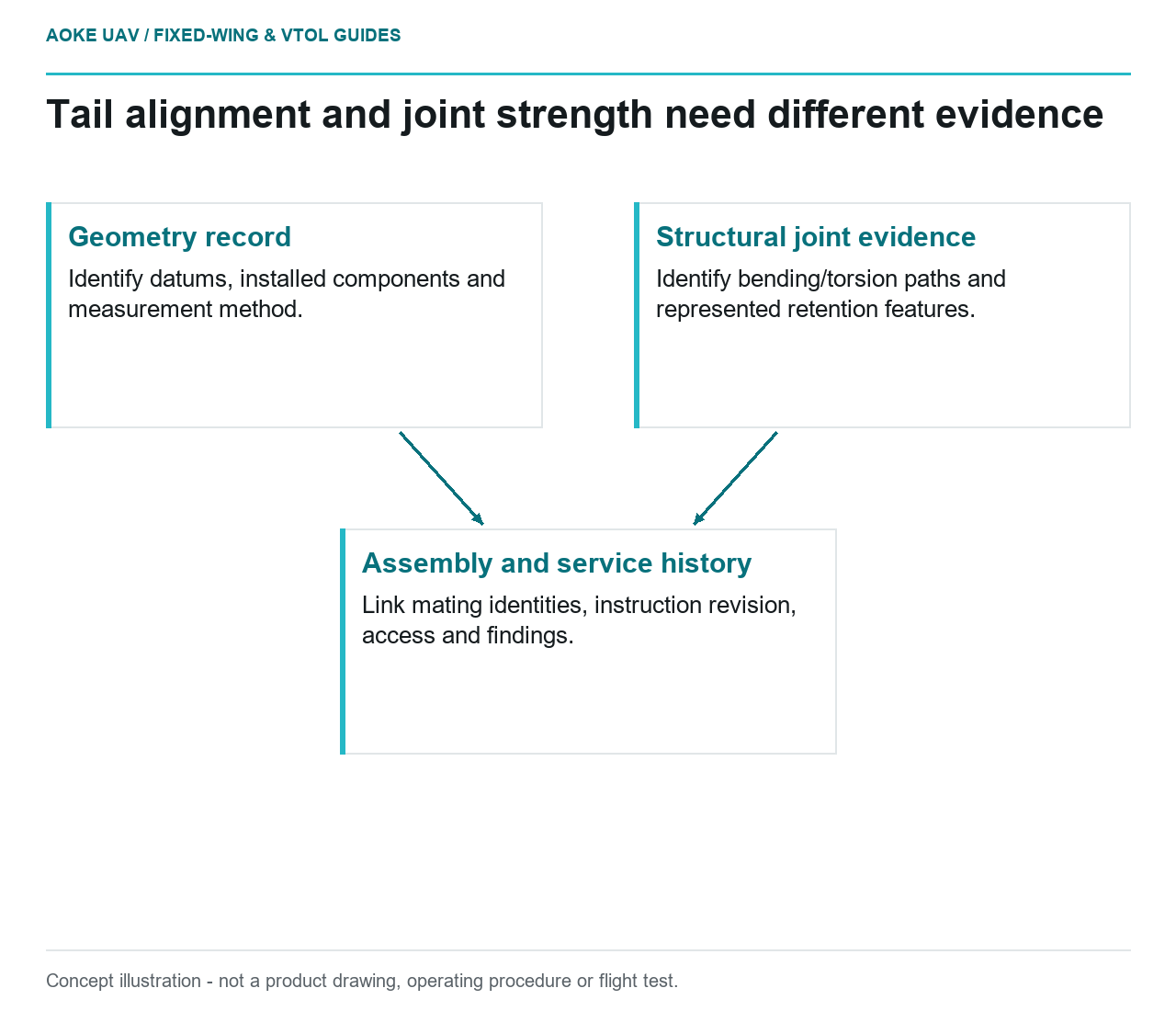
- Geometry record: Identify datums, installed components and measurement method.
- Structural joint evidence: Identify bending/torsion paths and represented retention features.
- Assembly and service history: Link mating identities, instruction revision, access and findings.
A civil mapping team repeatedly assembles a detachable tail boom on a hypothetical large fixed-wing UAV. Photographs show the tail apparently straight, but the team needs a repeatable way to relate alignment, joint condition and configuration. Geometric repeatability and structural adequacy are different evidence questions. This article outlines what to request from the responsible designers and how to preserve assembly history. It provides no alignment tolerance, retention setting or field technique for correcting a boom that does not match its documentation.
Alignment reference surfaces
Ask the airframe supplier to identify the reference surfaces and measurement definitions used to establish tail-boom alignment. The definition should say which components are installed and which configuration the drawing represents. A measurement without a datum description is difficult to compare with an earlier record, even when the displayed number appears precise.
For this hypothetical fixed-wing review, distinguish the tooling reference, assembly locator and flight-structure interface. Do not assume that a transport fixture defines the aircraft geometry. FAA guidance includes dimensional tolerance control in composite manufacturing and assembly, and it calls for documented procedures suited to the actual structure. [1] Its US certificated-aircraft scope is background for requesting those definitions, not a source of tolerances for this UAV.
Bending and torsional load paths
Request the joint section and the designer’s identification of how bending and torsional reactions are carried through the assembled interface. Ask which attachment features were represented in the supporting analysis or tests. The purpose is to connect the joint to the evidence, not to infer load capacity from connector length or a successful fit check.
FAA guidance addresses joints as structural details and explains why substantiation progresses through representative specimens, details and components. [1] Consequently, a result for a straight composite tube cannot automatically answer the joint question. For this industrial fixed-wing scenario, list the exact joint configuration covered by the evidence and the differences that remain unresolved. An alignment record establishes geometry only within its defined method; it does not independently establish the retention system’s strength.
Retention and inspection access
Ask how retainers are identified, accessed and inspected under the aircraft instructions. Include the route of any cable crossing the detachable interface in the review drawing. Does the assembly sequence allow the documented checks to be completed, and does the record distinguish electrical connection from mechanical retention? These are integration questions for the actual equipment, not a proposed routing prescription.
The FAA maintenance discussion expects disassembly, handling and repair information appropriate to the particular composite structure. [1] Apply that as an evidence request for the joint: which instruction revision governs assembly and which inspection applies to the surrounding composite interface? Do not invent retention torques, acceptable play or cable clearances. Where the documents omit a necessary condition, leave a named question for the supplier rather than substituting workshop custom.
Records after repeated assembly
Maintain separate entries for boom identity, airframe identity, mating components and instruction revision. Record measured results with their method and datum references, not merely a pass mark. Note replacements and reported assembly difficulties so that a later alignment change is not stripped of its context. Keep unresolved findings visible when the aircraft moves between civil survey sites.
FAA guidance links repairs to part-specific maintenance records and calls for feedback on service damage and degradation. [1] In this hypothetical large fixed-wing program, that supports asking the supplier how repeated assembly observations enter its review process. It does not establish a permitted assembly count or service life. The useful handoff explains what was measured, what structural evidence covers the joint and who dispositioned any discrepancy. A tail that looks straight is not the completed record.
Related reading
- Removable Wing Joints for Multi-Meter UAV Transport
- Printed Alignment Fixtures for Detachable Wing Assemblies