Concept illustration
Read diagram notes
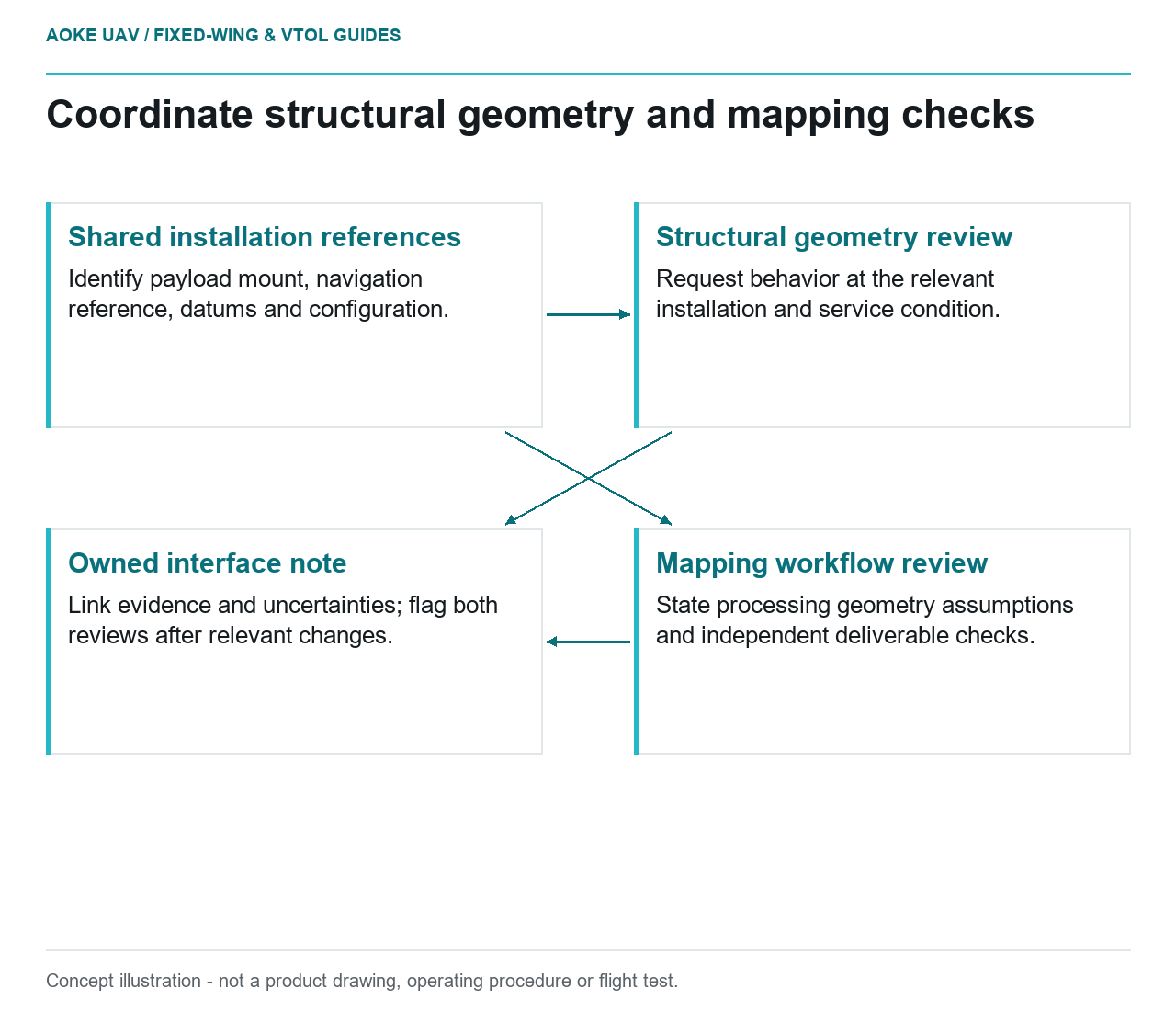
- Shared installation references: Identify payload mount, navigation reference, datums and configuration.
- Structural geometry review: Request behavior at the relevant installation and service condition.
- Mapping workflow review: State processing geometry assumptions and independent deliverable checks.
- Owned interface note: Link evidence and uncertainties; flag both reviews after relevant changes.
Ask two different acceptance questions
A wing may have a structural evidence package while a payload installation still has unresolved geometry questions. Consider a hypothetical large fixed-wing civil survey aircraft carrying a camera on a flexible wing, with its navigation reference elsewhere on the airframe. This scenario asks how the structural and calibration reviews connect. It is not an GAUTEN installation, test result or claim that a particular displacement is acceptable.
FAA composite guidance distinguishes static substantiation from aeroelastic assessment and discusses environmental effects on stiffness as well as strength. Those are reasons not to treat a strength statement as a complete statement about loaded geometry. The guidance addresses certificated aircraft; it does not qualify the survey accuracy of this UAV. [1]
Locate every relevant reference
For the hypothetical installation review, request one drawing that identifies the payload mount, navigation reference, relevant airframe datums and the supporting structural members. Ask which positions and orientations the processing workflow assumes. The drawing should distinguish a measured installation geometry from a conceptual CAD location.
Then ask the structural reviewer what configuration and loading assumptions underlie the geometry assessment. Does the explanation describe only an unloaded installation, or does it address the service conditions relevant to the proposed survey? Do not infer a movement allowance from the apparent rigidity of a mount, the material name or the wing’s external shape.
Separate static alignment from changing shape
As original integration reasoning, suppose the team measures a payload orientation before a mission. That record answers what was measured in that condition. It does not, without further evidence, answer whether the same relationship describes every exposure during flight. The review should identify which relationship needs to remain known and what evidence supports the assumption.
Ask whether the structural assessment supplies information useful to the payload specialist, and whether that information is expressed at the correct location and reference frame. A wing-tip displacement alone is not necessarily the requested installation quantity. This article does not derive an error equation or supply a generic deflection tolerance.
FAA’s aeroelastic section identifies structural loading and resulting deformation among the considerations affecting stability and control and discusses stiffness, mass and damping changes. [1] That is a structural context, not a quantitative model connecting wing motion to a mapping error. Keep that distinction explicit in the review record.
Do not replace checking with pixel size
USGS calibration guidance explains that imagery ground sample distance does not directly establish achieved data accuracy and that the spatial positioning and accuracy of ground control matter. It also emphasizes documenting and testing acquisition practices for three-dimensional accuracy. [3] Consequently, a fine pixel-size statement cannot close an unresolved installation-geometry question.
For this hypothetical fixed-wing mission, ask the mapping specialist to document the processing assumptions and the independent checks used to evaluate the delivered data. Keep data validation distinct from the structural assessment: each answers a different question. A structural pass does not demonstrate the final map, while an apparently good dataset does not substantiate the wing.
Coordinate the two reviews
Propose an interface note shared by structural and mapping reviewers. It would identify the payload configuration, measured geometry, assumptions about change during acquisition, evidence references and unresolved uncertainties. Give each assumption an owner. The purpose is to prevent a data-processing default from silently becoming an aircraft engineering requirement.
USGS discusses geometric calibration as determining camera parameters and addresses the role of control and check points in evaluation. Its recommendations are contextual rather than a universal acceptance threshold. [3] Ask which portions of that framework fit the proposed deliverable, and which payload-specific documentation is still required.
If the payload position or mounting structure changes, flag both reviews for applicability assessment rather than presuming an earlier calibration remains representative. This is a proposed change-control practice, not a statement that every modification requires the same test or that a recalibration alone is sufficient.
Keep the conclusion bounded
No GAUTEN wing deformation data, payload geometry limits or installed calibration results were supplied. The useful outcome for this large industrial fixed-wing scenario is a coordinated evidence request: structural behavior at the relevant installation and an independently checked mapping workflow. Do not invent a displacement limit or turn the explainer into a survey accuracy guarantee.