Concept illustration
Read diagram notes
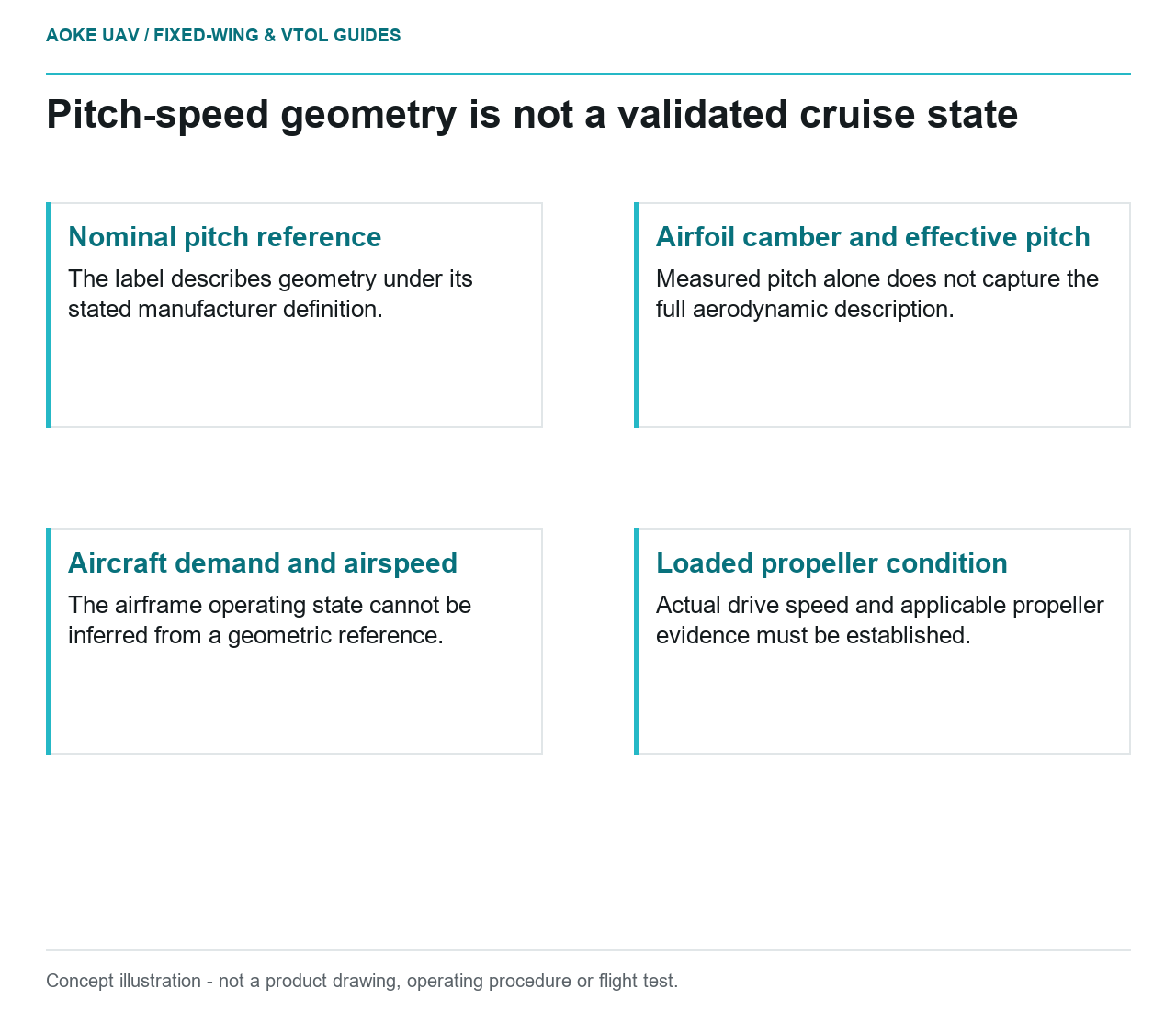
- Nominal pitch reference: The label describes geometry under its stated manufacturer definition.
- Airfoil camber and effective pitch: Measured pitch alone does not capture the full aerodynamic description.
- Loaded propeller condition: Actual drive speed and applicable propeller evidence must be established.
- Aircraft demand and airspeed: The airframe operating state cannot be inferred from a geometric reference.
A propeller’s diameter-and-pitch label is not an aircraft speed certificate. In a large fixed-wing integration proposal, a pitch-speed calculation may look precise while leaving the actual propulsion operating point undefined. The right response is not to discard geometry, but to ask what the label describes and what evidence connects it to the aircraft.
Start with the manufacturer’s pitch definition
Consider a hypothetical civil mapping aircraft whose propulsion proposal presents nominal pitch speed as its expected cruise speed. This is an original editorial scenario, not an GAUTEN product claim. Ask the supplier to identify the exact propeller, the meaning of its pitch designation and the rotational state used in the calculation. A number without those definitions should not enter the aircraft performance summary.
APC’s FAQ explains that a pitch-speed calculation based on measured pitch does not account for blade-airfoil camber, and that effective pitch can therefore differ from measured pitch.[4] That is a specific warning against treating the simple geometric reference as a complete aerodynamic description. It also means the reference should not be described as an absolute upper speed limit for every aircraft using that propeller.
For the hypothetical proposal, retain nominal pitch speed in a clearly labelled reference column if it helps explain the geometry. Do not relabel it measured airspeed, maximum speed or validated cruise. This editorial separation preserves useful information without manufacturing a performance conclusion from a familiar label.
Replace a universal slip allowance with evidence
A tempting shortcut is to subtract an assumed slip percentage and call the remainder realistic cruise speed. This article supplies no such factor. The manufacturer explanation above shows why a single geometric interpretation is already incomplete.[4] Ask for the operating-point evidence relevant to the actual propeller instead of inventing a universal correction that makes the proposal seem more conservative.
As an integration review method, distinguish the nominal geometry, the propeller’s aerodynamic evidence and the aircraft’s demonstrated state. Keep the source and conditions of each separate. If a supplier offers a correction method, ask what it predicts, how it was established and whether it applies to the proposed configuration. A labelled estimate can be useful; an unexplained adjustment should not masquerade as validation.
Account for the loaded drive and airframe
For the large industrial fixed-wing scenario, request the loaded rotational-speed basis rather than assuming the motor’s no-load speed defines the flight condition. Ask for the motor, controller and propeller combination represented by the evidence. Likewise, obtain the aircraft demand basis for the actual mapping payload and configuration. This is a request for substantiation, not a claim that any particular combination will reach the proposed speed.
APC’s Performance Data page describes geometry-based analytical performance calculations and records simulation provenance in its files.[9] Such a dataset is an example of operating-point information that goes beyond a pitch label, but remains a prediction with its own scope. It cannot establish the cruise or maximum speed of an unrelated large aircraft. Do not describe a calculated propeller result as a flight test.
State what the data actually establish
Prepare an evidence summary with distinct entries for the propeller designation, calculated geometric reference, documented propeller performance and installed aircraft evidence. Preserve atmosphere, rotational-speed and power definitions in the underlying record. Where a category is empty, identify the missing document or measurement rather than filling it with a number borrowed from another model.
In the civil mapping comparison, the eventual decision should concern a supported operating condition, not the most attractive pitch-speed headline. The aircraft team may discover that the proposal has useful geometry information but no substantiated cruise claim. That is a legitimate finding and a focused request for further evidence.
Large fixed-wing integration benefits from keeping labels in their proper role. Nominal pitch speed can help frame a question about helical advance, while camber and actual operating conditions require a fuller explanation. Until component and aircraft evidence close that gap, publish the limitation rather than an airspeed guarantee.