Concept illustration
Read diagram notes
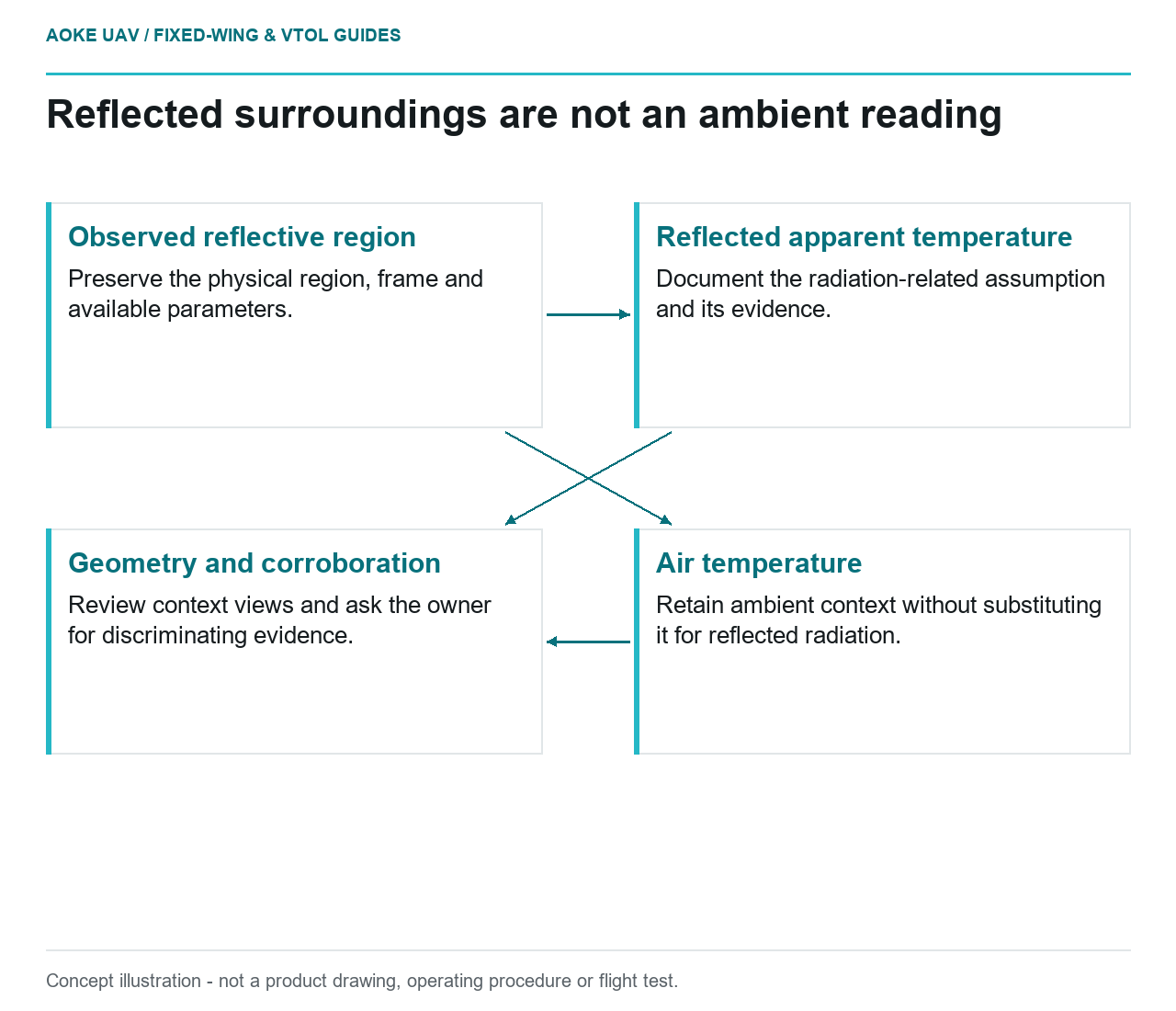
- Observed reflective region: Preserve the physical region, frame and available parameters.
- Reflected apparent temperature: Document the radiation-related assumption and its evidence.
- Air temperature: Retain ambient context without substituting it for reflected radiation.
- Geometry and corroboration: Review context views and ask the owner for discriminating evidence.
A striking thermal patch can invite the wrong question: how hot is this component? In a hypothetical industrial survey, a large fixed-wing aircraft images a reflective metal enclosure near other equipment. The initial question should instead be what radiation reached the camera. This civil monitoring example is not an GAUTEN test or customer finding. It illustrates why reflected apparent temperature deserves its own investigation rather than being replaced automatically with the weather-station reading.
Object emission versus reflected surroundings
FLIR distinguishes radiation emitted by an object from radiation originating in the surroundings and reflected by that object. Its measurement guidance uses reflected apparent temperature to compensate for the latter contribution. [1] A displayed temperature is therefore not independent proof that all of the received signal came from local heating.
For the proposed survey review, preserve the finding as an observation first. Record the physical region, original frame and available measurement parameters. Then ask which nearby surroundings could be represented in the reflective surface. This is a hypothesis-building step, not a method for remotely assigning a definitive fault mechanism.
Keep reflected apparent temperature distinct from air temperature. FLIR notes that a thermocouple measures temperature rather than the radiation intensity represented by apparent temperature. [1] A nearby ambient reading may be useful context, but the report should not present it as a verified substitute for a different measurement quantity.
View angle and reflective surfaces
In its reflected-temperature procedure, FLIR directs users to consider possible reflection sources and the relationship between incidence and reflection angles. [1] That source describes measurement techniques; it is not an instruction to conduct intrusive work around industrial equipment or a guarantee that airborne frames can resolve the relevant geometry.
In the hypothetical fixed-wing dataset, request a context view that shows the enclosure’s orientation and surrounding scene. If adjacent frames are available, inspect how the apparent feature changes with view. State what this comparison can and cannot establish: a changing appearance may motivate a reflection hypothesis, but it does not by itself identify the surface temperature.
Do not demand an improvised close approach to settle the issue. A large fixed-wing overview should not be scoped as if it can hover at an arbitrary industrial location. Where the needed view is unavailable, log the unresolved geometry and request an appropriate asset-team investigation through an independently planned method.
Measurement parameter documentation
Create a proposed interpretation record with separate fields for emissivity, reflected apparent temperature, atmospheric inputs, distance and any optical-window assumptions. For each value, distinguish measured evidence from a default or analyst estimate. Link revisions to the original finding so the uncertainty is not lost when the data move into a maintenance system.
When revisiting a frame, ask the analyst to preserve the parameter set used for each reported result. If an alternative reflected-temperature assumption changes the interpretation, record that sensitivity as a limitation. Do not adjust a parameter merely to make neighboring assets appear equal or to force the selected component into a severity category.
The fixed-wing deliverable should make missing information legible. For example, mark that a reflective surface was observed but the relevant background radiation was not established. That statement is more useful to the next investigator than a precise-looking temperature stripped of the assumptions that produced it.
Corroborating evidence before interpretation
Ask the asset owner what independent observation would discriminate among competing explanations. Depending on the asset and its approved procedures, that might involve another suitable viewing arrangement, operational records or an appropriate direct inspection. These are questions for the owner, not a universal diagnostic sequence supplied by a camera chapter.
For this hypothetical workflow, close the record only when the assigned reviewer can explain the evidence supporting the chosen disposition. Retain unresolved cases rather than silently deleting them from the report. Palette color alone is not the decision rule, and the retrieved FLIR source supplies no asset-specific defect threshold.
The practical boundary is simple: use the large fixed-wing overview to locate and preserve a thermal observation, then document what would be required to interpret it. Recognizing a possible reflection is a reason for disciplined corroboration, not a reason either to declare a fault or dismiss a genuine concern.