Concept illustration
Read diagram notes
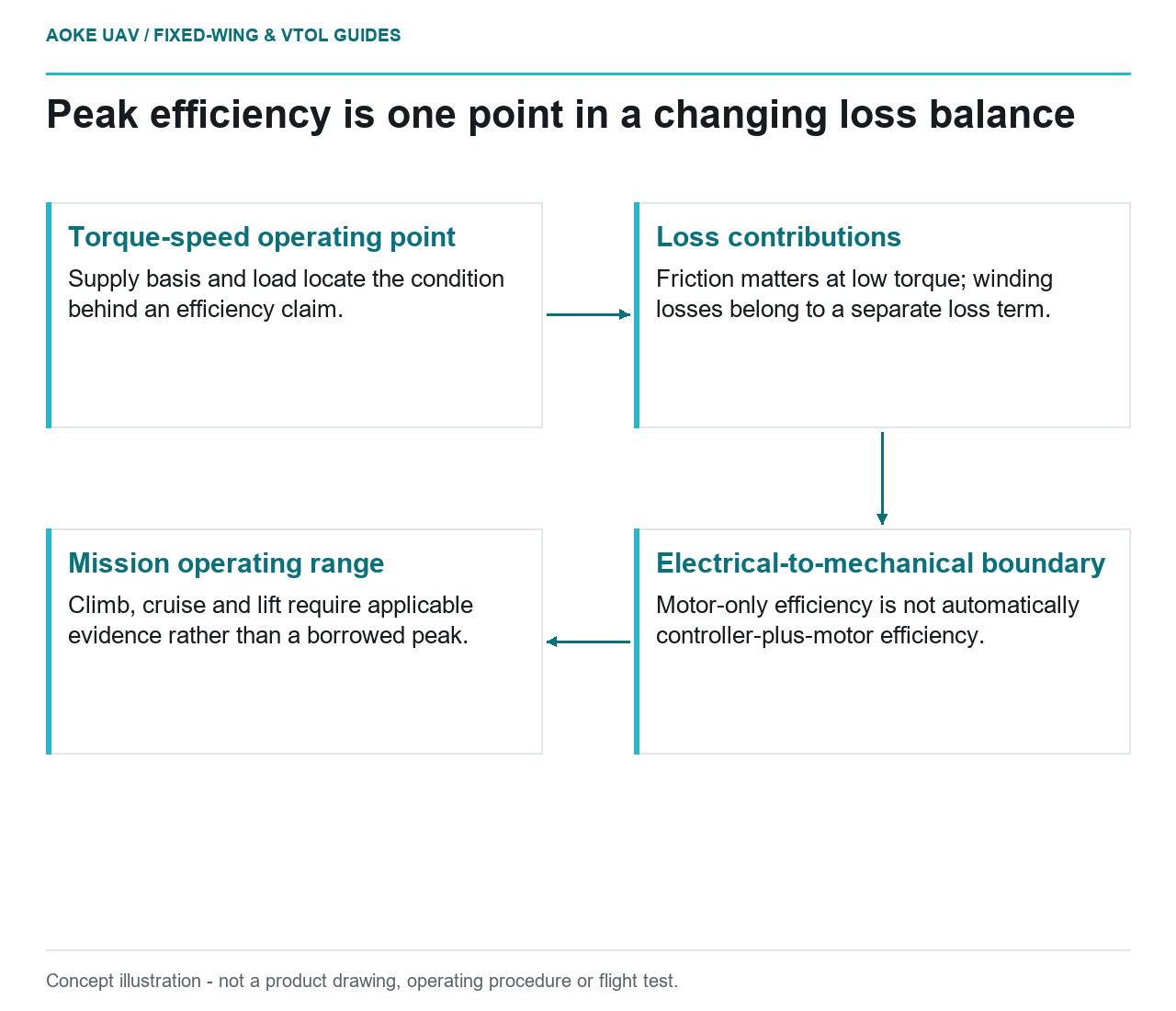
- Torque-speed operating point: Supply basis and load locate the condition behind an efficiency claim.
- Loss contributions: Friction matters at low torque; winding losses belong to a separate loss term.
- Electrical-to-mechanical boundary: Motor-only efficiency is not automatically controller-plus-motor efficiency.
- Mission operating range: Climb, cruise and lift require applicable evidence rather than a borrowed peak.
Turn the peak claim into a bounded question
A hypothetical large fixed-wing VTOL aircraft is being considered for a civil land-survey mission. A propulsion proposal advertises a peak motor efficiency but says little about the conditions corresponding to climb, transition or sustained mapping cruise. The editorial problem is how to assess that claim, not how to assign an efficiency value to an untested aircraft.
The maxon technical reference defines efficiency through mechanical power delivered and electrical power consumed. Its diagrams present efficiency alongside speed, current and output power as functions of torque at a specified voltage. The reference also states that maximum efficiency and maximum output power do not occur at the same torque. A peak is therefore a point with conditions, not a description of the whole diagram. [1]
Begin by asking the supplier to identify those conditions: motor and winding, speed, torque, supply basis and measurement boundary. If these are unavailable, retain the advertised peak as an incomplete claim rather than using it to close an aircraft energy budget.
Inspect the operating range rather than one favorable point
In the reference’s efficiency discussion, friction becomes increasingly significant at low torque, while winding losses appear separately in its power balance. Its motor diagrams provide a conceptual way to discuss changes with load. They are generic OEM explanations, not an efficiency map for the proposed large-aircraft propulsion unit. [1]
For the hypothetical survey mission, request efficiency evidence at the particular speed-load combinations the project intends to assess. Describe each combination as a candidate demand until the aircraft evidence establishes it. A cruise point should not be stretched into a climb result, and an example lift-motor point should not automatically describe a separate forward-propulsion motor.
Also ask what lies inside the stated boundary. A motor-only efficiency claim and a measured controller-plus-motor result answer different questions. This is a proposed evidence distinction, not a conversion supplied by the generic reference. Without the actual test definition, do not label a motor figure as complete battery-to-shaft or aircraft propulsive efficiency.
Connect losses with the thermal evidence request
Maxon describes electrical input being converted into mechanical output with losses, including winding heating. Its rated-operation discussion associates nominal current with thermally permissible continuous operation. These concepts justify asking about both efficiency and thermal conditions; they do not supply an allowable temperature for an unrelated aircraft motor. [1]
For the illustrative fixed-wing installation, ask whether the supplied evidence reflects the intended mounting, enclosure and cooling arrangement. Request the duration and thermal state associated with each relevant operating condition. If the efficiency record is a short characterization and the mission requires sustained operation, state that evidence gap explicitly instead of assuming the test demonstrates endurance.
The design review should also ask how loss information was obtained. A map derived from a model and a measured map can both have value, but the report should identify which is present and preserve its assumptions. No cited source here validates a particular mapping aircraft, controller or thermal installation.
Make an efficiency claim usable without overextending it
A proposed review table can place mission-state names beside speed, torque, electrical input boundary, efficiency evidence and thermal evidence. Use descriptive entries rather than invented numbers where project information is missing. Its purpose is not to create a generic percentage deduction from the advertised peak; it is to show exactly which operating states still need support.
Keep demand analysis separate from efficiency assessment. The mission-side question asks what the aircraft requires. This article asks how conversion losses are represented across those required states. Mixing the two can make a favorable efficiency claim look like proof that the mission demand itself was established.
For a large civil fixed-wing or fixed-wing VTOL project, a useful conclusion might be that the peak is documented but the relevant operating range is not. That is a substantive review finding, not a reason to substitute a guessed average. Preserve the claim’s actual scope, request the missing data and leave installed performance, usable energy and operational suitability undecided until their own evidence exists.