Concept illustration
Read diagram notes
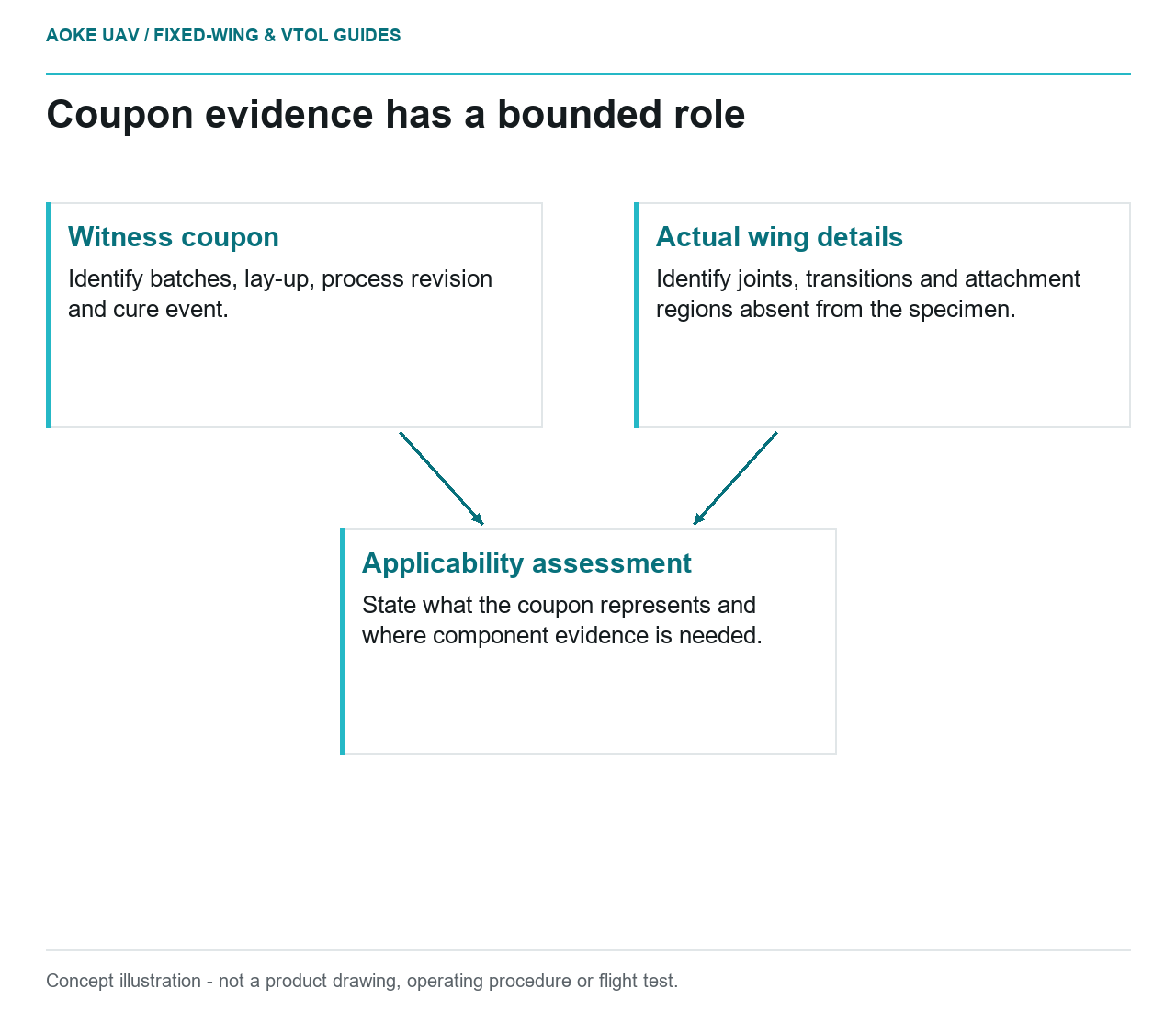
- Witness coupon: Identify batches, lay-up, process revision and cure event.
- Actual wing details: Identify joints, transitions and attachment regions absent from the specimen.
- Applicability assessment: State what the coupon represents and where component evidence is needed.
A hypothetical manufacturer supplies a small witness laminate beside a multi-meter wing intended for civil fixed-wing surveying. The coupon report contains measured properties and a reassuring pass mark. Before using that report, the integration team needs to establish what the specimen represents and what it does not. This article concerns the link between material, process and manufactured airframe. It does not convert a coupon result into whole-wing capacity, set acceptance values or prescribe a production test for an unidentified composite system.
Material and process linkage
Start with specimen identity and the documented relationship to the wing. Ask which material batches, lay-up definition, process revision and cure event the coupon shares with the assembly. If those differ, request the supplier’s explanation of why the specimen remains relevant. The word witness is not a complete description of processing equivalence.
FAA guidance connects design values to stable materials and representative production processes, and it emphasizes manufacturing records supporting acceptance. [1] Its US certificated-aircraft context is not an approval framework for this hypothetical fixed-wing UAV. The useful review question is narrower: does the report establish a traceable relationship between this test specimen and the specific wing, or merely describe a material system used elsewhere? Keep those evidence roles separate in the file.
Part geometry versus coupon simplicity
Compare the coupon’s documented geometry with the features that matter on the wing: joints, local thickness transitions, attachment regions and other defined details. Ask which features are represented by the specimen and which require separate evidence. This is not an invitation to calculate the wing from the coupon without a validated method.
The FAA describes a building-block approach in which tests and analysis progress from simpler specimens to details, subcomponents and components. Structural discontinuities and manufacturing variability are among the reasons to examine increasing complexity. [1] For the large industrial fixed-wing assembly, a flat witness laminate may contribute process information while leaving a wing-root joint or bonded hardpoint unresolved. Request the higher-level substantiation rather than treating a small specimen’s successful test as a structural demonstration of every feature.
Batch traceability and deviations
Link the test report, specimen label and wing record through explicit identifiers. Ask whether the coupon and wing experienced the same documented processing deviations and whether their dispositions differ. A specimen produced before an interrupted cure event, for example, would create an applicability question in this hypothetical review; it would not establish the consequence of the interruption.
NASA JSC’s sandwich specification illustrates verification records tied to mandatory inspection points and part identification. Its potting control coupon has a particular process-verification purpose, not a general role as proof of an aircraft assembly. [2] Use that example to ask what each specimen was intended to verify. Do not interchange a material property coupon, a process witness and a locally specified manufacturing check merely because each is a small test piece.
Limits on generalising measured properties
Read the test conditions and reported result together. Ask what property was measured, which acceptance plan applied and who established its relevance to the airframe. Keep temperature, conditioning, specimen orientation and any deviations attached to the result instead of retaining only the highest value. No comparative material ranking or aircraft allowable is established here.
For this hypothetical fixed-wing procurement, the closing statement should explain the coupon’s supported role and list the assembly questions answered elsewhere. FAA guidance permits lower-level evidence within a justified structural substantiation program, not as an automatic substitute for representative component evidence. [1] A traceable coupon is valuable because its meaning is bounded. Calling it whole-wing proof would remove precisely the limits the record needs to preserve, particularly after an assembly or manufacturing change.