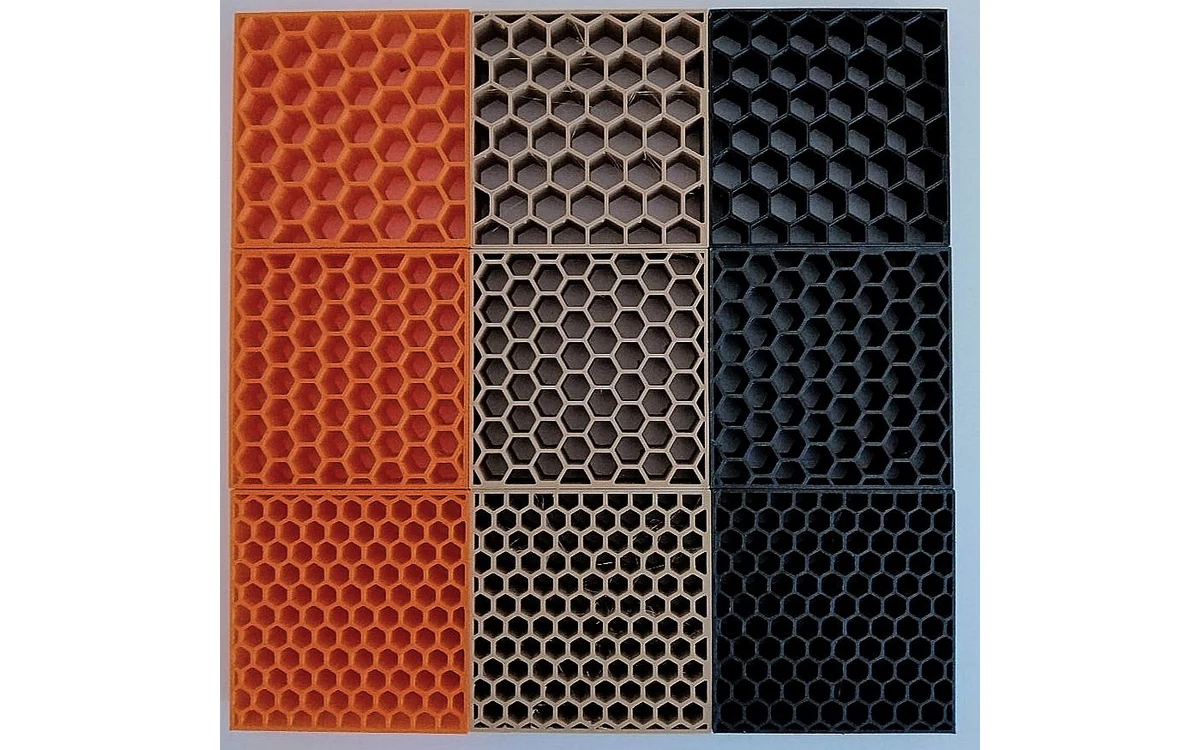
A small successful test piece can be useful evidence and still leave the important fixture question unanswered. Imagine a long printed wing-assembly jig for a large industrial fixed-wing mapping aircraft. A supplier submits coupon results as its main justification. This hypothetical review asks what those results represent, which assumptions connect them to the jig and what separate fixture-level evidence remains necessary.
Identify the question the coupon answered
NASA-STD-6030 distinguishes process-control witness evidence from other part acceptance activities. Its witness-testing discussion cautions that samples cannot necessarily reveal local or intermittent loss of process control. This is a spaceflight standard, not a UAV fixture approval route. [4]
For our fixed-wing jig, begin by naming the test objective: material characterization, process monitoring or a particular functional demonstration. A coupon report without a stated purpose is difficult to use responsibly. Keep its reported result attached to specimen identity, test method and the tested configuration rather than reducing the evidence to a pass label.
Do not ask a tensile specimen to answer a location-repeatability question merely because both involve the same polymer. In this scenario, the jig’s job is to maintain assembly datums under defined support and handling conditions. Translate that job into measurable fixture requirements before deciding which coupon results contribute to the argument.
Review orientation, geometry and traceability
The NASA document discusses consistent witness specimen geometry, direction, surface condition and build location when comparing process evidence. Those controls belong to its own qualification framework; they are not generic settings for a workshop printer. [4]
Our proposed evidence comparison would identify the actual jig material, machine, build revision, orientation and post-processing route alongside the corresponding coupon information. Label every mismatch. A coupon produced during a development trial should not silently represent later fixtures manufactured through a changed route.
Geometry needs separate attention. The long fixed-wing jig includes supports, local contacts and perhaps joints that the small specimen does not contain. List those features as unrepresented rather than claiming that specimen strength scales automatically to the completed tool. Establish which require analysis, a representative feature test or evaluation of the entire fixture.
Match the use condition, including time
Formlabs warns that continually loaded SLA tooling can creep and recommends functional fixture testing. That is material/process-specific OEM context, not a universal deformation rate. [2] In our review, an unloaded dimension check and a brief material test would therefore be classified as narrower evidence than a sustained fixture-use demonstration.
Define the intended support arrangement, loading sequence and exposure from the real assembly task. Identify whether an accepted fixture must preserve location during a short operation, a longer hold or another specified condition. This article supplies no duration, load or environmental limit because those values are absent from the application documentation.
Where a trial uses substitute parts, record what they represent. A convenient dummy that contacts different regions may not exercise the proposed locating system. Decide in advance how the trial will reveal movement and how measurement uncertainty will be treated, rather than choosing an acceptance threshold after seeing the result.
Build a fixture-level verification argument
Our suggested package would connect three evidence layers: controlled material/process records, relevant feature evaluations and measurements of the assembled jig performing its intended task. Retain the coupon results in the first layer where appropriate. Do not discard useful process evidence simply because it cannot settle every functional question.
For a large fixed-wing manufacturing station, include datum verification, support configuration, loaded behavior and reinspection after any relevant handling or reassembly. Define review triggers for changed materials, repairs and replaced segments. The decision is whether this particular ground fixture meets its documented requirements. Neither a green coupon report nor the contextual NASA standard establishes UAV airworthiness, flight-part allowables or public approval of the manufacturing process.
Related reading
Sources
- [4] NASA-STD-6030: Additive Manufacturing Requirements for Spaceflight Systems
- [2] Jigs, fixtures, and manufacturing aids
Visual summary
Concept illustration
Read diagram notes
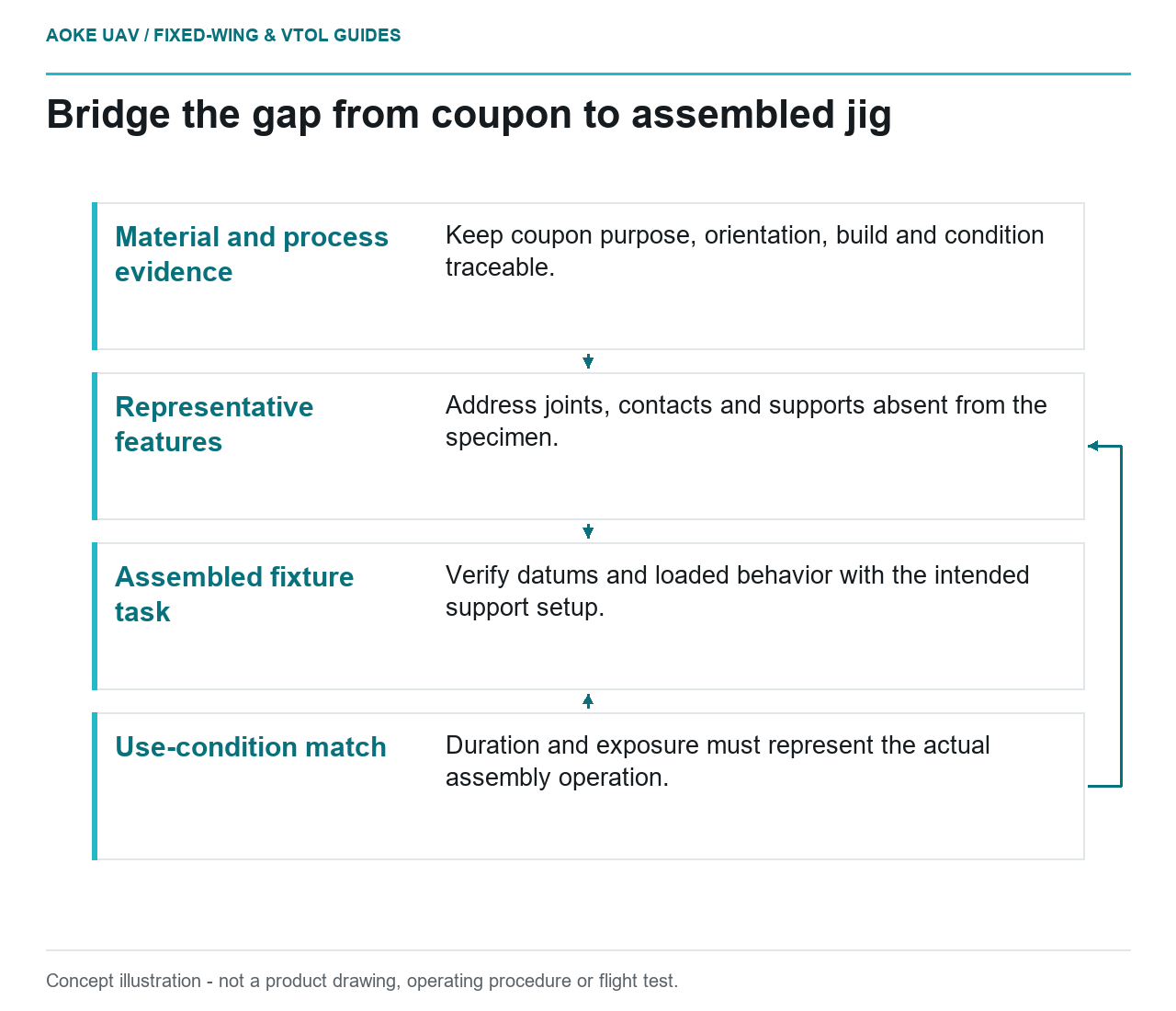
- Material and process evidence: Keep coupon purpose, orientation, build and condition traceable.
- Representative features: Address joints, contacts and supports absent from the specimen.
- Assembled fixture task: Verify datums and loaded behavior with the intended support setup.
- Use-condition match: Duration and exposure must represent the actual assembly operation.