Concept illustration
Read diagram notes
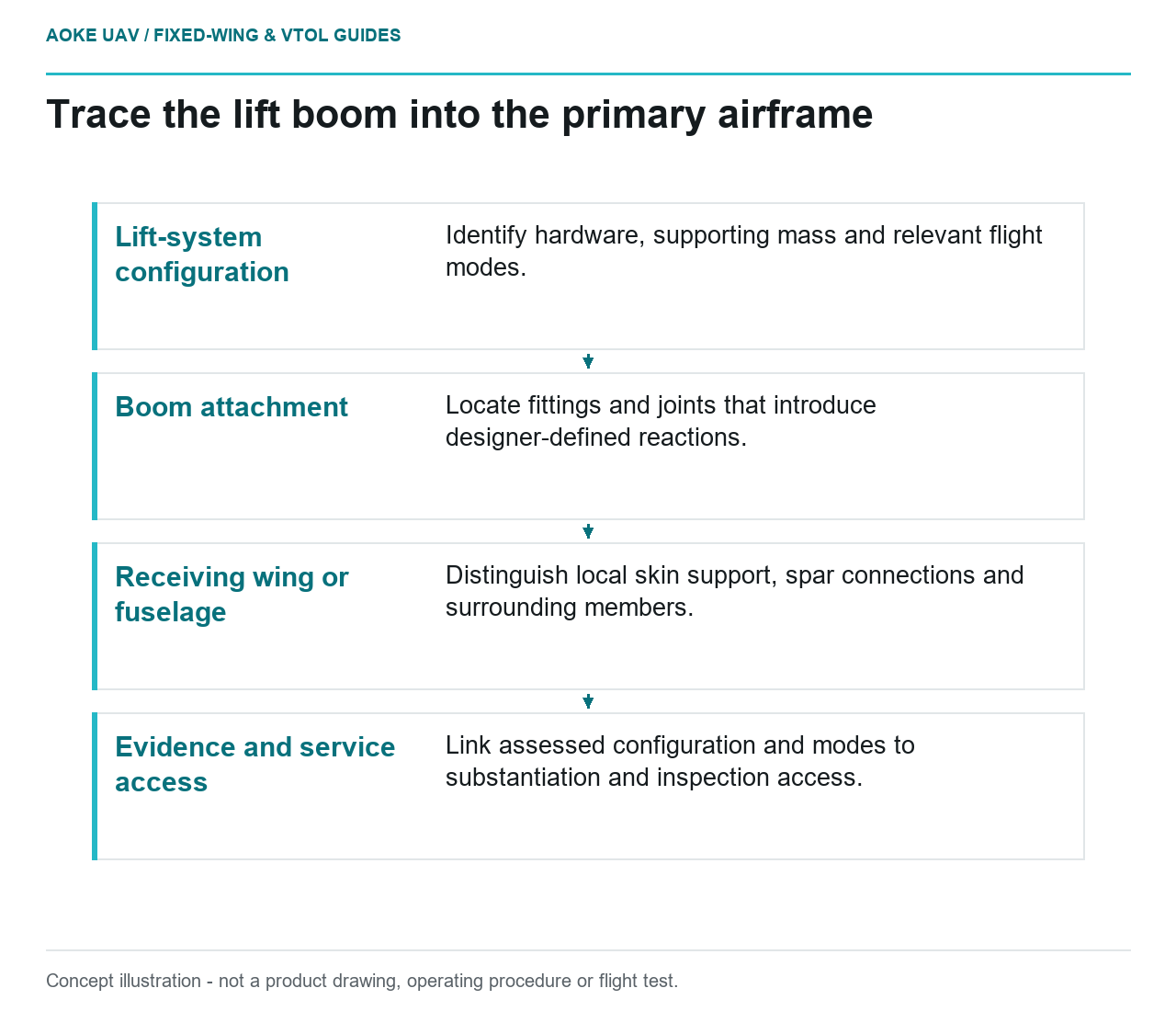
- Lift-system configuration: Identify hardware, supporting mass and relevant flight modes.
- Boom attachment: Locate fittings and joints that introduce designer-defined reactions.
- Receiving wing or fuselage: Distinguish local skin support, spar connections and surrounding members.
- Evidence and service access: Link assessed configuration and modes to substantiation and inspection access.
Begin at the attachment, not the motor label
Consider a hypothetical large fixed-wing civil survey aircraft with separate VTOL lift booms. The integration question is where the lift-system reactions enter the wing or fuselage and what structural evidence covers that route. This is original review reasoning, not an GAUTEN installation, performance claim or flight result. It does not specify propulsion ratings or prescribe a transition procedure.
ArduPilot’s QuadPlane overview describes combined fixed-wing and multicopter architecture, including configurations with additional motors and transitions between flight modes. It establishes that these functions can coexist in a software-supported architecture. It does not substantiate boom attachments, installed loads or endurance for this aircraft. [4]
Keep hover and cruise questions separate
For the hypothetical fixed-wing review, request load-case descriptions for the proposed lift system, wing-supported flight and relevant intermediate configurations. Ask the responsible designer to identify what changes between them and which combinations the assessment represents. Do not assume a cruise wing assessment automatically covers the added lift-system installation.
The proposed document review should identify the propulsion hardware and supporting mass as part of the configuration rather than treating a boom as an empty attachment. Ask which reactions the designer includes and where each is applied. This is an evidence question, not an attempt to derive loads from an unspecified motor’s advertised thrust.
FAA composite guidance calls for consideration of critical load cases and associated failure modes in static substantiation, including relevant environment, process variability and permitted damage. That certificated-aircraft context supports asking for a complete configuration assessment, but it does not approve a UAV lift-boom concept. [1]
Trace load introduction into primary structure
Request a drawing from each lift-boom attachment into the receiving wing or fuselage structure. Identify which fittings, joints and surrounding members participate in the intended route. Ask where the interface assessment ends and how it connects to the broader airframe evidence. Avoid treating a large mounting plate or tidy exterior fairing as a structural explanation.
For our large fixed-wing concept, review local skin support and any spar connection as distinct interfaces. Ask whether the substantiation represents the actual support arrangement, including access openings and attachment details. FAA’s building-block discussion connects detail and subcomponent tests to component validation for combined loads and complex load paths. [1]
Use that framework to ask what the supplied evidence actually represents. A material coupon may be relevant to a material property, while leaving the boom-to-airframe arrangement unresolved. Record that boundary instead of calling the coupon a test of the complete installation.
Make the transition review configuration-specific
ArduPilot describes transitions between Plane and VTOL modes and notes that additional rotors can provide lift and stability in Plane modes. That overview cautions against treating the architecture as only two disconnected labels. It does not identify the structural load combinations for this proposed aircraft. [4]
Ask the structural reviewer which transition configurations and system interactions are represented by the actual analysis. Keep this question separate from the electrical review of simultaneous power demand. A control-software description is not a structural substantiation summary, and a structural summary is not a battery assessment.
For this hypothetical project, propose a shared configuration index so propulsion, controls and structural reviewers refer to the same hardware arrangement. Identify assumptions requiring reconciliation rather than inventing a transition envelope from the existence of autopilot support.
Plan access before accepting replaceability
Ask how technicians reach the attachment and surrounding composite for the applicable inspections. Determine whether removing a boom exposes the assessed region or disturbs a connection that requires a controlled restoration procedure. Do not infer field replaceability merely from visible bolts.
FAA guidance emphasizes field inspection and repair access, special documentation for difficult damage types and substantiated repair processes. It also distinguishes initial visual findings from characterization of hidden damage. [1] For the proposed attachment, request applicable instructions and an access demonstration rather than a universal maintenance interval from this article.
End with a bounded interface record
The useful deliverable is an attachment-to-airframe evidence map, indexed to the assessed configuration and relevant modes. No GAUTEN boom geometry, structural loads, transition analysis or repair limits were supplied. The review therefore remains a set of specific integration questions. It cannot establish aircraft readiness or convert a supported software architecture into an approved structural installation.
Related reading
- Reviewing Structural Load Cases Across VTOL Transition
- Concurrent Power Demand During Fixed-Wing VTOL Transition