Concept illustration
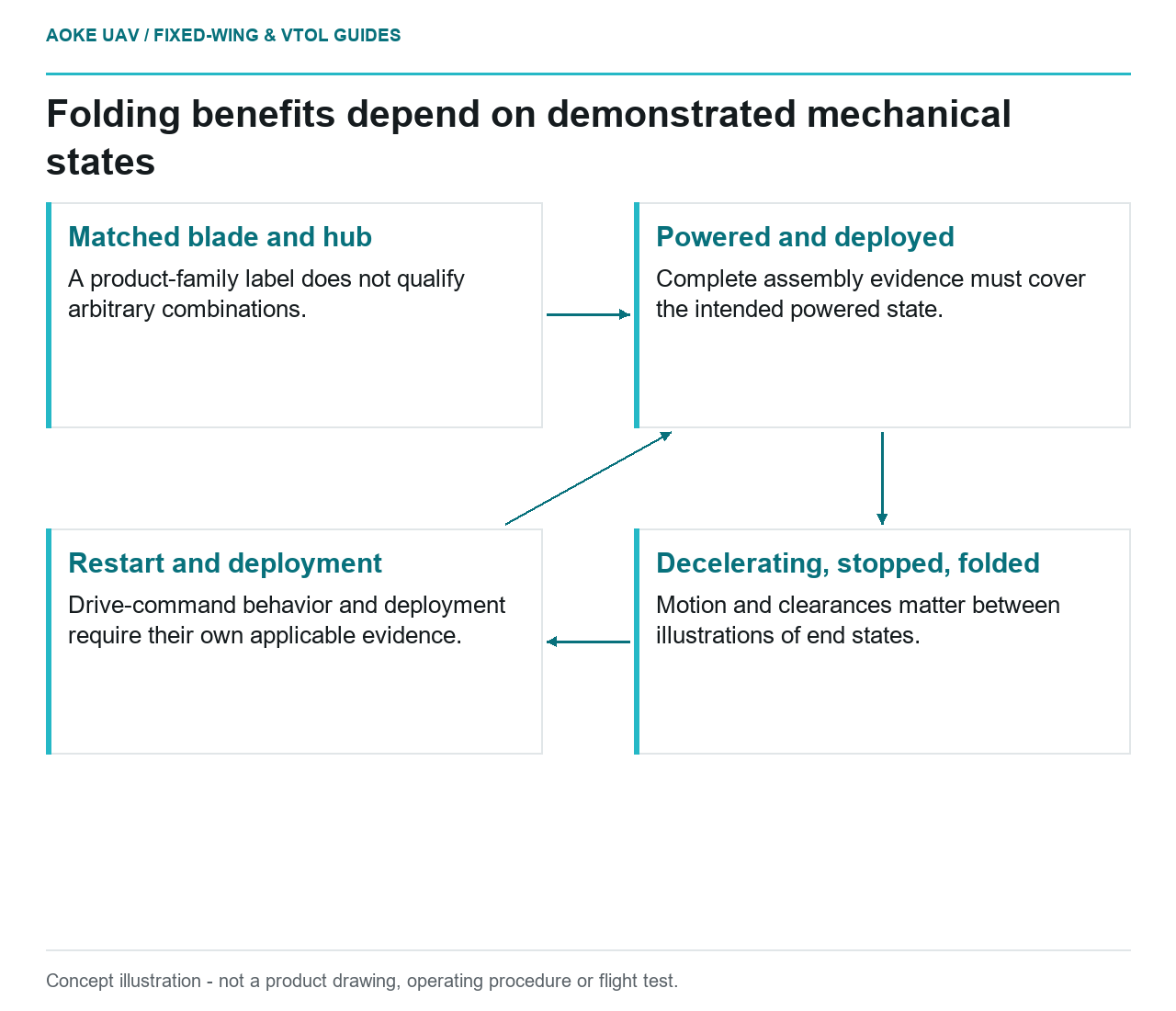
Read diagram notes
- Matched blade and hub: A product-family label does not qualify arbitrary combinations.
- Powered and deployed: Complete assembly evidence must cover the intended powered state.
- Decelerating, stopped, folded: Motion and clearances matter between illustrations of end states.
- Restart and deployment: Drive-command behavior and deployment require their own applicable evidence.
A folding-propeller proposal often starts with a hoped-for cruise-drag benefit. That does not resolve whether the particular blades, hub and aircraft installation have been substantiated together. For a large industrial fixed-wing design, the useful review question is broader: what evidence covers the assembly in every relevant state, including the changes between those states?
Identify the hub and blade combination
Consider a hypothetical civil fixed-wing survey aircraft proposing a folding propulsion assembly. The team has a concept drawing but no applicable large-aircraft hub-and-blade manual or deployment evidence. This is an original editorial scenario, not an GAUTEN design or demonstration. The proposal should remain an evidence request rather than being treated as a validated aerodynamic improvement.
APC’s FAQ distinguishes folding-blade products within its own designation system.[4] A family label helps identify a product, but does not establish compatibility between arbitrary blades and hubs. Request the actual manufacturer’s complete combination definition: blade identity, hub identity, revisions and the documentation that explicitly covers their use together. A matching nominal size or a photograph is not an adequate substitute.
APC’s folding-propeller advisory describes a particular design update and states compatibility with existing hubs for its listed products.[13] That is a bounded manufacturer statement. It is not evidence that a large-UAV assembly from another source is compatible, nor a recommendation to select one of those model propellers. Preserve the product scope instead of turning a specific compatibility statement into a general rule.
Define deployed, stopped and changing states
For the hypothetical survey aircraft, propose a state table: deployed and powered, decelerating, stopped, folded where intended, and restarting or deploying. Ask the design owner which states are actually part of the concept and what evidence supports each transition. This article does not assert that the assembly will fold, stay folded or deploy reliably under any particular flight condition.
Keep control behavior and mechanical compatibility linked in the review. APC’s separate quick-release hub advisory contains its own matched-blade, pivoting and active-braking warnings.[13] Those instructions concern that specific hub system, not all folding propellers. Their relevance here is that superficially similar assemblies can have model-specific constraints. Do not copy an example controller setting, braking strategy or installation procedure into the proposed large aircraft.
Ask for documented behavior when the actual drive commands a stop or restart, including what evidence applies to the intended installation. If the supplier has only static assembly information, record that limitation. A free-moving blade on a bench does not demonstrate the complete aircraft’s deployment behavior, and a clean concept rendering demonstrates none of these states.
Review clearances and structural interfaces
Propose reviewing the assembly geometry throughout the relevant motion, not just in a fully extended illustration. Identify relationships with the fuselage, mounts and nearby equipment. Ask the responsible engineers what evidence addresses loading and attachment at the applicable states. No clearance distance, hinge tolerance, structural limit or fastening specification is supplied here.
FAA composite-structure guidance emphasizes structural substantiation and access for inspection and repair.[10] It offers contextual principles for a composite installation review, not approval of this UAV or of a folding hub. For the survey concept, request the aircraft-specific substantiation and maintenance provisions instead of inferring adequacy from material choice or surface appearance.
Keep drag benefit separate from validation
Assign the proposed aerodynamic benefit its own evidence column. Ask which configuration and stopped state any drag comparison represents, and whether the folding behavior needed to achieve that state has independent support. A predicted benefit should remain a prediction until the actual installation’s evidence justifies a stronger description. Do not infer a quantified endurance gain from the concept alone.
The present evidence gap is explicit: no applicable manual or state-transition substantiation for the hypothetical large-aircraft combination has been supplied. The outcome is therefore a focused documentation and integration checklist, not component approval. Large fixed-wing design review advances when that missing evidence is named rather than hidden behind an attractive folding silhouette.
Related reading
- Propeller Diameter Is an Airframe Integration Choice
- When a New Payload Requires a Structural Reassessment