Concept illustration
Read diagram notes
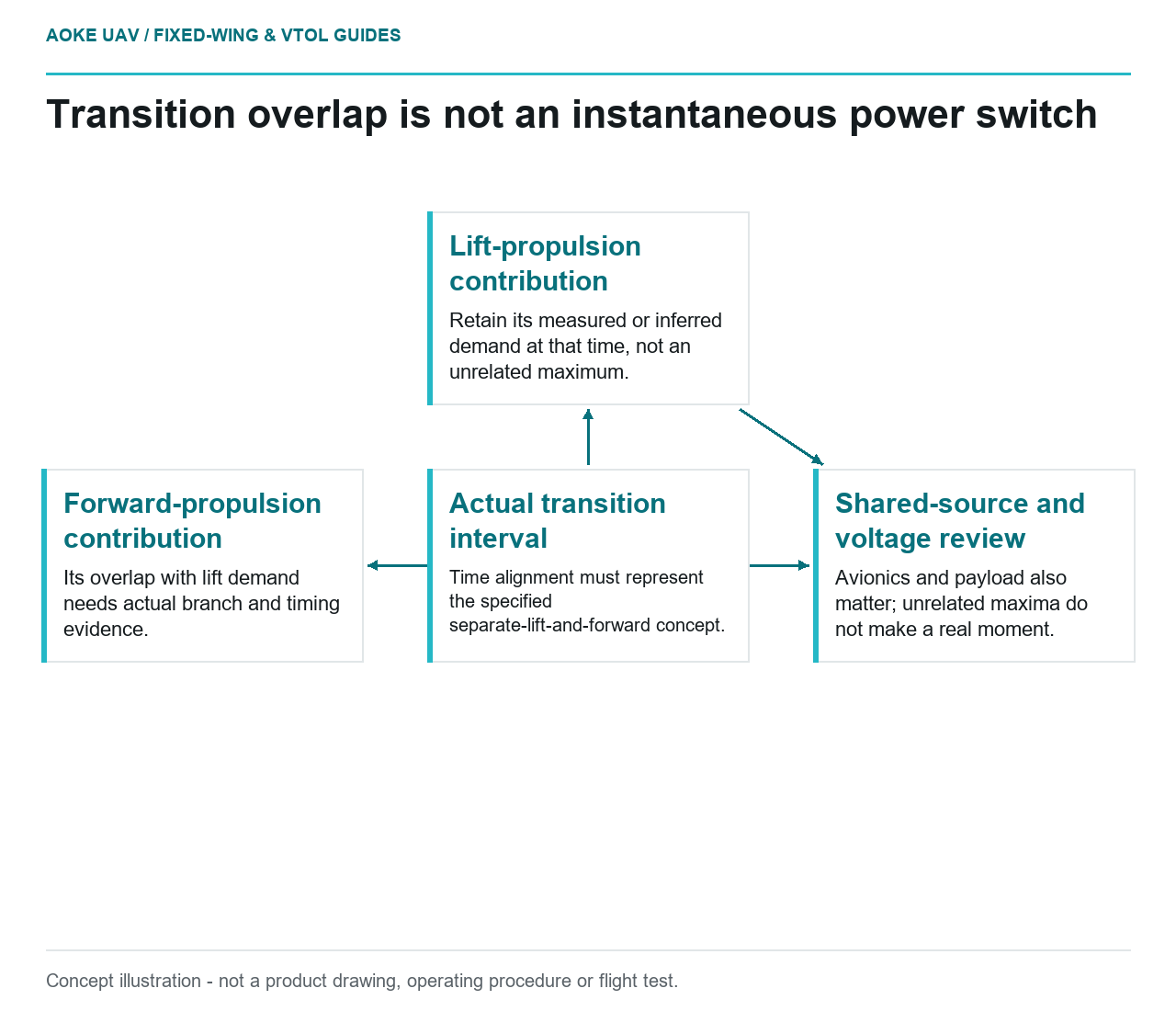
- Actual transition interval: Time alignment must represent the specified separate-lift-and-forward concept.
- Lift-propulsion contribution: Retain its measured or inferred demand at that time, not an unrelated maximum.
- Forward-propulsion contribution: Its overlap with lift demand needs actual branch and timing evidence.
- Shared-source and voltage review: Avionics and payload also matter; unrelated maxima do not make a real moment.
Hover and cruise are useful labels, but they do not necessarily bound every electrical demand during a fixed-wing VTOL mission. Transition deserves its own evidence record. The central integration question is which consumers operate together while the aircraft changes how it produces lift and forward motion. Treating transition as an instantaneous switch can hide the very overlap that the electrical review needs to examine.
Changing lift and thrust contributions
Consider a hypothetical large industrial fixed-wing VTOL departing for a civil infrastructure survey. It has separate vertical-lift and forward-thrust propulsion branches. This is an original editorial scenario, not an GAUTEN aircraft description or a tested procedure. The review team wants to understand the departure power history before accepting an energy-storage or distribution proposal.
ArduPilot’s QuadPlane overview provides an example combining fixed-wing and multicopter capabilities, while its transition documentation describes changing propulsion contributions as the aircraft moves between modes.[2][5] Those documents concern that control architecture; they do not prove the performance of the hypothetical installation. Establish the actual aircraft type, control implementation and software configuration before using an example transition description as a requirement.
Record simultaneous consumers
The transition documentation specifically warns of high simultaneous motor demand and associated battery voltage sag during VTOL-to-fixed-wing transition.[5] The supported lesson is that overlap needs investigation. It is not permission to copy the page’s battery numbers, parameter values or suggested remedies into a different large aircraft. This article supplies no cell-voltage threshold, throttle limit or controller setting.
For the survey scenario, propose a time-aligned record of lift propulsion, forward propulsion, avionics, payload and any other documented consumer. Mark which quantities are directly measured and which are inferred. A total current trace without branch information may leave the cause of an excursion unresolved; isolated branch maxima from different moments do not establish that those maxima occurred together. Preserve timing rather than constructing a fictional worst moment from unrelated samples.
Ask the integration team to associate observations with aircraft mass, battery identity and condition, control configuration and environmental context. If the aircraft changes architecture, such as using tilting propulsion rather than separate lift motors, require a revised demand description. The example’s branch diagram must not become a universal model for every fixed-wing VTOL.
Voltage behavior and reserve assumptions
Propose reviewing voltage at the relevant supply and load interfaces alongside current and event timing. The question is whether applicable component and aircraft requirements are supported throughout the transition, not whether a graph looks smooth. Without the exact installed battery, wiring, controller and power-supply documents, this explainer cannot define acceptable voltage behavior or declare a recorded event safe.
FAA AC 20-184A addresses rechargeable lithium battery systems through design, installation, operation and maintenance guidance.[6] It is contextual aircraft battery guidance, not approval of this UAV or a substitute for its applicable component limits. Use it to recognize the need for an installation-level evidence chain, while leaving actual acceptance criteria to qualified review of the specific system.
Tie evidence to the actual transition
For this hypothetical project, distinguish the power-demand question from structural transition loads and from flight-control tuning. Assign each to the appropriate review owner. The electrical deliverable should identify what runs concurrently, what the supply measurements cover and which requirements remain unverified. It should not quietly imply that resolving the power ledger establishes the aircraft’s handling or structural envelope.
Finally, carry transition duration as a documented assumption in the mission budget, with uncertainty left visible. Do not apply a fixed reserve percentage borrowed from another platform. A useful outcome is a configuration-specific list of supported observations and unresolved acceptance questions. A large fixed-wing VTOL power architecture is not substantiated merely because its hover and cruise rows each appear plausible when reviewed separately.
Related reading
- Reviewing Structural Load Cases Across VTOL Transition
- VTOL Site Footprints in Civil Inspection Planning