Concept illustration
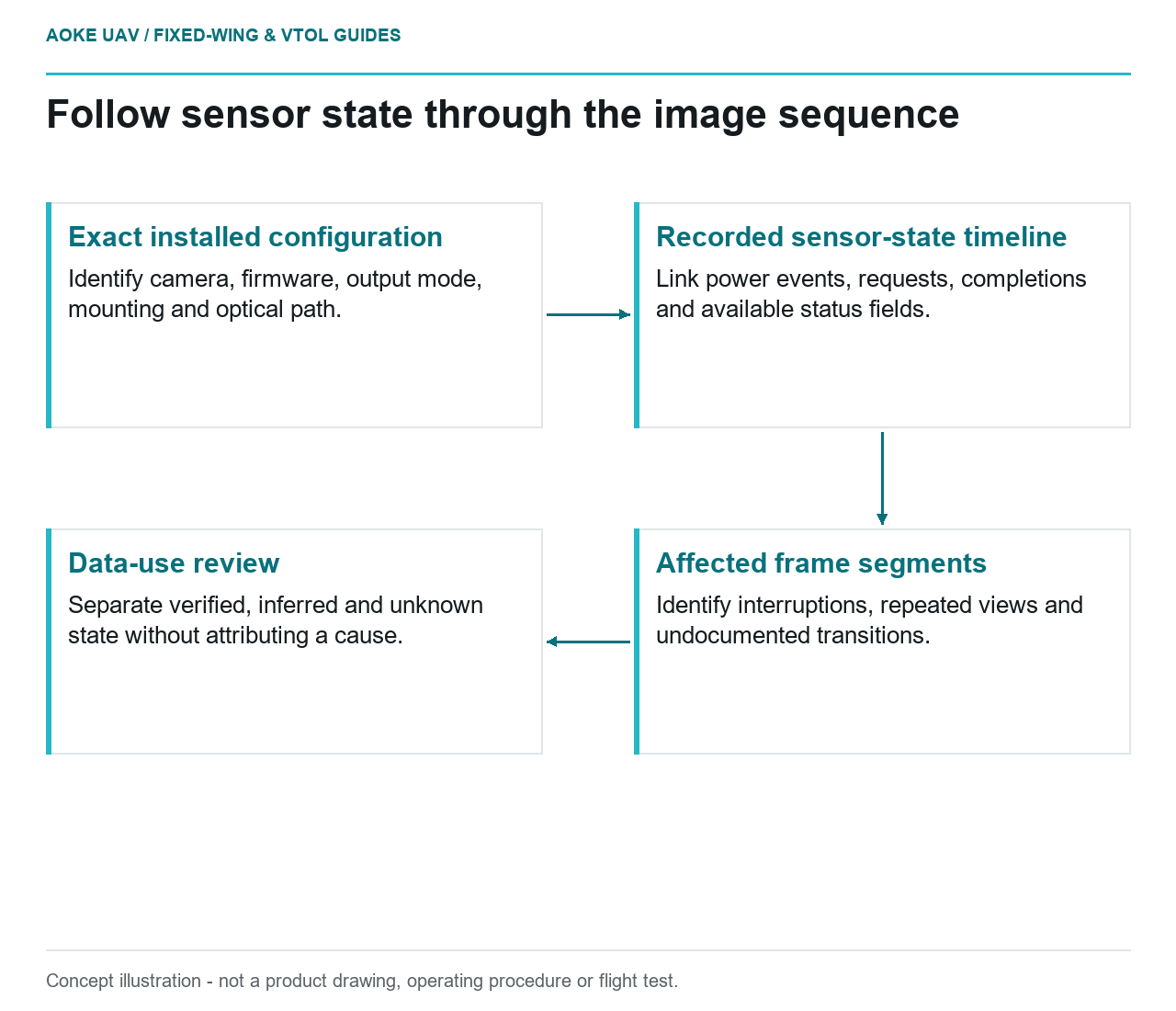
Read diagram notes
- Exact installed configuration: Identify camera, firmware, output mode, mounting and optical path.
- Recorded sensor-state timeline: Link power events, requests, completions and available status fields.
- Affected frame segments: Identify interruptions, repeated views and undocumented transitions.
- Data-use review: Separate verified, inferred and unknown state without attributing a cause.
A long acquisition is not characterized fully by the moment a camera was switched on. In this hypothetical civil integration, a large fixed-wing UAV records an industrial thermal overview while its payload operates through changing conditions. The receiving analyst needs to know which sensor-state evidence accompanies the files. This is not an GAUTEN camera installation, endurance result or prescribed operating schedule.
Detector and calibration behavior are model-specific
FLIR’s Boson FFC/NUC application note describes flat-field correction modes and calibration-table management for that camera family. It states that responsibilities differ between automatic operation and host-managed manual or external modes. [7] The retrieved document is a 2018 application note, not proof of how an unspecified current payload or firmware operates.
Start the proposed integration review by identifying the exact sensor variant, firmware, output mode and applicable OEM documents. Ask whether the installed system exposes correction requests, completion states and other status records. Do not copy another model’s behavior into the flight checklist merely because both devices produce thermal imagery.
Keep startup readiness separate from continued measurement quality. The acceptance discussion should ask what evidence establishes suitability for the intended recording period and what conditions require review. An arbitrary elapsed-time label cannot replace the exact camera’s instructions or an installed-system evaluation.
Time-dependent sensor state
The Boson note describes status information for determining whether correction or calibration-table operations are requested and completed. It also discusses output interruption during correction. [7] Those are concrete examples of why the image sequence and the sensor-state history need to be reviewed together.
For the hypothetical fixed-wing dataset, propose a timeline containing power events, configuration changes, available sensor temperatures, correction requests and completion records. Distinguish commands issued by the host from confirmation supplied by the camera. If some fields cannot be recorded, state that limitation rather than inventing a continuous health history.
Ask the integrator how affected frames are identified in the recording. A repeated or interrupted view should not quietly be treated as a fresh observation of the next asset. Require the analyst to flag uncertain segments and preserve the event context needed to decide whether those segments support the intended interpretation.
Environmental exposure and mounting
FLIR’s Boson radiometry setup guide includes window properties and environmental parameters among the influences on measurement. Its example window-transmission test has a laboratory thermal-equilibrium step. [6] That test context must not become a universal airborne warmup interval or a promise that every installation stabilizes after the same delay.
For a large fixed-wing installation, ask what evidence represents the actual mounting, enclosure and optical path. Record whether a protective window is present and which configuration was evaluated. A camera-core example alone does not establish the behavior of a different enclosure or a changed payload assembly.
Propose comparing acquisition segments against available state records before interpreting a sitewide pattern. If an apparent change coincides with an undocumented configuration or camera event, retain it as a question for review. Do not automatically attribute it either to the asset or to sensor drift without corroborating evidence.
Evidence required from the exact OEM manual
Request a document-controlled answer to several questions: what constitutes readiness, which corrections are required, who manages them, which status fields are available, and how recording is affected? The answer must identify the applicable model and software version. This article does not supply wiring instructions, correction commands or a flight-specific interval.
Make the handover distinguish verified state, inferred state and unknown state. For example, a host log may prove a request was sent while lacking confirmation of completion. Preserve that distinction in the dataset inventory instead of replacing it with a single green status indicator.
The practical fixed-wing objective is continuity of evidence, not a claim of permanent stability. Retain originals, documented camera-state transitions and the limits of the available records. The asset team can then decide which observations are fit for its method and which need another appropriately scoped acquisition.
Related reading
- Cooling a Fixed-Wing Propulsion Bay: Evidence Before Ducts
- Joining Multi-Sortie Fixed-Wing Survey Datasets