Keep the nameplate and the installed claim separate
Imagine a hypothetical large fixed-wing aircraft proposed for civil agricultural mapping. A battery pack has a nominal capacity and voltage description, but the integration team wants to treat that description as energy available throughout the mission. The review task is to identify what additional evidence connects the pack’s rating to its intended use. This is an original scenario, not an aircraft endurance claim.
FAA AC 20-184A discusses design, installation, operation and maintenance of rechargeable lithium battery systems on aircraft. It calls attention to battery monitoring and evaluation across expected aircraft environmental extremes. That installation perspective is useful context, but the advisory circular is not a pack datasheet or proof of compliance for this hypothetical UAV. [1]
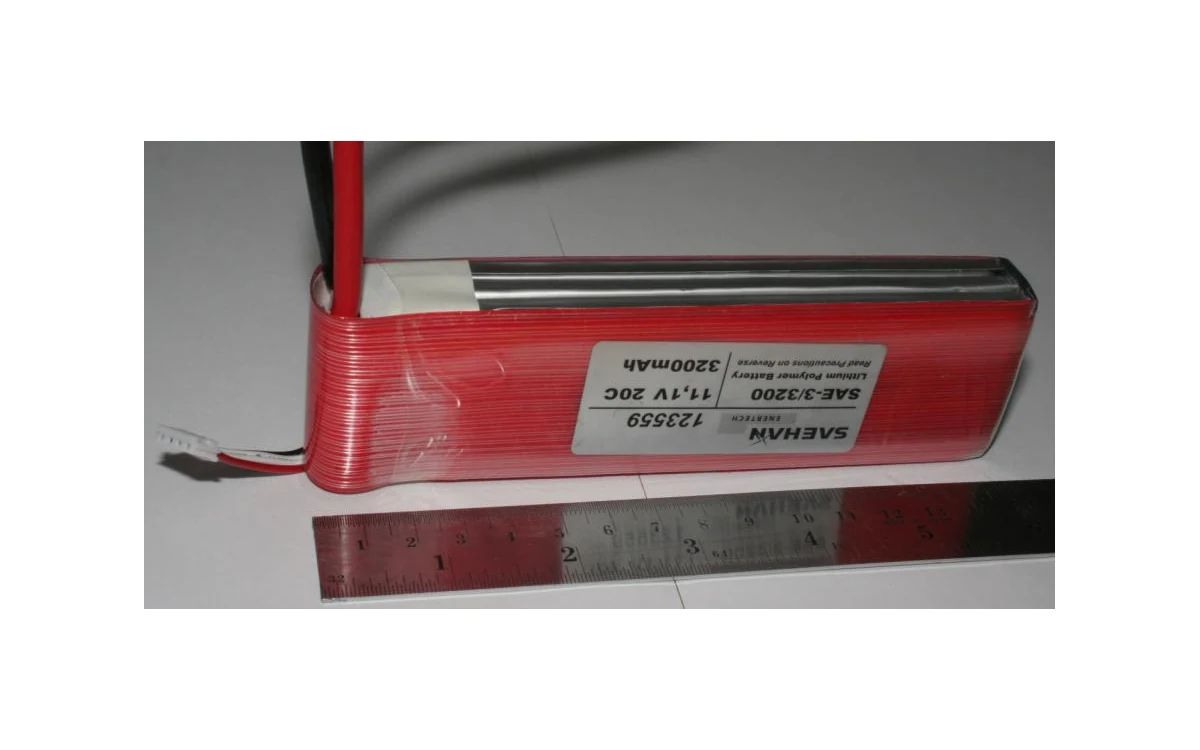
Retain the actual pack manufacturer, revision, configuration and rating conditions before comparing proposals. A nominal description should remain a description until the project has evidence defining what the installed system can deliver under its applicable conditions. No usable-energy percentage is established by the sources cited here.
Ask what conditions the supplied evidence represents
For the illustrative fixed-wing project, request the manufacturer’s discharge evidence for the intended operating load and temperature range. Ask how the tested pack’s identity and service condition relate to the proposed installation. If the available data concern a different configuration, record that difference instead of silently borrowing its performance.
The FAA guidance notes that rechargeable lithium batteries have electrical impedance characteristics that should be considered with other aircraft electrical-system components. It also discusses monitoring-system evaluation under expected environmental extremes. These points support an installed-system evidence question, not a generic correction factor that can be applied to any nameplate. [1]
Keep the supply-side question distinct from the mission-demand calculation. This article asks what evidence supports energy availability from a particular installed battery system. It does not calculate the aircraft’s climb, cruise, payload or transition demand. A complete mission review needs both sides, but one should not be invented to make the other appear adequate.
Define endpoints, protection and reserve assumptions
Ask the responsible battery and aircraft teams how the proposed usable-energy claim defines its starting condition and endpoint. Request the applicable protection and downstream supply constraints, rather than choosing a cutoff from a generic article. If the project uses a reserve concept, identify who established it and the evidence behind it; do not insert an arbitrary percentage.
The FAA document discusses capacity loss associated with over-discharge and warns that simple voltage observations may not reveal such loss. It also treats maintenance and state-of-charge issues as part of battery-system oversight. These are reasons to request appropriate battery records, not instructions to diagnose an installed pack from one terminal-voltage reading. [1]
For a fixed-wing VTOL derivative, ask whether the claimed available energy is supported for the proposed sequence of demands and supply constraints. Do not assume that an energy total alone resolves every phase’s power requirement. This remains a proposed evidence question, with no aircraft-specific electrical limit or operating threshold supplied here.
Make the measurement basis and uncertainty visible
ArduPilot’s common analog-module documentation describes voltage and current conversion settings, a current offset and comparison with independent meter readings in its supported setup context. Such information helps frame a monitoring-record request, but it does not provide a capacity test or validate the large aircraft’s installed battery. [2]
A proposed availability record should therefore retain pack identity, conditions, applicable endpoints, measurement definitions and uncertainty alongside the result. Ask whether the monitor includes all relevant supply paths and whether its calibration record applies to the data being used. Keep those questions distinct from the pack manufacturer’s nominal rating.
The defensible outcome for the hypothetical civil fixed-wing project is a conditional supply claim supported by identified evidence, or a clear statement that usable installed energy remains unestablished. Neither a nameplate nor a dashboard alone supplies an endurance guarantee. FAA guidance adds installation context, while the actual pack and aircraft still require their own applicable evidence and review.
Related reading
- Mission Energy Budgets Without Endurance Guarantees
- Tracking Structural Mass Growth During Payload Integration
Sources
- [1] Guidance on Testing and Installation of Rechargeable Lithium Battery and Battery Systems on Aircraft, AC 20-184A
- [2] Common Power Module
Visual summary
Concept illustration
Read diagram notes
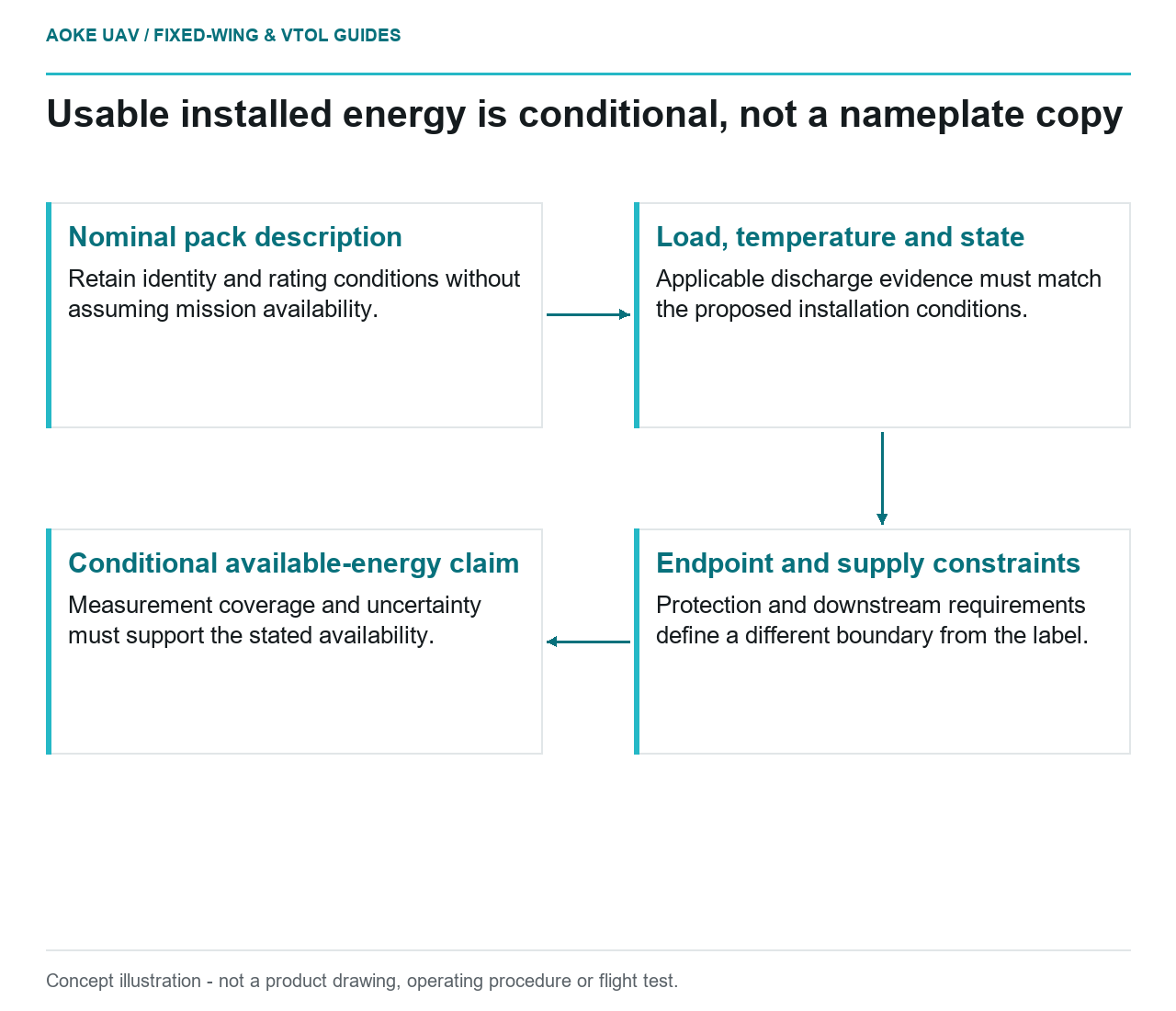
- Nominal pack description: Retain identity and rating conditions without assuming mission availability.
- Load, temperature and state: Applicable discharge evidence must match the proposed installation conditions.
- Endpoint and supply constraints: Protection and downstream requirements define a different boundary from the label.
- Conditional available-energy claim: Measurement coverage and uncertainty must support the stated availability.