Concept illustration
Read diagram notes
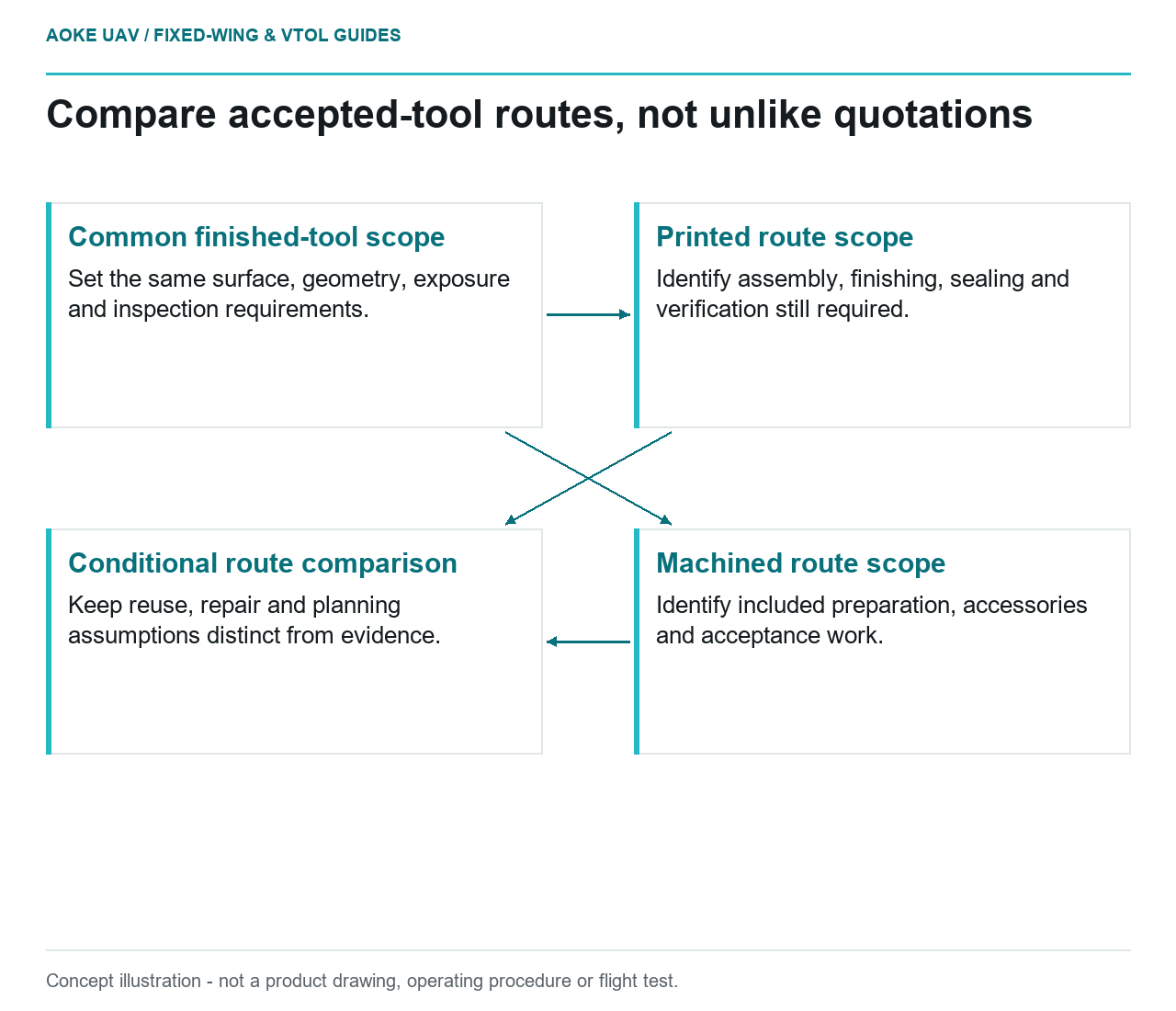
- Common finished-tool scope: Set the same surface, geometry, exposure and inspection requirements.
- Printed route scope: Identify assembly, finishing, sealing and verification still required.
- Machined route scope: Identify included preparation, accessories and acceptance work.
- Conditional route comparison: Keep reuse, repair and planning assumptions distinct from evidence.
A low-volume civil fixed-wing program must choose between a printed mold and a machined alternative. A quote for printing and a quote for a finished metal tool are not necessarily comparable. This hypothetical review asks what belongs inside the comparison boundary before any price is interpreted. It offers a cost-record structure, not fictional savings, an industry benchmark, or an observed GAUTEN purchasing result.
Tool requirements before process choice
Write a common requirement set covering the complete mold: geometry, finished surface, dimensional acceptance, manufacturing conditions, assembly interfaces, handling provisions, and intended use. Ask each supplier which requirements its proposal actually includes. A low purchase price is not a saving if the quotation excludes work required for the tool’s defined function. Keep unanswered scope items visible rather than assign them a guessed cost.
Stratasys identifies temperature, thermal expansion, tolerances, pressure and bagging conditions, preparation, and anticipated tool life as composite-tool design considerations. [3] Those categories are useful for defining equivalent requirements. They do not establish that a printed tool and a machined alternative are interchangeable, or that the OEM’s general cost discussion predicts the outcome of this specific fixed-wing project.
Finishing and verification effort
Request an explicit route from the quoted starting state to the accepted tool. Include design adaptation, support removal, assembly, finishing, sealing, inserted hardware, and required inspection where applicable. Stratasys explains that as-built FDM tooling generally requires post-processing for the desired surface and vacuum integrity. [3] A raw print quotation should therefore not silently stand in for an accepted finished mold.
Formlabs recommends inspecting printed aids against CAD and evaluating their functional performance. [4] In the hypothetical cost sheet, make labor, inspection access, external services, and disposition of failed checks visible. The same discipline applies to the machined option: identify which preparation, verification, or accessory items its quote includes rather than assume that a conventional manufacturing route arrives ready for every intended process.
Reuse and repair assumptions
State the intended quantity and planning horizon without pretending that tool life is already known. If a supplier claims reuse capability, ask for evidence applicable to the material, geometry, process conditions, and finishing system proposed. Keep replacement, maintenance, repair, storage, and reinspection assumptions separate from verified history. A hypothetical future reuse count is a planning assumption, not a demonstrated production result.
The Stratasys guide discusses tool repair and tool-life characterization in a specific FDM material context, with acknowledged limits to long-term evidence. [3] It does not supply a guaranteed life for every wing mold. A cost comparison should therefore show where uncertainty about life or repair affects the decision rather than turn a favorable assumption into an apparently precise unit-cost claim.
Scenario-based comparison boundaries
Use written scenarios when the program’s demand or reuse needs remain uncertain. For each scenario, identify the accepted-tool deliverable, included activities, quantity assumptions, supplier evidence, and unresolved items. Compare like scopes and show exclusions next to the quoted values. No numerical example is needed to demonstrate the method, and this article deliberately assigns no invented prices or savings percentages.
For the large fixed-wing program, the useful conclusion may be conditional: one route is preferable only if specific finishing, verification, or reuse assumptions are supported. Retain the basis of that judgment and revisit it when requirements or quotes change. The goal is a transparent procurement decision about a bounded tooling task, not a universal claim that additive manufacturing is always cheaper, faster, or more capable than machining.