Concept illustration
Read diagram notes
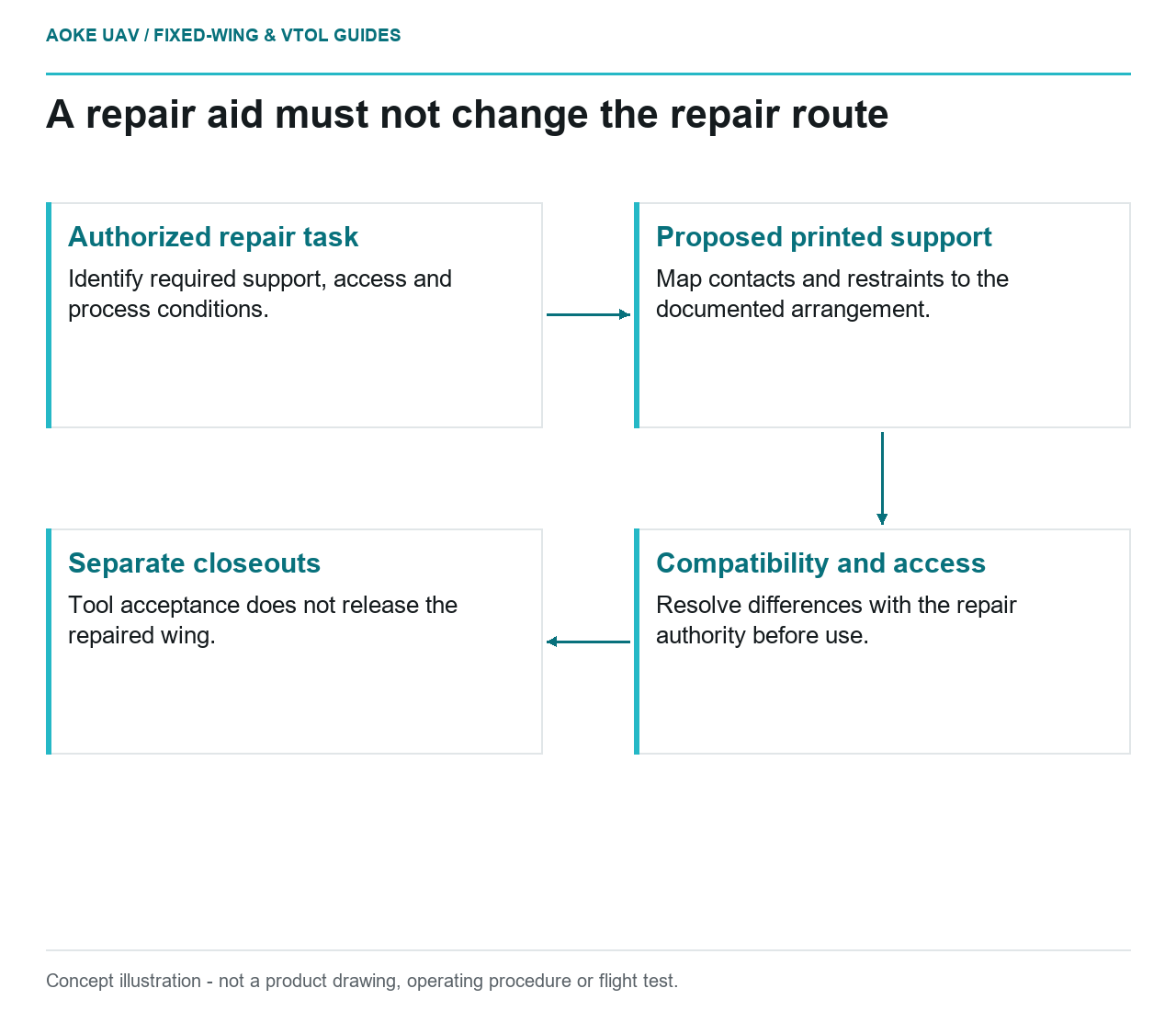
- Authorized repair task: Identify required support, access and process conditions.
- Proposed printed support: Map contacts and restraints to the documented arrangement.
- Compatibility and access: Resolve differences with the repair authority before use.
- Separate closeouts: Tool acceptance does not release the repaired wing.
A thin composite wing needs support during a repair, and its unusual contour suggests a printed cradle. The useful question is not whether a printer can reproduce the shape. It is whether the proposed aid can serve the task defined by the responsible repair authority. This hypothetical large fixed-wing survey aircraft already has an authorized repair route; the printed tool must not quietly change that route.
Repair instructions define the task
Start with the applicable repair documentation and aircraft configuration. Identify the work sequence, access requirements, support locations, and processing conditions that the instructions actually establish. If the proposed aid introduces a new contact location or changes how the workpiece is restrained, send that difference for review before use. Do not describe an informal fixture drawing as an approved repair method.
The FAA composite-structure circular discusses repair substantiation, documented damage limits, and the need for additional substantiation when damage falls outside existing repair data. That certificated-aircraft guidance provides context, not authorization for this UAV repair. Its relevance is the distinction between having a convenient aid and possessing applicable engineering evidence for the repair itself. [1]
Support geometry and access
In the proposed fixed-wing workshop review, map the tool contacts to the documented support arrangement. Ask whether the repair area, inspection features, bagging boundary, and installation path remain accessible. Use the model to identify conflicts, not to create new allowable loads. No support spacing, contact pressure, or permissible wing deflection is specified here because the aircraft-specific data is absent.
Formlabs recommends checking printed aids against their CAD models and assessing seating against locating surfaces and supports under the intended fixture function. That is useful for inspecting a proposed support artifact. It cannot show that the aircraft skin is allowed to carry a particular tool contact, especially if the repair involves a locally unsupported area. The airframe decision belongs in the repair review. [4]
Material and thermal compatibility
Request the actual printed material, finishing system, any pads, and the intended exposure conditions. The tool review should ask whether those items are compatible with the authorized repair process, including cleaning, adhesive handling, and any relevant heating sequence. A fit-check material selected for convenience is not automatically a suitable repair support. Leave unanswered compatibility questions open rather than substitute a generic polymer rating.
Stratasys organizes composite-tool design around cure temperature, thermal expansion, accuracy, pressure and bagging conditions, sealing, and anticipated tool use. These are OEM process-specific considerations, not a universal repair recipe. [3] For this scenario, compare the proposed complete support configuration with the actual repair instructions and seek the repair authority’s disposition where the two do not clearly agree.
Tool inspection and repair records
Give the support its own inspection identity and record which repair task and aircraft configuration it was reviewed for. Include contact-surface checks, assembled alignment, observed defects, and any restrictions on reuse. This is a proposed record structure rather than a claim about completed work. Keep the tool acceptance record available alongside, but not in place of, the aircraft repair record.
At closeout, separate the conclusions. The aid may have been acceptable for its defined ground role, while the repaired wing still requires the inspection and release specified by the repair authority. A replacement support does not close a repair discrepancy, and an accepted repair does not establish indefinite tool life. That separation lets a large fixed-wing team use custom tooling without disguising a change in repair engineering.