Concept illustration
Read diagram notes
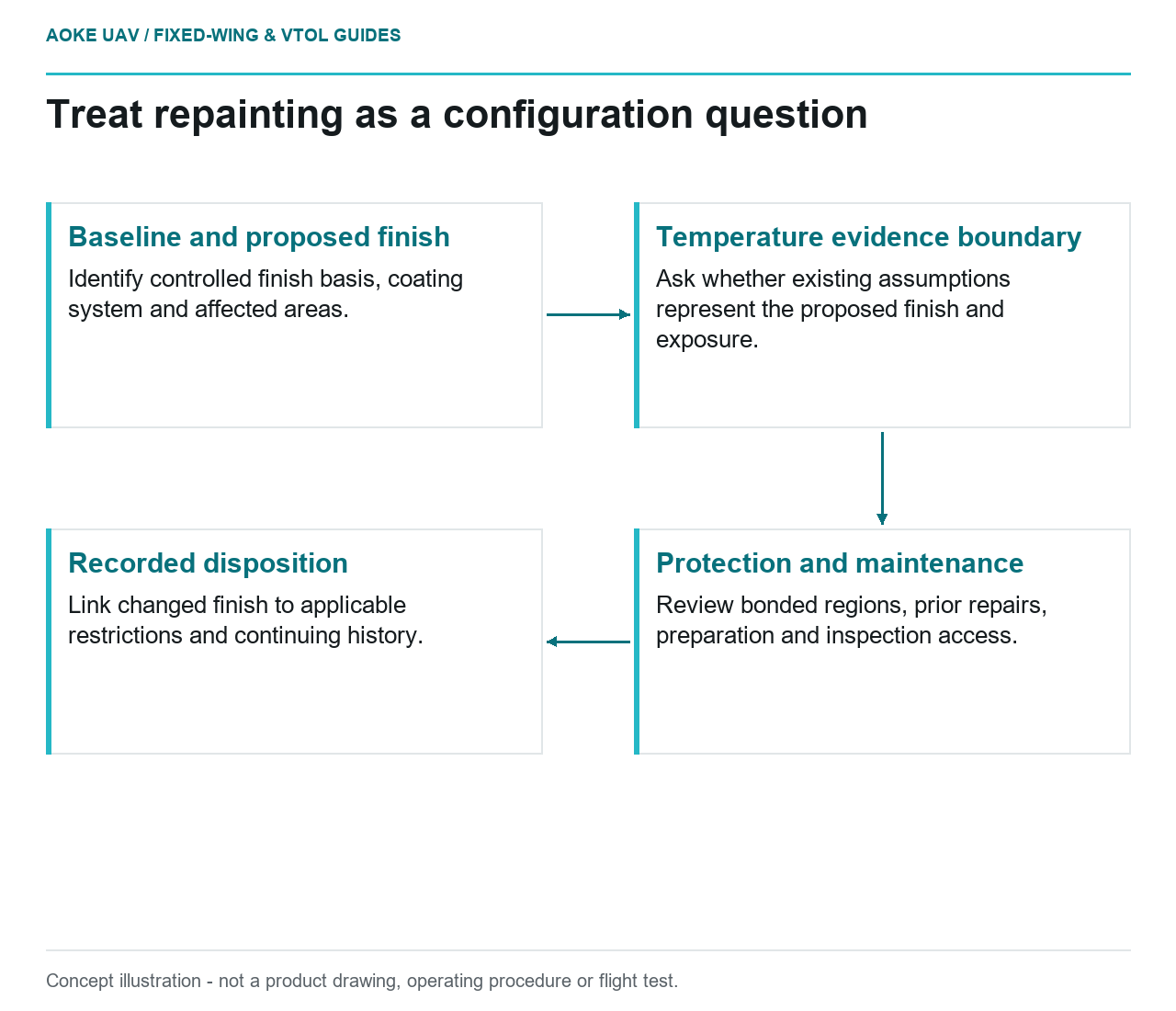
- Baseline and proposed finish: Identify controlled finish basis, coating system and affected areas.
- Temperature evidence boundary: Ask whether existing assumptions represent the proposed finish and exposure.
- Protection and maintenance: Review bonded regions, prior repairs, preparation and inspection access.
- Recorded disposition: Link changed finish to applicable restrictions and continuing history.
A new paint scheme can change more than a photograph. Imagine a proposed dark repaint on the composite fuselage of a hypothetical large fixed-wing civil survey aircraft. The question is whether the proposed finish remains within the material and structural assumptions already substantiated. This article offers a configuration-review framework, not a claim about an GAUTEN finish, a prediction of surface temperature, or a universal rule that one color is safe.
Solar heating and surface finish
FAA composite guidance explicitly includes repainting instructions and restrictions for paint colors that increase structural temperatures in its continued-airworthiness discussion. It also calls for identifying relevant thermal exposures in environmental design criteria. These statements support treating finish as a possible engineering input rather than assuming it is always cosmetic. The circular concerns certificated aircraft; it is contextual guidance here. [1]
For the hypothetical fixed-wing repaint, ask the responsible designer whether the original finish or finish family is controlled. Request the relevant drawing, maintenance instruction, or material restriction. If no finish basis is available, record that absence rather than replacing it with a general statement about light or dark colors. The proposed review concerns this construction and finish combination, not a color ranking for all composite aircraft.
Temperature assumptions in substantiation
Ask which structural temperature assumptions underpin the existing evidence and whether they account for the proposed finish and service exposure. FAA guidance calls for evidence that material design values are achieved under appropriate critical environmental conditions and notes that different details or failure modes may have different critical environments. [1] The implication for the review is to seek the actual evidence boundary, not a single temperature copied from a generic resin description.
For this large fixed-wing survey scenario, request an assessment that identifies affected areas, relevant materials, and any difference between the baseline finish and the proposed repaint. If temperature measurements are proposed, ask how they represent the intended conditions and how the responsible engineer will interpret them. A surface reading alone should not be advertised as complete substantiation for the whole fuselage.
Coatings near bonded joints
Coatings also belong in a maintenance and processing review. FAA guidance discusses protective surface layers and says repair must restore relevant protection. Its bonding discussion emphasizes qualified preparation and controlled handling of substrates. [1] These are reasons to request applicable refinishing instructions; they do not authorize an improvised stripping, cleaning, sanding, or bonding process.
In the hypothetical civil fixed-wing project, identify seams, bonded attachments, access panels, markings, and previously repaired regions on the repaint scope. Ask which areas have special restrictions in the actual documentation. Request how existing protection and inspection access will be preserved and how discrepancies discovered during preparation will be assessed. Do not assume a visually uniform finish proves that an underlying joint or earlier repair is unchanged. Keep finish application quality separate from the structural acceptance question.
Documenting a configuration change
Propose a change record that identifies the aircraft and affected parts, baseline finish reference, proposed coating system, scope of preparation, and the technical disposition. Include any revised maintenance instructions or restrictions issued by the responsible organization. These are recommended traceability fields for the scenario, not a regulatory form or a declaration that the repaint has been accepted.
FAA guidance connects manufacturing and maintenance records with substantiated changes and future damage disposition. It also identifies surface color and finish among factors relevant to visual damage detection. [1] For the large fixed-wing team, ask whether inspection instructions need review after the finish changes. A new scheme should not sever the connection between prior repairs, component history, and later inspections. Record unresolved questions explicitly so the next operator does not interpret a completed paint job as completed engineering acceptance.
Decision boundary
The useful decision boundary is whether the proposed repaint is covered by applicable material, process, temperature, and maintenance evidence. This article supplies no allowable paint color, coating thickness, or structural temperature limit. For the hypothetical fixed-wing fuselage, request configuration-specific review before treating the change as cosmetic; neither a bright finish nor a dark finish creates an automatic approval.