Concept illustration
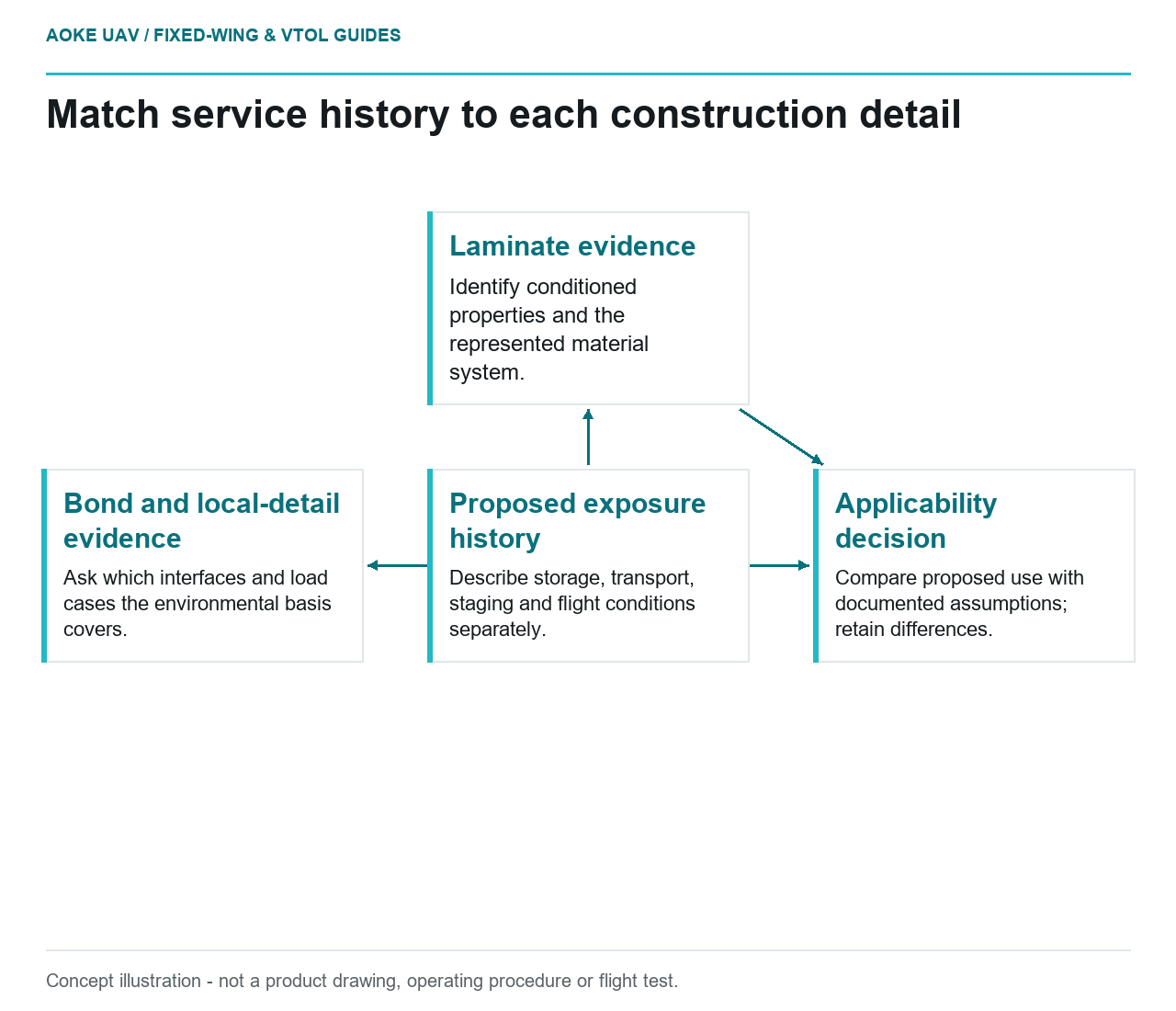
Read diagram notes
- Proposed exposure history: Describe storage, transport, staging and flight conditions separately.
- Laminate evidence: Identify conditioned properties and the represented material system.
- Bond and local-detail evidence: Ask which interfaces and load cases the environmental basis covers.
- Applicability decision: Compare proposed use with documented assumptions; retain differences.
A dry-room material value does not describe every service environment. Consider a hypothetical large fixed-wing aircraft proposed for recurring civil surveys in a humid industrial region. The review question is what environmental evidence applies to the actual laminate, bonds, and structural details across that service history. This is an original planning scenario, not a report of an GAUTEN aircraft’s environmental qualification or an authorization to operate in particular weather.
Environmental conditioning and material response
FAA composite guidance calls for environmental criteria that identify critical exposures, including temperature and humidity, and for evidence that relevant design values apply under the expected service conditions. It notes that the worst environment can differ among failure modes and structural details. “Hot-wet” is therefore a question to define, not a complete qualification label. This guidance concerns certificated aircraft and supplies context here. [1]
For the hypothetical fixed-wing survey program, request the environmental assumptions underlying the offered design evidence. Ask which materials, properties, loading conditions, and construction details were assessed. Separate ambient laboratory data from conditioned data and identify whether test conditions represent the intended use. Do not infer a service-temperature or humidity limit from a composite material’s generic description.
Adhesive and laminate may differ
Compare evidence for the complete construction rather than treating a laminate report as a report for every interface. FAA guidance emphasizes environmental durability for structural bonding, along with material and process qualification. It also notes that local details and differential thermal expansion may require consideration. [1] That supports asking how each significant material and interface is represented without claiming that all will respond identically.
In this proposed review, identify skins, bondlines, core where present, and attached materials on the actual configuration drawing. Ask what evidence supports each relevant detail under the environmental assumptions used in the structural assessment. If the package contains only dry laminate coupons, record the unaddressed interface questions. Do not manufacture a universal degradation percentage or assume that a more expensive adhesive automatically closes the gap.
Storage conditions versus flight exposure
Flight exposure is only one part of the proposed service history. For this scenario, ask the planning team to describe storage, transport, staging, and repeated deployment conditions separately from the airborne mission. Those are proposed inputs for a realistic exposure review, not proof that a particular hangar or container is harmful. Identify uncertainty where the future storage arrangement is not yet decided.
FAA guidance relates relevant moisture content to service life, thickness, diffusion properties, and realistic environmental exposure. It also discusses cycling and warns that accelerated methods should represent real environmental and loading exposure rather than chemically changing the material. [1] Request an explanation of how the selected conditioning represents the large fixed-wing aircraft’s proposed history. A short demonstration in a humid location would not, by itself, document all of those assumptions.
Evidence matched to the proposed environment
Organize the proposed evidence review by the decision being made. If the question is structural capability, request the analysis and tests connecting environmental effects to the critical properties and load cases. If it is protection or maintenance, request the applicable provisions and inspection instructions. FAA guidance addresses environmental effects on static strength, fatigue, and stiffness, and also discusses protection against service degradation. [1]
For the hypothetical civil fixed-wing platform, compare the proposed use with the documented environmental basis and list differences explicitly. Ask the responsible engineering organization to determine whether existing data is directly applicable or whether additional work is needed. Keep material data, structural substantiation, and operating documentation distinct. A report title containing “hot-wet” should not be treated as blanket evidence for all temperatures, exposure durations, bond systems, or fixed-wing configurations.
Decision boundary
The practical outcome is a matched set of environmental assumptions and applicable evidence, with unresolved differences identified. This article establishes no weather limit, drying procedure, life extension, or continued-service decision. Without the actual aircraft documentation, the honest fixed-wing planning conclusion is that suitability remains to be assessed, not that composite construction is inherently suitable or unsuitable for humid work.