Concept illustration
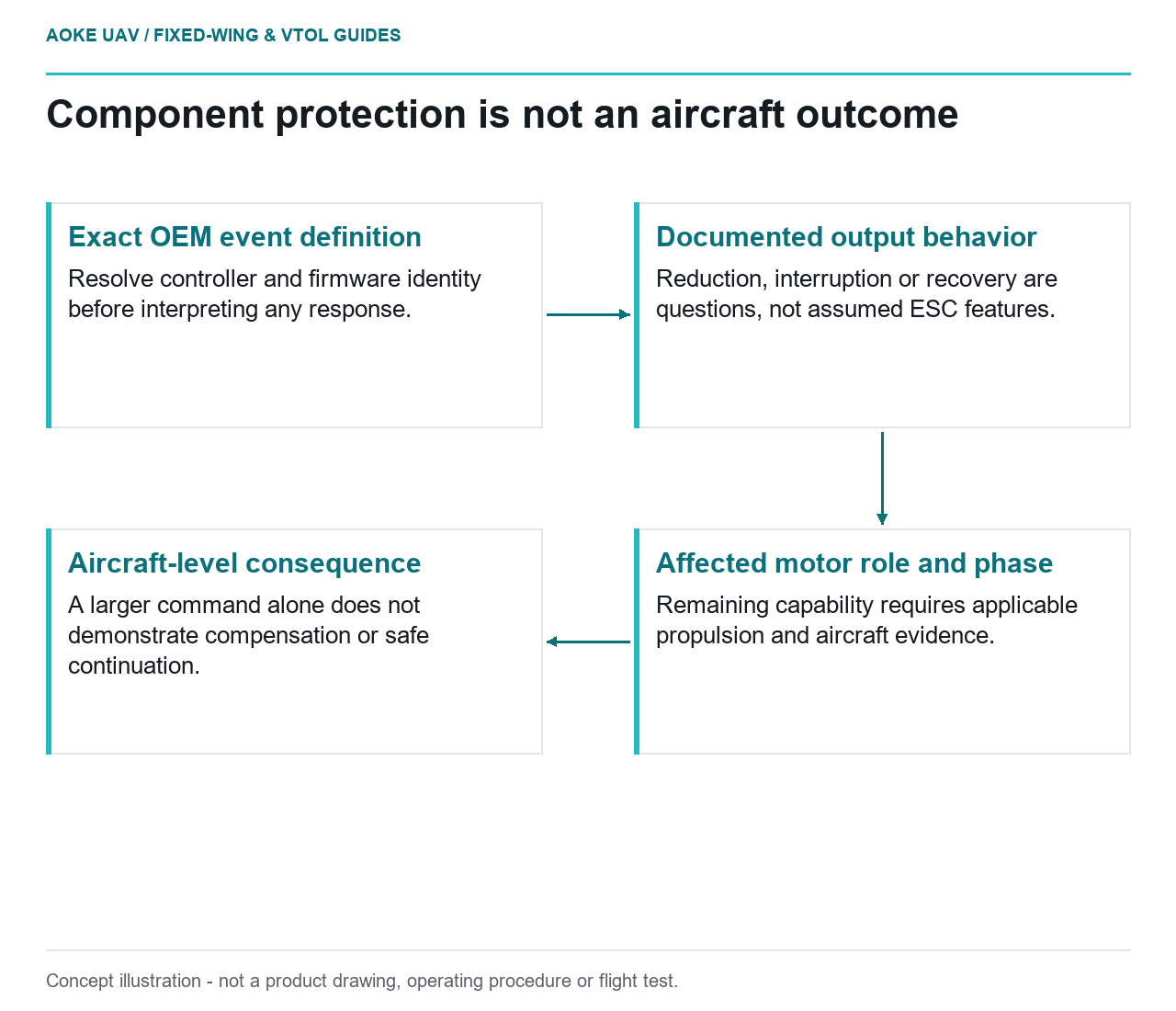
Read diagram notes
- Exact OEM event definition: Resolve controller and firmware identity before interpreting any response.
- Documented output behavior: Reduction, interruption or recovery are questions, not assumed ESC features.
- Affected motor role and phase: Remaining capability requires applicable propulsion and aircraft evidence.
- Aircraft-level consequence: A larger command alone does not demonstrate compensation or safe continuation.
Protection language is not an aircraft outcome
Imagine a hypothetical large fixed-wing VTOL aircraft supporting civil terrain surveys. Its integration review encounters a controller feature described simply as protection. The team still needs to know the resulting output behavior and how that behavior relates to the aircraft’s propulsion demands. This article proposes evidence questions, not a fault diagnosis or settings recommendation.
The available HOBBYWING example cannot establish the selected controller’s behavior: its printed body and PDF metadata disagree about model identity. It is retained only as a documentation example, not as a source of ratings or operational instructions for the proposed aircraft. Its protection sections show the kind of material that must be found in an applicable, identity-matched manual. [1]
Begin with the exact installed controller and firmware. Ask which document defines each response and whether that definition depends on mode or configuration. A feature name should remain incomplete in the review until the manufacturer explains what the controller does, under which conditions and with what recovery requirements.
Ask whether output changes gradually or stops
For the actual controller under consideration, request a response description rather than importing terminology from another unit. Ask whether a relevant event produces output reduction, immediate interruption, a restart attempt or another documented state. These are alternative questions to the OEM, not assertions that a particular selected ESC provides all those behaviors.
The conflicting-identity example contains discussions of temperature, voltage, current and signal-related protection. That establishes only the presence of those subjects in that document. It does not resolve the hypothetical aircraft’s controller model, behavior or thresholds, and none of its numerical settings should be copied into this review. [1]
Next ask what output remains available and how recovery occurs in the applicable implementation. Do not translate a phrase such as reduced power into an assumed remaining thrust. For the large fixed-wing aircraft, that would require applicable propulsion and aircraft evidence that these generic documents do not provide.
Examine the aircraft phase and control interaction
ArduPilot’s QuadPlane transition documentation warns that lift and forward motors can simultaneously operate at high levels during transition and discusses associated battery sag. This is relevant evidence that a transition can involve interacting propulsion demands within that documented system. It is not proof of the hypothetical aircraft’s operating envelope or a recommendation to copy its parameters. [2]
Use that distinction to structure the proposed review: identify which motor role is affected, which phase is under consideration and which other demands are present. Ask the aircraft team how a documented reduction or interruption would be assessed in those conditions. Do not presume the autopilot can compensate merely because it can issue a larger command.
Also ask whether the aircraft can identify the controller state from the available feedback. A command trace alone should not be labeled measured thrust. This is a proposed evidence boundary, not a claim about the telemetry capabilities of the selected controller. Retain the actual sensor and feedback definitions before interpreting the response.
Document recovery and unresolved consequences
A useful review record would place the OEM event definition beside its output response, recovery conditions, observability and affected propulsion role. Add the aircraft-level question still needing assessment. This is an original documentation method, not a safety-analysis standard or a complete hazard assessment.
For the hypothetical fixed-wing VTOL project, request applicable verification records through the responsible engineering process. Do not devise an in-flight fault-injection procedure from a general article. If the exact controller manual or approved project method is missing, the correct outcome is an unresolved evidence item rather than an improvised test instruction.
The central distinction is between protecting a component according to its own documented logic and demonstrating the consequences for the installed civil aircraft. These are separate questions. Without exact model behavior and aircraft-specific evidence, this review cannot establish safe continuation, landing capability or an acceptable operating setting. It can make the missing links visible before protection language is mistaken for system assurance.
Related reading
- Reviewing Structural Load Cases Across VTOL Transition
- ESC Command Interfaces: Compatibility Is More Than a Plug