Concept illustration
Read diagram notes
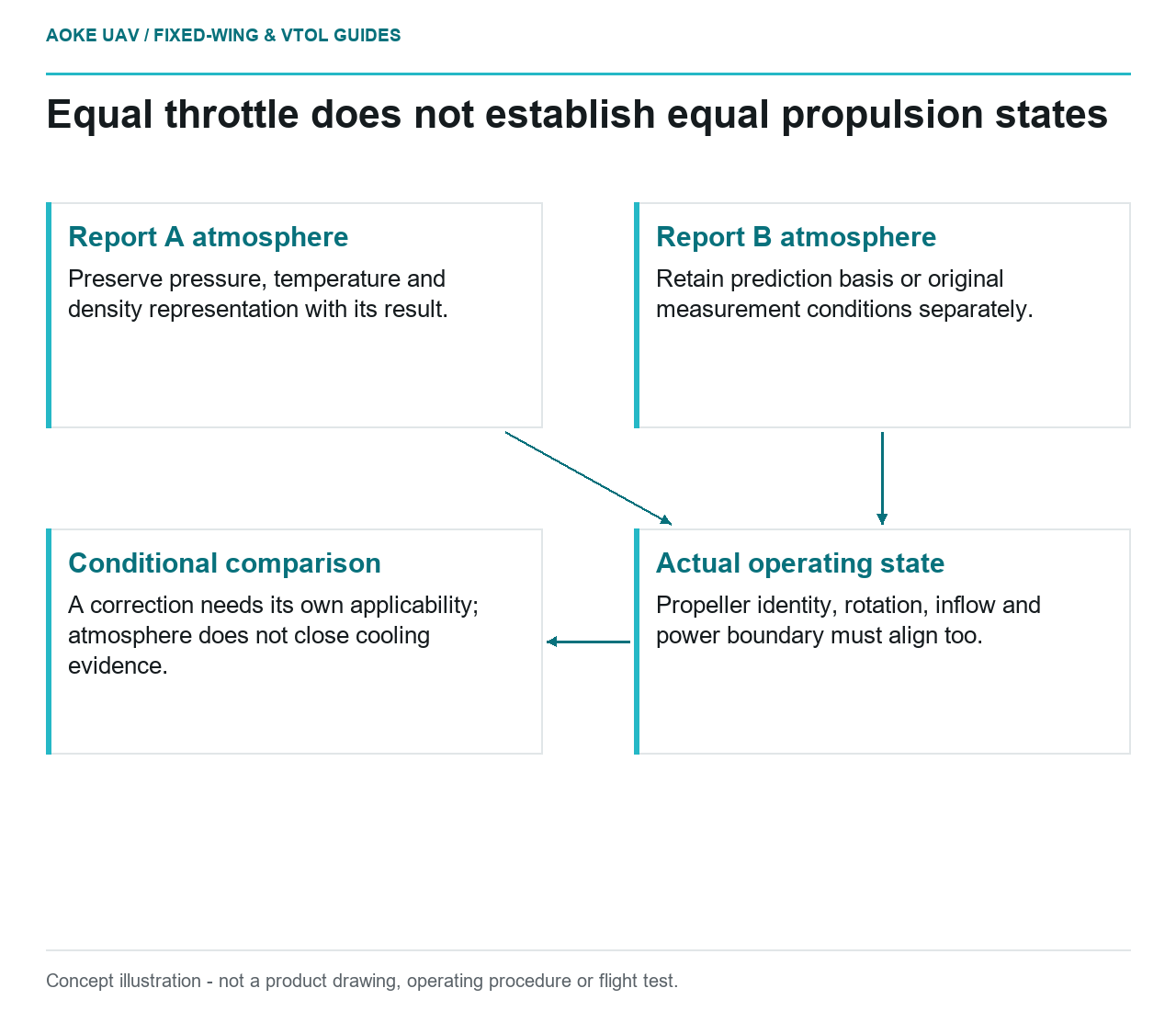
- Report A atmosphere: Preserve pressure, temperature and density representation with its result.
- Report B atmosphere: Retain prediction basis or original measurement conditions separately.
- Actual operating state: Propeller identity, rotation, inflow and power boundary must align too.
- Conditional comparison: A correction needs its own applicability; atmosphere does not close cooling evidence.
Two propulsion reports can use the same throttle label while describing different conditions. Before calling their results inconsistent, ask what each report actually held constant. For a large industrial fixed-wing integration review, atmosphere, rotational state and installation context belong beside the reported result. A tidy comparison table can otherwise conceal more uncertainty than it resolves.
Record the atmosphere behind the result
Consider a hypothetical civil survey airframe whose team receives a bench report from one site and a supplier prediction based on another atmosphere. This is an original comparison scenario, not an GAUTEN test. The team should first request pressure, temperature, relevant atmospheric assumptions and the method used to represent density. An altitude label alone should not substitute for the conditions or correction basis used in the report.
APC’s FAQ states that its calculated power, torque and thrust values use sea-level Standard Atmosphere conditions, and identifies the performance data as analytical.[4] This establishes the baseline of that particular source. It does not establish what the hypothetical aircraft will produce at a different site, nor does it authorize a correction formula for another manufacturer’s propeller.
In the proposed review worksheet, retain both the original reported condition and any corrected result, with the correction method attributed. Ask the supplier what variables its method changes and what assumptions remain fixed. Where the method’s applicability is undocumented, keep the comparison conditional rather than quietly converting every result into a supposedly universal sea-level equivalent.
Identify the operating state, not just throttle
Record propeller identity, rotational speed, forward-flow condition, drive configuration and measurement boundary. Treat equal throttle commands as insufficient evidence that these quantities match. This is a proposed evidence rule: the command should be recorded, but the comparison should be built from the states and measurements it actually produced. A mismatch then becomes a traceable question rather than a vague disagreement.
The UIUC Propeller Data Site explicitly concerns wind-tunnel measurements of small UAV and model-aircraft propellers. It also defines the Reynolds-number basis used for its static plots at a specified blade station.[8] The lesson for this large fixed-wing review is to preserve the dataset’s definitions and scope. Those measurements do not establish large-propeller performance merely because the same aerodynamic vocabulary appears in both reports.
Review cooling separately from aerodynamic conditions
Atmospheric comparison is not complete thermal substantiation. maxon’s generic motor guide describes continuous loading in relation to heat dissipation and stated ambient conditions.[1] That source does not rate the hypothetical aircraft motor. It does show why a motor report needs its own thermal context rather than assuming the propeller atmosphere entry explains every part of the propulsion system.
Ask whether supporting motor evidence represents an exposed installation, an enclosure or the proposed nacelle. Request the relevant initial temperature, measurement location and duration information from the actual supplier or engineering report. Do not infer an installed sustained rating from a brief observation, and do not prescribe a cooling change without the aircraft-specific analysis needed to evaluate it.
Compare like evidence before drawing conclusions
For the survey scenario, organize reports into measured, analytical and aircraft-installed evidence. Preserve software or document versions where available. Identify differences in atmosphere and operating point before attempting a numerical ranking. If a required input is missing, write a targeted supplier request: for example, confirmation of the atmospheric basis or the exact propeller used. Avoid labelling an undocumented difference a performance advantage.
The final comparison should state which conditions align and which remain unresolved. It may legitimately conclude that the reports cannot yet support a ranking. That is more informative than forcing unlike data into a single column. Large fixed-wing integration requires evidence relevant to the intended configuration; a familiar test atmosphere is only one part of that evidence chain.