Concept illustration
Read diagram notes
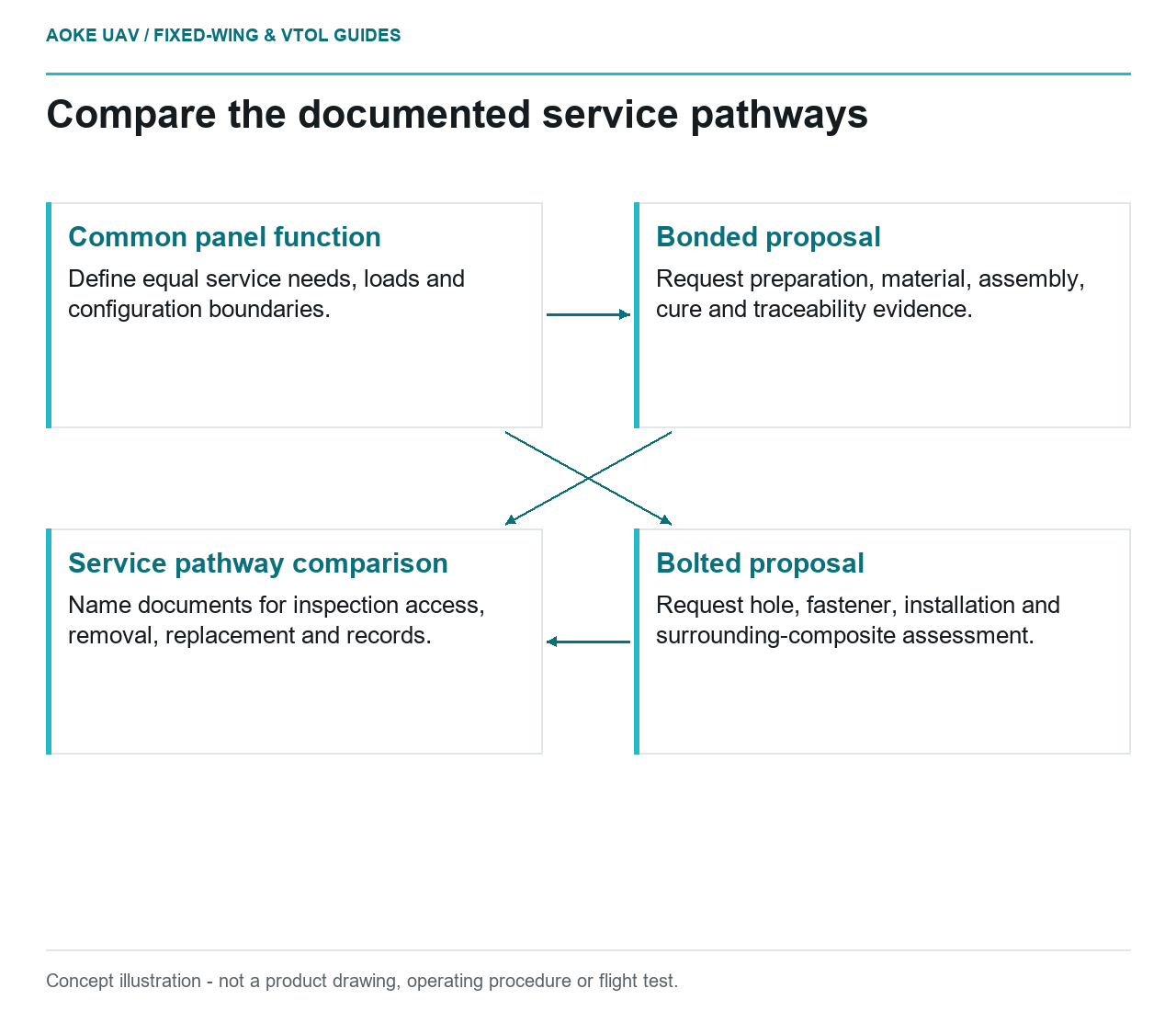
- Common panel function: Define equal service needs, loads and configuration boundaries.
- Bonded proposal: Request preparation, material, assembly, cure and traceability evidence.
- Bolted proposal: Request hole, fastener, installation and surrounding-composite assessment.
- Service pathway comparison: Name documents for inspection access, removal, replacement and records.
Compare service concepts, not just joining labels
A hypothetical civil mapping aircraft needs a large-wing panel that provides service access. Two proposed attachments are described as bonded and bolted. The useful comparison is not which label sounds stronger or simpler, but what each complete arrangement requires throughout inspection, disassembly and replacement. This is original decision reasoning for a large industrial fixed-wing concept, not a tested comparison of GAUTEN hardware.
FAA composite guidance discusses both controlled structural bonding and configuration-specific details such as holes and joints. It also requires attention to maintenance and repair access in its certificated-aircraft context. That provides a framework for evidence questions, not a universal preference or approval for either UAV attachment. [1]
Define what each concept actually does
Start by asking whether the panel is structural, nonstructural or part of a mixed arrangement, and which installed configuration the assessment covers. Identify the intended reactions and the route into the surrounding wing. For the comparison, do not quietly assign different loads or service functions to the two options and then attribute the difference to the joint type.
Ask the responsible engineer to explain how the bonded interface transfers the assessed loads and how the fastened arrangement transfers them. Include surrounding material, geometry and support in both explanations. A price for adhesive or a count of fasteners does not describe the full joint concept.
Identify the different evidence burdens
For the bonded proposal, request the qualified surface preparation, material controls, assembly and cure process, acceptance criteria and traceability. FAA emphasizes stringent process controls for structural bonding and cautions that weak adhesion is not automatically excluded by proof loading. A smooth seam is not a replacement for process substantiation. [1]
For the bolted proposal, request the assessment for the actual holes, fasteners, installation and surrounding composite. FAA identifies potential composite damage during special fastener installation and corrosion considerations at relevant interfaces. The existence of removable hardware does not establish a damage-free or universally repeatable installation procedure. [1]
In our hypothetical fixed-wing review, record the evidence title and configuration beside each concern. If one option has a drawing and substantiation summary while the other has only a brochure, record unequal evidence rather than presenting a false engineering tie.
Rehearse access and replacement
For each concept, sketch the proposed service sequence. What must be opened to reach the intended inspection region? Which tasks disturb the structural connection? What instructions govern return to the assessed configuration? Treat the sequence as a question set until actual maintenance documents are supplied.
FAA guidance says inspection and repair methods should account for field access and necessary documentation and training. Its maintenance discussion notes that practices substantiated for different aircraft types and models are not generally common. [1] Do not import a removal method, tightening value or repair step from an unrelated aircraft merely because the attachment looks familiar.
For the proposed access panel, ask whether a replacement changes the structure or simply restores a documented configuration. A concept advertised as maintenance-friendly should identify the equipment, skills and evidence needed, rather than leaving those requirements to a field crew’s improvisation.
Build a configuration-specific matrix
A useful editorial comparison matrix would contain these rows: load-transfer evidence, manufacturing records, initial damage detection, detailed inspection access, authorized removal process, replacement evidence and recordkeeping. Each cell should name a document or state that information is missing. Do not substitute a universal score for an unanswered configuration question.
Keep detection separate from characterization. FAA explains that visual indications provide limited information about hidden damage and that additional procedures are generally needed for full characterization. [1] Consequently, one visible fastener row and one clean bonded edge are not comparable demonstrations that all relevant damage can be found.
Choose the supported service pathway
For this large fixed-wing mission, a defensible decision would explain which documented service pathway fits the intended access needs and available maintenance resources. It need not declare an all-purpose winner. No GAUTEN panel design, bonding qualification or fastener installation limit was supplied. The open decision is therefore about the adequacy of the requested evidence, not permission to replace one joint concept with another.