Concept illustration
Read diagram notes
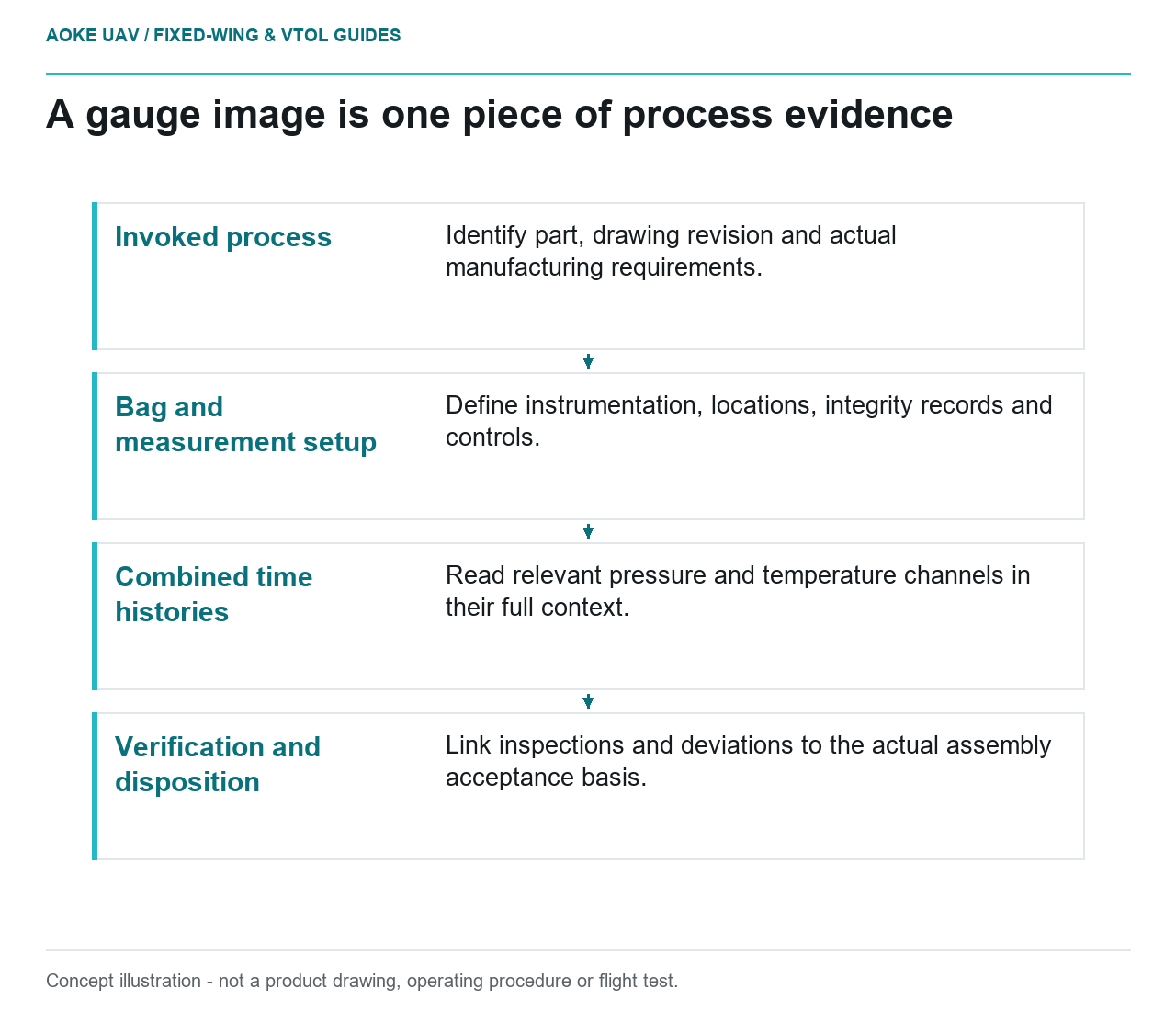
- Invoked process: Identify part, drawing revision and actual manufacturing requirements.
- Bag and measurement setup: Define instrumentation, locations, integrity records and controls.
- Combined time histories: Read relevant pressure and temperature channels in their full context.
- Verification and disposition: Link inspections and deviations to the actual assembly acceptance basis.
A hypothetical supplier presents a single vacuum-gauge photograph as proof that a large fixed-wing sandwich wing was processed correctly. The photograph may document one indication, but the review needs the specified process, its complete records and the connection to the actual assembly. This article asks what belongs in that evidence chain. It does not prescribe a vacuum level, leak criterion, cure pressure or temperature schedule. NASA process examples discussed here are scoped examples, not manufacturing instructions for an industrial UAV wing.
Specified consolidation process
Identify the part, drawing revision and invoked manufacturing process before interpreting the recorded values. Ask whether the assembly definition specifies the materials, process route and verification level represented by the supplied documentation. A record cannot be judged against an unspecified acceptance basis, even if the gauge display appears plausible.
NASA JSC’s sandwich assembly specification distinguishes manufacturing process types and ties use of the specification to the applicable drawing or CAD model. Cure and post-cure requirements refer to material and engineering documents. [2] This is a particular NASA process framework, not a qualification scheme for the hypothetical fixed-wing aircraft. Its useful lesson is documentary: first identify which controlled process applies, then ask whether the record demonstrates that process rather than an unrelated example.
Bag integrity and measurement locations
Request the bagging and measurement configuration relevant to the recorded process. Ask how instrumentation is identified, how measurement locations are defined and what records address bag integrity. Keep a distinction between the pressure indicated at a measuring point and the evidence used to accept the completed process. Do not infer uniform consolidation from a photograph alone.
NASA’s specification includes airtight bag assemblies, prevention of bridging, equipment calibration and tool-related controls within its scope. [2] Those are reasons to ask for the actual controlled requirements and records, not to import NASA’s numerical criteria into this wing. For the industrial fixed-wing review, ask how the supplier documented a leak, sensor problem or interruption if one occurred. An absence of explanatory notes is not proof that the process had no departures.
Temperature and pressure records together
Ask for the relevant time history and its connection to the part, equipment and process revision. The review should establish what pressure and temperature channels represent and how the acceptance decision considered them together. Do not interpret one favourable interval as a substitute for the specified cure record. Where a channel or part identity is missing, record the precise gap.
FAA guidance includes bagging, cure thermal management, tooling and dimensional control among manufacturing considerations that need control consistent with qualification. [1] NASA’s sandwich example likewise ties cure schedules to applicable documents and addresses temperature and pressure measurement equipment. [2] Neither source establishes a cure recipe for this fixed-wing wing. The question is whether the supplier’s recorded process matches the one substantiated for the actual material system and assembly.
Inspection and deviation disposition
Request the process-verification report, inspection findings and disposition of any deviations. Ask how an interrupted record, failed check or equipment issue affected the acceptance decision. A subsequent inspection result may contribute evidence, but the responsible authority must explain its relevance; the reviewer should not invent a rule that inspection automatically cancels a process departure.
NASA’s Level 1 example includes defined mandatory inspection points and traceable verification records, while the FAA calls for manufacturing records supporting parts acceptance and allowable discrepancies. [2] [1] For the hypothetical large fixed-wing procurement, the closing record should link the assembly, specified process, actual histories and disposition. Keep manufacturing conformance distinct from a claim of whole-wing strength. A gauge image can remain part of the record without being promoted into proof of an entire sandwich assembly’s quality.