Concept illustration
Read diagram notes
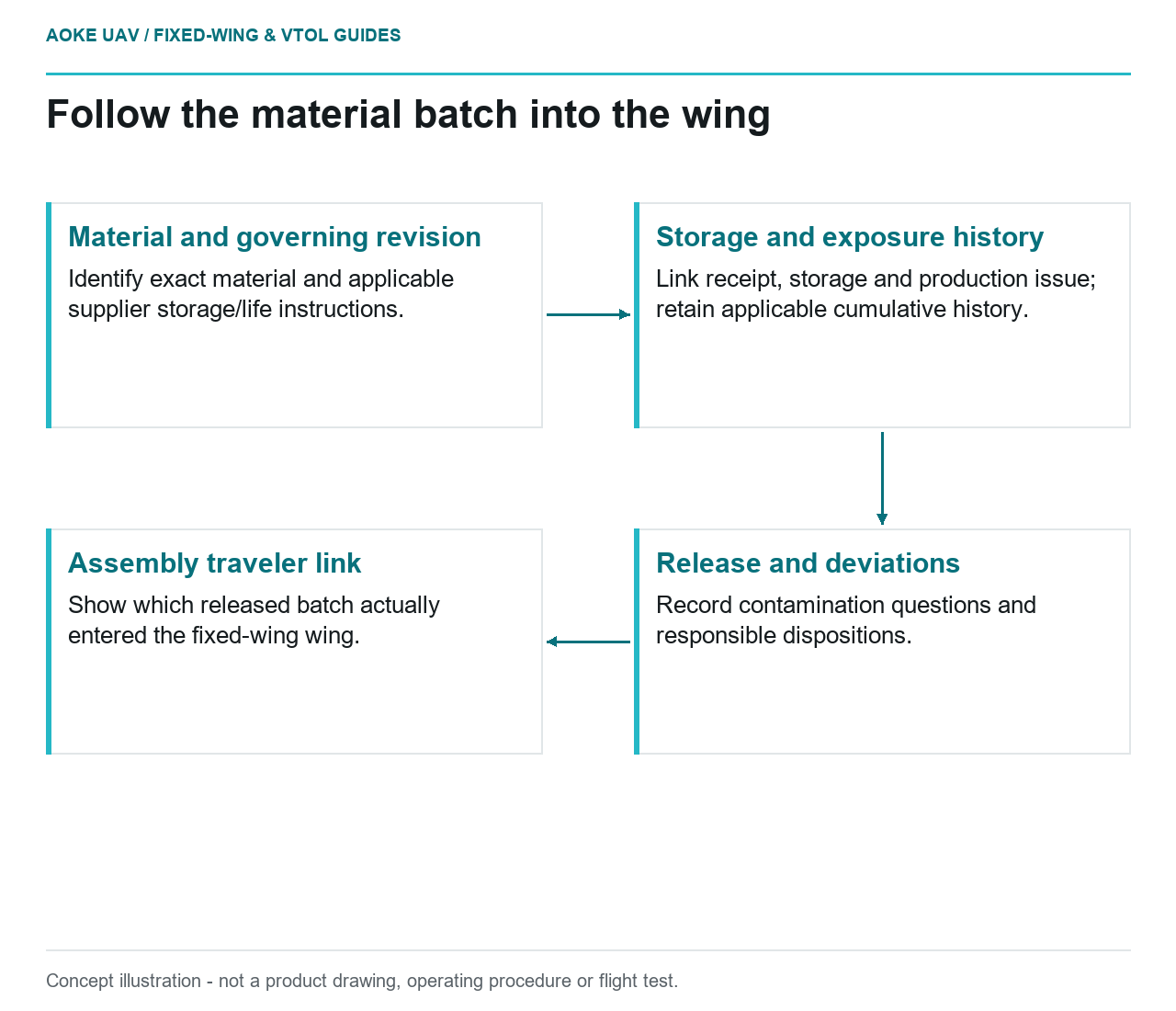
- Material and governing revision: Identify exact material and applicable supplier storage/life instructions.
- Storage and exposure history: Link receipt, storage and production issue; retain applicable cumulative history.
- Release and deviations: Record contamination questions and responsible dispositions.
- Assembly traveler link: Show which released batch actually entered the fixed-wing wing.
A hypothetical large fixed-wing survey wing has a complete-looking fabrication traveler, but the adhesive record identifies only a product name. The review needs to establish which batch was used and whether its storage and exposure history met the applicable material definition. This article concerns evidence before and during manufacture, not a universal resin-storage guide. It supplies no refrigerator setting, shelf life, thaw duration or method for extending expired material. Any actual release decision belongs with the applicable supplier documentation and responsible manufacturing authority.
Supplier storage requirements
Ask for the exact material identity and the supplier document governing its storage and life limits. Distinguish the purchasing label from the controlled specification used in the build. The review should identify which revision applied when the material was released, rather than silently evaluating a historical batch against an unrelated product’s current brochure.
NASA JSC’s sandwich specification bases raw-material storage on applicable Material Data Sheets or vendor recommendations and requires management of specified life limits. [2] It is a NASA manufacturing specification, not a general UAV procedure. The relevance to the hypothetical fixed-wing wing is the evidence structure: material identity, applicable instructions and a traceable record of conformance. Do not transplant the document’s specific cold-storage conditions to every adhesive or resin used in an industrial aircraft.
Batch dates and exposure history
Connect receipt, batch identity, storage record, issue to production and the assembly traveler. Ask how partial rolls, containers or kits remain traceable after use. If dates are recorded in different systems, request a reconciliation rather than assuming that the labels describe the same release event. Keep uncertain entries visible for disposition.
NASA’s specification treats out-time for cold-storage materials as cumulative and calls for traceable records when out-time or shelf-life limits apply. [2] For this hypothetical fixed-wing review, ask which materials have such limits and what intervals the supplier counts under their actual instructions. Do not assume that returning material to storage resets an exposure history, nor invent a permitted exposure period. The controlled material requirements must establish the accounting rule for the batch in question.
Handling and contamination controls
Request the handling and contamination controls relevant to the documented material process. Ask how opened packaging, preparation stages and suspect contamination are represented in the record. The purpose is to identify the applicable controls and deviations, not to prescribe a generic cleaning method. A clean-looking container cannot supply a missing exposure or release history.
FAA guidance includes material handling, storage and cleanliness within manufacturing and bonding controls, while NASA’s sandwich example includes contamination provisions and documented nonconformance when suspected contamination cannot be dispositioned. [1] [2] Those sources frame the questions but do not diagnose a specific batch. For the large industrial fixed-wing build, separate an observed issue from its technical consequence and ask the responsible authority to establish the appropriate disposition.
Material release tied to the assembly
Follow the released material into the actual assembly record. Ask which batch references appear in the traveler and how exceptions, requalification or rejected material were documented. A supplier certificate and a storage log have different roles; together they still need a clear link to the material used on the wing. Do not rewrite a missing link as an implied pass.
FAA guidance expects manufacturing records to support parts acceptance and substantiated discrepancies, and NASA’s example retains traceable process-verification records. [1] [2] For this hypothetical fixed-wing procurement, a satisfactory handoff identifies what was used, which requirements applied and how departures were resolved. It does not grant a new shelf life or guarantee structural performance from the existence of a certificate. An unresolved storage-history gap should remain explicit in the evidence pack until properly reviewed.
Related reading
- Bond Preparation Records for Composite Airframes
- Feedstock Storage Records for Repeatable Printed Tools