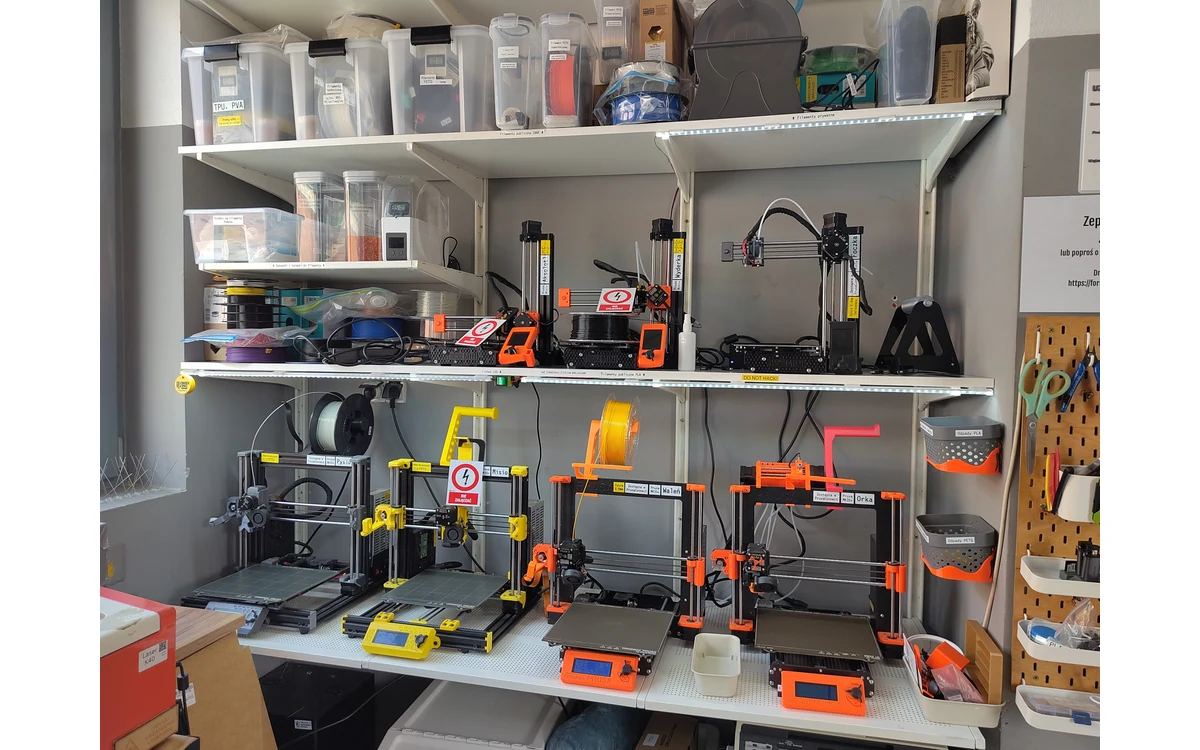
Halfway through producing a segmented wing tool, a workshop proposes using another printer and a similarly named polymer. The CAD files would stay the same, so the change is described as a repeat build. In this hypothetical large fixed-wing civil program, the review must distinguish repeated geometry from repeated manufacturing conditions. The question is what evidence remains applicable after the proposed changes, not whether the substitution is convenient.
Machine and process configuration
List the original accepted machine and process definition alongside the proposed one. Include equipment identity, relevant software and firmware, orientation, toolpath definition, and authorized processing parameters. Do not record only the model name if the actual controlled definition distinguishes individual equipment or parameter sets. The purpose is a reviewable difference list, not an assumption that every change necessarily produces an unacceptable tool.
NASA-STD-6030 identifies machine-specific process variables and emphasizes that machine configuration, settings, and software versions matter to process definition. Its spaceflight framework also places qualified processes under configuration control. [5] That provides a disciplined way to ask about change, not direct UAV approval criteria or proof that a replacement printer is equivalent to the original.
Material version and supplier
Confirm the exact feedstock definition and actual supplier documentation for both candidates. Similar polymer family names or marketing categories are not an equivalence demonstration. Ask what evidence covers the finished construction under the tool’s intended conditions. If properties are compared, require the reviewer to establish whether material state, specimen manufacture, directions, and conditioning make that comparison relevant to the proposed use.
For this fixed-wing tool set, note where old and new sections would meet. A change may need review at assembled interfaces even if each section independently meets a basic dimensional check. Stratasys emphasizes thermal expansion and process conditions in composite tooling design. [3] That is a reason to request application-specific evidence, not a prediction of mismatch or a numerical compensation instruction for the proposed materials.
Post-processing and sealing steps
Compare the entire route to the finished tool. Identify support removal, finishing, machining, joining, sealers, and other steps that form the accepted configuration. Do not stop the change review at the printer door. NASA includes post-AM processing in candidate process definition, while Stratasys describes finishing and sealing as contributors to surface quality and vacuum integrity in its tooling applications. [5] [3]
A proposed replacement may therefore need its own instructions rather than reuse an old finishing recipe without review. Record which steps are unchanged, which changed intentionally, and which are unresolved. No sealer, cure cycle, or material treatment is selected here. The responsible tool and process authorities must determine what the new combination requires before it is described as an accepted substitute.
Reverification plan for changed builds
Set the review scope before producing acceptance evidence. Identify the features, assembly relationships, and process functions potentially affected by each change and the criteria that govern their evaluation. NASA describes methodology for modification and requalification of part processes within its own spaceflight system. [5] The relevant conceptual lesson is proportionate, documented change review rather than either automatic equivalence or automatic rejection.
Close this large fixed-wing tooling decision with a controlled configuration and an explicit applicability statement for the evidence. Record any restrictions on mixing old and replacement sections. A valid change review may preserve some earlier evidence and require new evidence elsewhere; it should explain that reasoning. It cannot be replaced by a matching file name, a successful print, or an unsupported claim that a similar polymer is the same engineering material.
Related reading
- Manufacturing Changes That Deserve Structural Review
- Feedstock Storage Records for Repeatable Printed Tools
Sources
- [5] NASA-STD-6030: Additive Manufacturing Requirements for Spaceflight Systems
- [3] FDM for Composite Tooling: Design Guide 2.0
Visual summary
Concept illustration
Read diagram notes
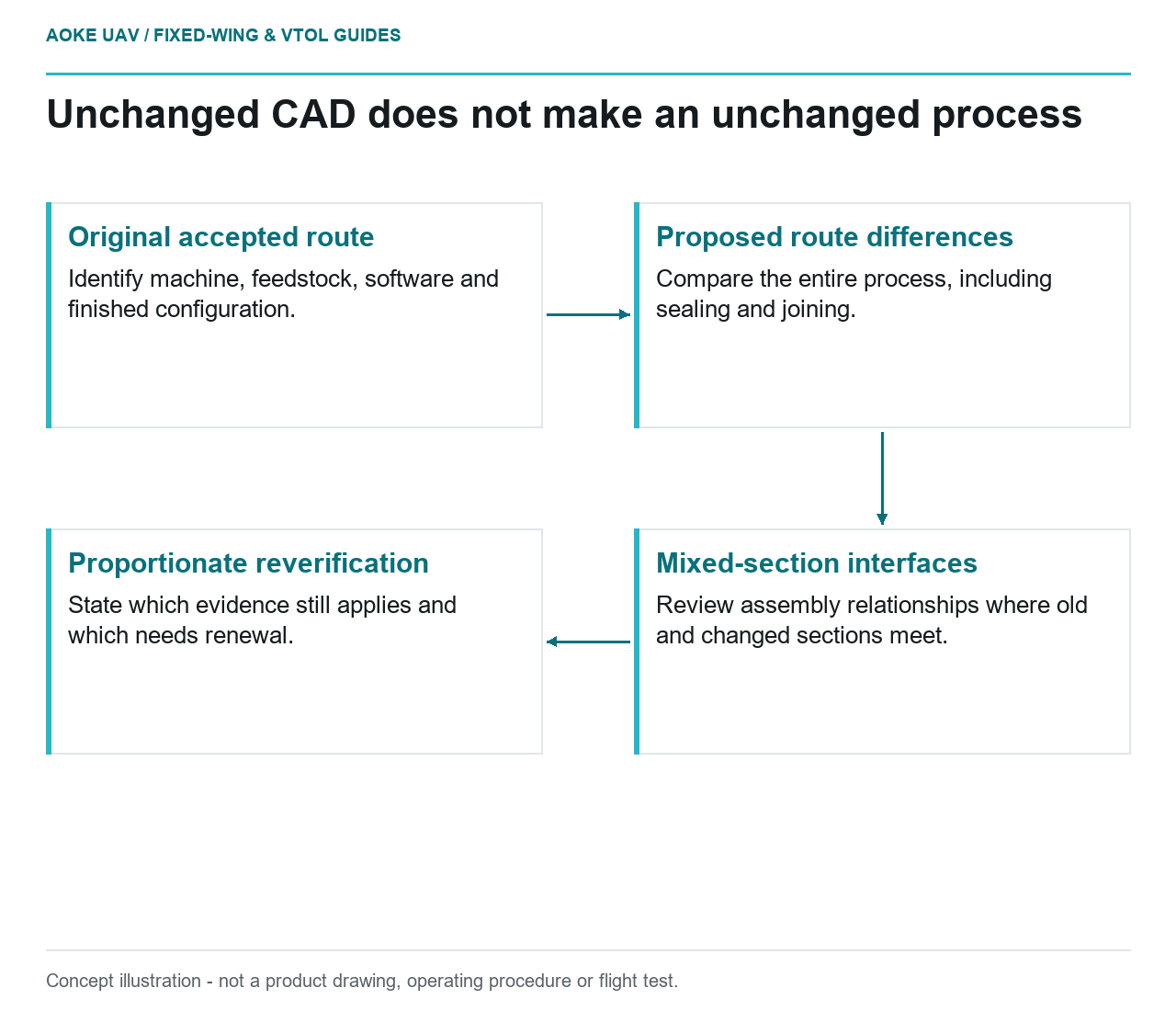
- Original accepted route: Identify machine, feedstock, software and finished configuration.
- Proposed route differences: Compare the entire process, including sealing and joining.
- Mixed-section interfaces: Review assembly relationships where old and changed sections meet.
- Proportionate reverification: State which evidence still applies and which needs renewal.