A hypothetical supplier proposes a new resin trade name for a composite wing used in large fixed-wing civil surveying. The proposal describes it as a minor production substitution. Before accepting that description, the customer needs to know exactly what changed and which existing evidence still applies. This article concerns change identification and structural review, not a list of interchangeable materials. No replacement resin, cure cycle or manufacturing deviation is approved here, and no similarity in appearance or marketing language establishes equivalence.
Material substitution and supply batches
Create a precise before-and-after description. Identify material designation, specification revision, reinforcement form, supplier and the attributes the responsible design authority considers significant. Distinguish a new supply batch within an existing controlled definition from a change to that definition. Neither should be left as a vague note saying equivalent material.
FAA guidance states that fabrication-process changes require additional qualification, including testing of differences, and that material specifications are tied to qualification results. [1] This is US certificated-aircraft guidance, not an automatic rulebook for the hypothetical fixed-wing UAV. Its value is the review question it raises: what evidence supports the proposed substitution in this structure? Ask for the supplier’s applicability assessment rather than comparing trade names or assuming that a newer product must be better.
Tooling and cure process changes
Include tooling and thermal-process changes in the same change description. Ask whether the altered tool, equipment or procedure remains within the qualified process definition. Record the actual revision rather than keeping the old traveler title while changing the work underneath it. A stable part number does not explain whether the manufacturing method has changed.
The FAA includes thermal management, tooling, bagging and technician-specific procedures among controlled manufacturing considerations. [1] For this hypothetical industrial fixed-wing wing, the reviewer should ask how the revised process was demonstrated to be repeatable and what differences were evaluated. Do not infer the acceptability of a new cure schedule from a visually similar finished panel. This article provides no temperature, pressure or timing values to use as a substitute process.
Joint geometry and inspection changes
Ask whether any mating dimensions, bond definition, machining operation or inspection method changes alongside the material proposal. A substitution may be accompanied by other revisions that require their own applicability assessment. Keep those revisions individually visible so that a favourable material result does not silently answer an unrelated joint or inspection question.
FAA bonding guidance links structural quality to process controls, while its manufacturing discussion requires substantiation for allowable discrepancies. [1] Apply those ideas by requesting the revised acceptance plan and the evidence supporting it. For the fixed-wing assembly, distinguish evidence that a part can be manufactured from evidence that its structural detail meets the intended requirements. A new inspection result cannot automatically compensate for an unassessed change to what the inspection is expected to detect.
Evidence and approval of revised configuration
The final review package should state the changed attributes, affected configurations, evidence used and any limits on applicability. Ask the design authority to identify the disposition and the record linking it to individual assemblies. Preserve old and new revisions so that an installed wing can be associated with the correct manufacturing definition later.
FAA guidance calls for manufacturing records for substantiated design and process changes and discusses qualification of new suppliers through trials and quality assessment. [1] Neither point means this hypothetical fixed-wing product has received certification or that a supplier declaration alone resolves every change. The practical decision is whether the revised configuration has a documented, applicable basis. If the evidence is incomplete, the outcome should remain an unresolved change request rather than an unsupported statement of interchangeability.
Related reading
Sources
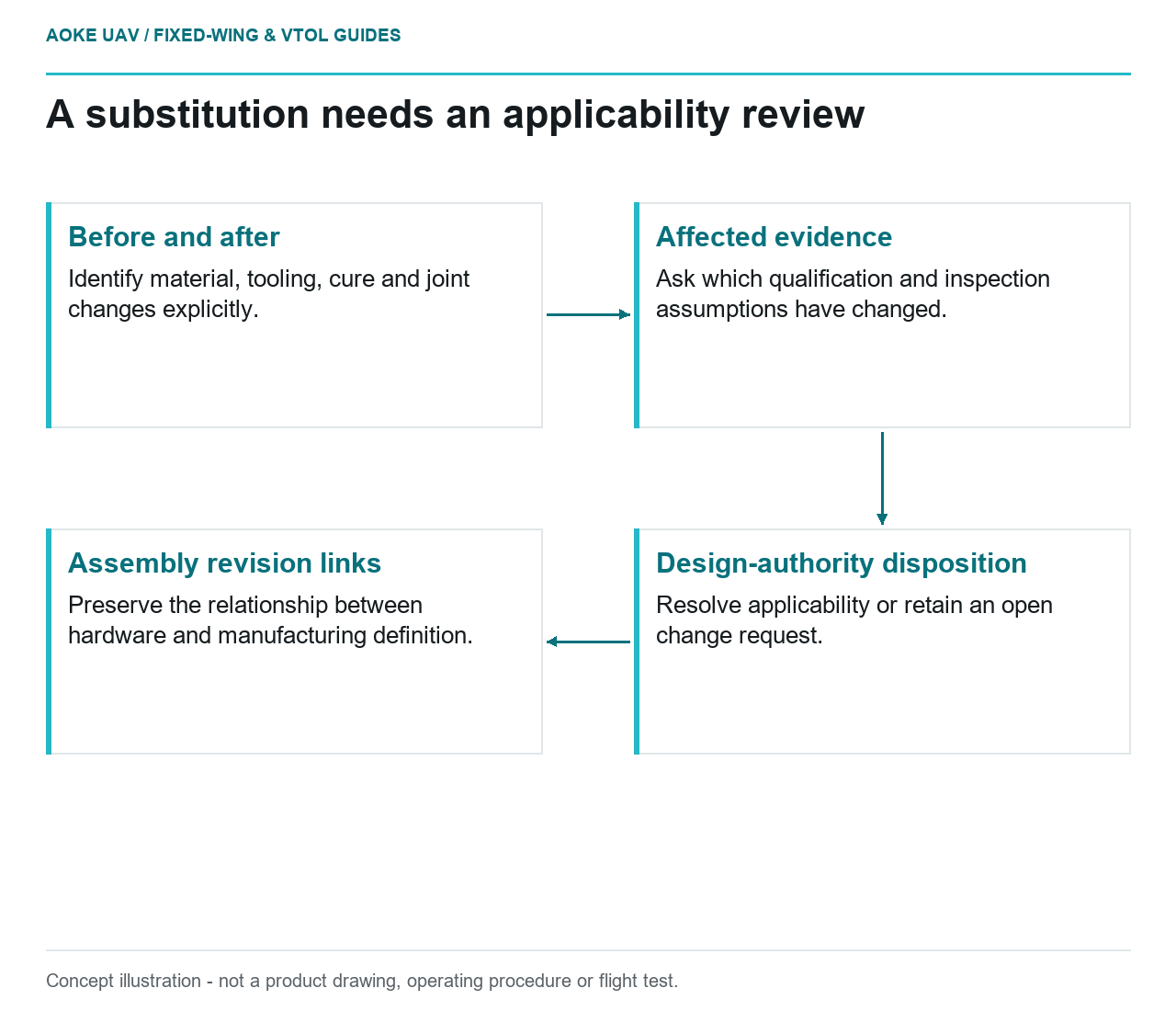
Visual summary
Concept illustration
Read diagram notes
- Before and after: Identify material, tooling, cure and joint changes explicitly.
- Affected evidence: Ask which qualification and inspection assumptions have changed.
- Design-authority disposition: Resolve applicability or retain an open change request.
- Assembly revision links: Preserve the relationship between hardware and manufacturing definition.