Concept illustration
Read diagram notes
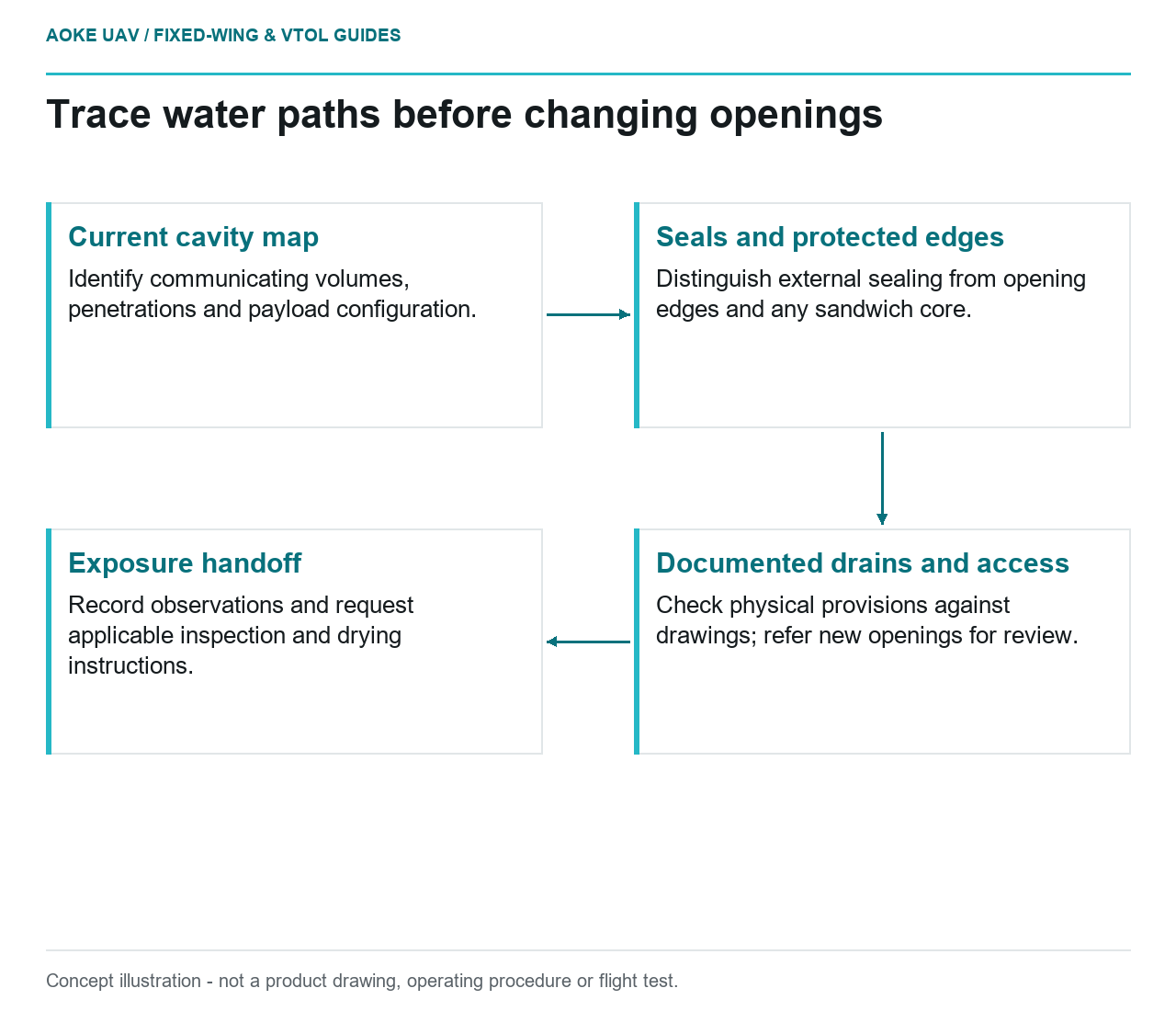
- Current cavity map: Identify communicating volumes, penetrations and payload configuration.
- Seals and protected edges: Distinguish external sealing from opening edges and any sandwich core.
- Documented drains and access: Check physical provisions against drawings; refer new openings for review.
- Exposure handoff: Record observations and request applicable inspection and drying instructions.
Imagine a large fixed-wing survey aircraft returning from a damp coastal deployment. Water appears near a payload hatch, but the visible opening does not identify every volume that might have been exposed. This hypothetical review concerns the route between entry, retention and inspection, not permission to operate in rain. A useful drainage discussion starts with the aircraft configuration and its documented provisions. It should end with questions that the design authority can answer, rather than a workshop decision to add holes.
Closed cavities and likely water paths
Draw a cavity map for the hypothetical fixed-wing fuselage, wing roots and removable panels. Mark service openings, cable penetrations and the boundaries between compartments. Ask which volumes communicate, which remain inaccessible and whether the drawing represents the current payload installation. Treat the resulting map as a review aid, not evidence that the assembled aircraft is watertight.
The FAA composite guidance discusses environmental exposure and calls for ventilation and drainage where necessary. It does not supply universal drain locations or dimensions. Its context is US certificated aircraft structure, so these principles are background for asking an industrial UAV supplier about the particular design, not an approval applicable to this scenario. [1]
Core edges and hardware openings
At a payload penetration, distinguish the external seal, the opening edge and any sandwich core behind it. Ask the supplier to identify the intended sealing detail and the inspection method for that detail. A dry outer surface would not answer whether the installation has retained its specified edge protection.
NASA JSC’s sandwich assembly specification illustrates how core preparation, potting and insert-related work are tied to drawings and detailed process instructions. That document is a NASA manufacturing specification, not a field sealing procedure for the fixed-wing aircraft. Its relevance here is the need to identify the controlled construction behind an apparently simple opening. Do not transfer its manufacturing dimensions or materials into an unidentified UAV. [2]
Drain access without structural improvisation
For each documented drain, ask how a maintainer reaches it and how blockage is assessed under the actual maintenance instructions. Record whether a cradle, temporary cover or newly installed payload obstructs access. Request an explanation for any apparent mismatch between the physical assembly and its drain drawing before changing either.
A proposed new opening needs design review because it changes the structural detail as well as the water route. The FAA discusses holes and other discontinuities as features requiring configuration-specific structural substantiation. A hole that releases visible water is therefore not automatically an acceptable modification. Do not drill, enlarge or relocate a drain on the strength of this explainer. [1]
Inspection after moisture exposure
After the hypothetical exposure, build a factual handoff: aircraft and panel identities, exposure circumstances, observed water locations, photographs and any deviation from the documented configuration. Keep observations separate from conclusions about internal damage. Ask the responsible maintenance organization which inspection and drying instructions apply; no drying temperature or return-to-service criterion is established here.
FAA maintenance guidance specifically includes part drying and documents the limitations of visible damage indications. Those points explain why draining free water alone cannot establish the condition of every affected interface. [1] For this large fixed-wing mission, the decision record should distinguish three unresolved questions: where water travelled, what inspection is applicable and whether the aircraft’s actual environmental qualification covers the proposed deployment. A clean drain answers only part of that review. Retain the cavity map with the payload configuration so that later equipment changes reopen the right questions.