Concept illustration
Read diagram notes
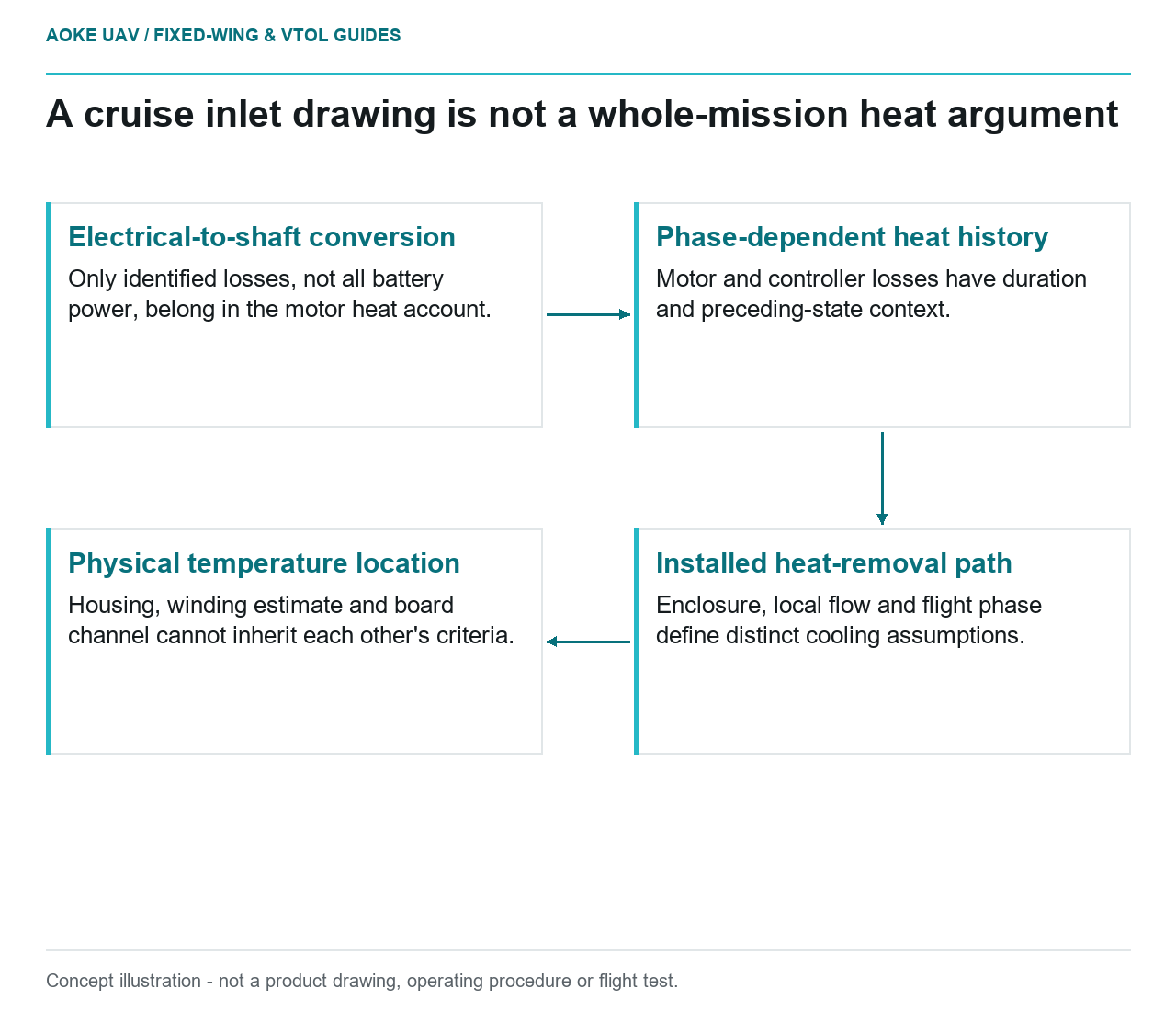
- Electrical-to-shaft conversion: Only identified losses, not all battery power, belong in the motor heat account.
- Phase-dependent heat history: Motor and controller losses have duration and preceding-state context.
- Installed heat-removal path: Enclosure, local flow and flight phase define distinct cooling assumptions.
- Physical temperature location: Housing, winding estimate and board channel cannot inherit each other's criteria.
A hypothetical large fixed-wing VTOL has a propulsion bay that looks well ventilated in a cruise drawing. The team has not yet explained the thermal conditions associated with low-speed and transition states. Adding an inlet may seem like progress, but the first deliverable should be an evidence map: what generates heat, how its operating history changes, where temperatures are observed and which installation requirements apply. No duct dimensions or aircraft operating limits are established here.
Heat sources and loss estimates
Separate electrical input from useful mechanical output when asking for motor thermal evidence. The maxon technical reference explains electrical-to-mechanical conversion and associated losses, and distinguishes continuous from short-term operating ranges.[1] Those are generic motor concepts from that manufacturer’s reference, not efficiency maps or allowable temperatures for the proposed aircraft motor. The installed motor and controller need their own identified documentation.
For the example bay, request a source-by-source heat assessment rather than assigning all battery power to bay heating. Ask whether the estimate covers the actual motor, controller, distribution components and nearby equipment. Keep assumptions visible, including which losses are measured and which are calculated. That distinction lets reviewers challenge an uncertain input before an inlet shape is treated as an engineering solution.
Airflow changes across flight phases
Use the fixed-wing mission architecture to organize the questions. Which cooling assumptions belong to cruise? Which depend on local propeller flow or vehicle motion? Which operating states have not been represented? The aim is not to prescribe how to fly a thermal test. It is to stop one favorable airflow condition from standing in for the whole proposed installation.
ArduPilot’s QuadPlane transition documentation describes changing flight phases and concurrent motor demand in parts of the transition.[2] It does not calculate airflow through this bay or establish a large UAV operating envelope. For the hypothetical fixed-wing design, that distinction motivates separate demand and cooling questions for the relevant configurations, rather than treating the software description as thermal validation.
Sensors and measurement locations
For every temperature trace, ask which physical item the value represents. A housing sensor, winding estimate and controller-board channel should retain their individual definitions. Record the sensor location, acquisition source, timing and configuration identification. If a summary simply says motor temperature, the reviewer should request the missing definition before comparing it with a limit taken from a different part of a manual.
Request evidence that the measured location and the OEM acceptance criterion refer to the same quantity. Where they do not, ask who has substantiated the relationship. In the hypothetical bay, a convenient accessible surface is not automatically the relevant internal location. Avoid translating a measurement into an internal temperature by an invented offset, or assuming that a protection indication proves all adjacent equipment remained within its requirements.
Configuration-specific thermal validation
A proposed review package should identify enclosure geometry, openings, component placement, harness routing and the conditions associated with each result. It should also distinguish ordinary thermal operation from battery hazard assessment; a cooling discussion is not a containment design. These suggested records connect the thermal argument to a physical configuration that another reviewer can recognize and compare after a change.
The large fixed-wing integration decision is whether the submitted evidence covers the intended installation, not whether a component has an impressive standalone temperature label. If evidence is missing, record the affected state and request the exact OEM requirements and responsible engineering assessment. A different duct, enclosure or payload arrangement should be evaluated against that argument. This article supplies neither an inlet-area rule nor an untested airflow requirement.
Related reading
- Printed Cooling Duct Prototypes: Fit Is Only the Beginning
- Thermal Camera Stability During Long Fixed-Wing Acquisitions